Tag: RPG

  • First Time Final Fantasy – Final Fantasy VI

    First Time Final Fantasy – Final Fantasy VI

    I talk a lot about legacy in this series. It makes sense; these games are a franchise that is continually evolve as technology and industry standards change, as expectations of audiences shift toward bigger and bolder experiences and more and more competitors appear with each passing year. Naturally, a key aspect of looking back at the history of the franchise is examining the ways in which the games are in deep conversation with previous entries, present concerns, and an effort to look ahead to what big moves they can make next.

    Returning from previous Final Fantasy games are the Active Time Battle system, a more rigid narrative structure than is found in the first game, and a party of prescribed characters with their own histories, mechanics, and who rotate in and out of the player’s control. With Final Fantasy VI, it feels like we’ve reached solid ground and the feelings we tend to associate with franchise entertainment (formulaic construction, familiar themes, returning characters/names, references to other titles in the series) are starting to settle in. For North American players at the time in 1994, this feeling was probably a ways off since this was only the third mainline FF game we got (FFIV was called FFII for us and VI was titled FFIII which, interestingly enough, has never confused anyone ever).

    But what’s new about Final Fantasy VI? What makes it breath? What makes it live in the hearts and minds of gamers all these years later? I think these question have two distinct sets of answers, because FFVI is very explicitly segmented into two sections.

    In the first, you are introduced piecemeal to the world and to each character you will have in your party (a whopping 10 characters with 4 additional secret ones). At times, these characters split into different groups and you are given the option of which story path you will follow first. The world is extremely narrow and linear, with very little side-content and few places to explore that aren’t on the critical path, but the pacing is pretty tight and there is a lot of variety in the environments and the tonal content of these chapters.

    The game introduces unique abilities for each character that to greater and lesser extents radically change the way you utilize them in your party. One character has a list of special moves that require you to perform fighting game button combos. Another is your standard thief with the ability to swipe items and additional gil from enemies. Celes (my favorite) has the ability to forgo attacking entirely to stand guard and block the next incoming magical attack, absorbing it for a quick boost to her MP. Gau (my least favorite and the objective worst member of the party) can be released from the party temporarily to go into the wild like the feral child he is, only to return hours later with a handful of new abilities learned from the same monsters you’ve been fighting. The variety gives each member of the party a signature feel that gives much needed life to the starting-to-stagnate combat system and cements the identities of each character in a way that significantly contributes to their iconic status in a lot of people’s minds.

    The linear feel is at times stifling, and sudden spikes in difficulty are frustrating but are mitigated by a very generous system in which game overs do not actually remove any experience or new abilities gained between death and your last save. This means that if you’re stuck on a particularly challenging boss and you’re locked into a section that you cannot leave, you can grind against weaker enemies as long as it takes for you to overpower the boss. It ends up killing the pacing, and it’s a compromise for a problem introduced by the game’s structure, but it technically solves the issue and I can’t complain about it too much all told.

    In the second part of the game…

    OK, huge spoilers incoming.

    Midway through the game, the primary antagonist, a fucked up clown wizard named Kefka, unleashes UNLIMITED POWER and destroys the whole world, rupturing the land and scattering the party, leaving them in a dark and miserable post-apocalyptic setting filled with deadlier monsters and the traumas of the cataclysm fresh in everyone’s mind.

    The real Final Fantasy VI starts here, and it is

    You take control of a single character, Celes, who is living in isolation and awash in grief at the party’s failure to save the world. They were the heroes! How could things have gone this way? How could Kefka win? How could the world end up like this, broken and inhospitable, crushed under the boots of an egomaniacal literal clown?

    What makes Final Fantasy VI truly special to so many players, myself among them, is the story of this second act. In a world in ruins, how do we find the hope to keep going? How do we continue to fight when the fight seems over, when so much has been taken from us and the harm can’t be undone?

    We can keep fighting because it’snotover. We’re still here. So is our enemy.

    As Celes, you set off into the World of Ruin, a remixed and greatly expanded version of the game’s overworld which is now stuffed with optional content and tons of secrets to find that will empower your party for the final showdown.

    Oh yeah, your party!

    A key element of Celes’ quest in the second act is to find and reunite with the members of your party, helping to rescue them from danger, aid them in their own adventures to try and put the pieces of the world and their own lives back together. Importantly, you don’t have to get all of them back in order to face the final boss (though… why wouldn’t you?). You can collect powerful Espers, this game’s biggest mechanical addition, spirits which can be bound to party members that guide the way their stats increase on level ups and allow them to learn powerful abilities and magics. You are given the freedom to swap these around, so you can shore up your party members’ weaknesses or play to their natural strengths.

    It’s a beautiful synthesis between the Job system and the designated character builds, one that blends freedom and character identity seamlessly. Plus, some of the Espers are gated behind challenging optional dungeons, quest-lines, or even secret encounters, making them really fun and rewarding to find. Mechanically, it’s easily the best part of the game.

    Once you’ve reached a certain point in the story, you are given the option to go and face Kefka whenever you’re ready.

    There’s something powerful about this freedom.

    Take your time. Make sure you’re prepared, that you know what you’ll be up against and how to protect yourself. It’s never too late. It’s never too late.

    It’s NOT TOO LATE. We’re still here. We’re alive and we can fight back. We can’t fix everything, we can’t save everyone, we can’t undo the damage that has been done.

    We can get better. We can heal. We can show each other the love and forgiveness we so desperately need, extending that grace to those around us and, hopefully, to ourselves. We can take time for ourselves, for those who need us because above all we know that we can’t do it alone.

    We can build life among the ashes. We can protect those who we can reach.

    And we can stop the fuckers responsible.

    Next month: Final Fantasy VII
  • Update – New Podcast: Table for Two!

    Update – New Podcast: Table for Two!

    Greetings everyone!

    If you have enjoyed my posts and are similarly inclined to play video games and tabletop games, then I cordially invite you to join me and my good buddy Kadmor on our quest to play a new TTRPG every single month!

    We’ll do an episode on setup and introducing the game to each other and our audience, an episode or two on actual play, and then a discussion episode.

    In the future, we will also have a Patreon wherein you can back us to receive monthly bonus episodes featuring dozens and dozens of micro-RPGs made by tons of talented and thoughtful creators.

    We hope to see you there!

    Use this RSS feed link or find us wherever you get podcasts!

    https://media.rss.com/table-for-two-pod1/feed.xml

  • First Time Final Fantasy – Final Fantasy V

    First Time Final Fantasy – Final Fantasy V

    Folks, we’re back.

    What a rollercoaster this has been. Five games into the series and we’ve seen some of the highest highs and the lowest lows, and at the heart of it all are ideas and questions surrounding the core identity of the RPG as a genre: narrative, or rather, how can narrative can be conveyed through the structure of a game.

    Final Fantasy I gave you a world and took its hands mostly off the reigns as far as your player characters go. That freedom can feel empty if you’re not willing to fill the spaces left with your imagination, the same way we can imagine a handful of colored squares on a TV screen are a dragon.

    Final Fantasy II grabbed you by the wrists and dragged you through a lifeless story while trudging through the death by a thousand cuts that is the gameplay.

    Final Fantasy III restored balance to the Force, giving you mechanical expression through the Jobs system and telling a (mostly boring, yes) story that focused on how your characters propel events forward.

    Final Fantasy IV took an odd back-step, trying to tell a more structured, focused story with almost no chance to express your own narrative through gameplay. The presentation was better, characters underwent arcs, but neither half of the experience felt fully coherent or enjoyable enough to really take my breath away.

    Now we have arrived. Final Fantasy V takes the series’ innovations and iterations, its confident strides and its clumsy staggers, and reaches newfound heights in nearly every aspect of the experience.

    So why am I so bored?

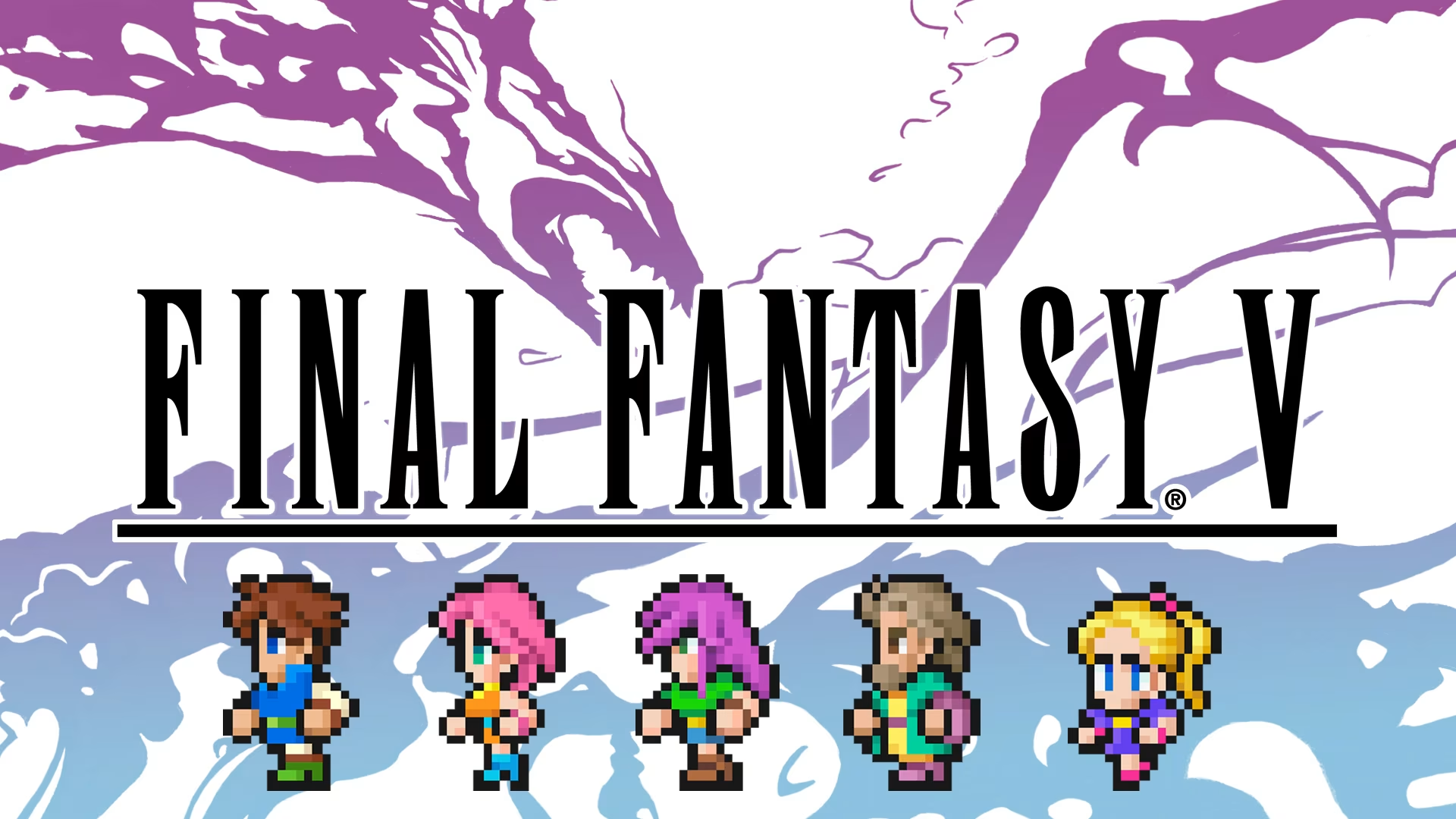
    Starting from the beginning, we are introduced to our main cast in fairly quick succession: Bartz (a wandering… uh, guy), Galuf (an amnesiac old man with his fair share of secrets), Lenna (the princess of the kingdom of Tycoon), and Faris (a pirate captain with a mysterious past). These are not your clay figures to mold into characters of your imagining. They are well-defined, they have a lot to say, and (most importantly) they are good characters.

    FFV is the first game in the series that makes an effort to have the characters move around in cutscenes. To emote, to react, to interact with one another in ways that are genuinely funny or heartfelt or that help to solidify the feeling that they are on an adventure together, developing bonds and gaining a sense of familiarity that comes with sharing so many experiences. While there aren’t many standout moments of characterization (all-in-all, these people are mostly one-note) there is far more effort made than in any of the previous games to endear them to the player. Cecil was a buffoonish loser, and the majority of other characters in FFIV ranged from annoying at worst to underutilized at best.

    There are arcs for these characters. Reveals, moments of genuine affection, stories that intertwine. This is by far the best character work in the franchise, easily.

    And now we reach an interesting point of contention. This game brings back the Job system from FFIII, only expanded and with the ability to mix and match abilities that you have mastered to create some truly fun and powerful combinations. Leveling up really only raises your HP; it’s the Job levels that make the difference. In practice, I adore this system and I am thrilled to see that it returned. It made the gameplay a lot more fun than some of the previous entries, probably the most fun yet in terms of digging into the mechanical structure of the game. But there is a downside and it’s that because any character can be any Job, some of the work done to give them a sense of identity is slightly undercut by giving the player free reign over how each character plays.

    There is a prevailing feeling in games criticism (what little of it remains) that player freedom is paramount, the primary goal and objective moral good of game design. To me, this is a baffling perspective. While freedom can be an exhilarating feeling and can lead to some of gaming’s best experiences (see the immersive sim genre) there is profound beauty in a tightly designed and carefully prepared linear experience. When a game lets you do anything, the things you can do become equally valuable by default. Sure, FFV locks away its more interesting and powerful Jobs behind story progression, but they become immediately available to all members of your party whether or not there is a narrative (written or implied) reason for them to take on this new role.

    So, yes, Galuf is an interesting character, but functionally there is nothing to separate him from the other characters and this feels like it was an over-correction from FFIV’s setup.

    It’s a strange, living contradiction. On one hand, the customization feels really good and lets you do a lot of fun things. On the other, it undermines a story that could’ve used a little bit of a boost.

    The story does play with some interesting ideas though. In this entry, the power of the crystals is not treated as sacred or divine, so much as they are batteries for industry and the conveniences of comfortable living. They are constrained, consumed, and ultimately destroyed by the people in power who have taken them for granted. The antagonist (yes, he’s really named Exdeath) is a being born of the natural world able to take on the shapes of trees and… a splinter. He is an avatar for the elements fighting back against the abuses of humans, and the many environments of the game often strive to show how the natural world is undergoing a state of turmoil.

    And wow, some of the most fun locales we’ve gotten to explore thus far are here. Ghost ships, other dimensions, massive castle sieges featuring an aggressively paced and epic struggle on an enormous bridge, and a truly cursed palace made of flesh and bones. The visuals are quite nice in these areas and the game world is suitably massive for a franchise that continues to make enormous leaps in scope with nearly every entry.

    But it’s almost too massive.

    A level of fatigue had started to settle in by the time I was in the game’s final act, and there was a lot of side content I very intentionally left out of my playthrough. With each time the game’s world expanded I felt myself growing less impressed and, frankly, more intimidated. Is the fact that I’m playing all of these massive JRPGs in a row partially to blame? Probably. But I couldn’t escape the feeling that some of this stuff could’ve been pared down a bit.

    Final Fantasy V is a great game. It has a fun story with fun characters, a level of mechanical complexity that is deep and enjoyable even by today’s standards, and for those who want it there is a ton of content. It’s biggest failing, oddly enough, is that it doesn’t quite manage to coalesce into a finished product that leaves a big emotional impact or introduces enough unique and new experiences. We’ve reached the “franchise fatigue” step in the arc that much of media undergoes. Will FFVI be able to breathe new life into the series?

    Next month: Final Fantasy VI

  • First Time Final Fantasy – Final Fantasy IV

    First Time Final Fantasy – Final Fantasy IV

    I stated early on in this project that I suspected that with each entry in the franchise there would be new and interesting innovations, not only within the context of Final Fantasy itself but in the wider field of RPGs and games writ large. Four entries in and I can say with confidence that so far my hypothesis is looking more and more likely to be true. Final Fantasy IV takes enormous swings in nearly every aspect of its design, breaking from conventions established by the previous three games. And I say nearly every aspect because, in a lot of ways, the game seems to slip into old pitfalls.

    Whereas the first three games in the series felt like they were always advancing, always iterating, adding new features and expanding its scope in both a narrative sense and a mechanical sense Final Fantasy IV seems to go hurtling backwards towards a some of the bad concepts from Final Fantasy II, heedless of the danger, the futility of the act. II took on a more story-centric approach. It was linear but let you wander into dangerous areas only to immediately die to trick you into thinking it wasn’t. One of my biggest complaints, aside from the extremely lackluster narrative content, was that it couldn’t make its characters special and well thought out OR blank slated enough that it was fun to tinker with their abilities. Unfortunately, IV seemed not to hear my complaints… decades before I made them.

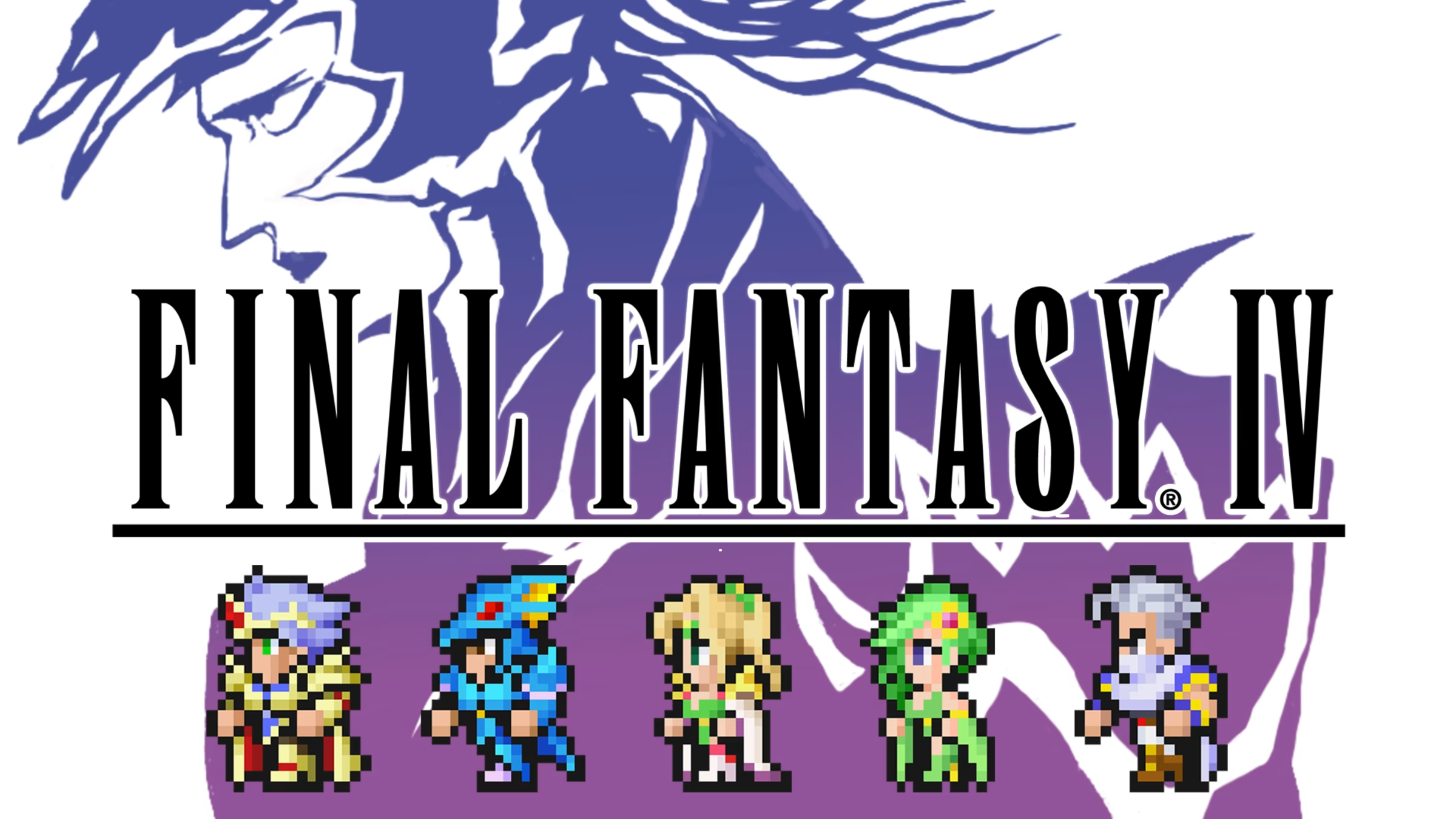
    IV begins with the story front and center. An introductory sequence introduces us to the Kingdom of Baron, the Red Wings airship brigade, and our …hero? OK, we’ll circle back to that, trust me. Cecil (our protagonist) is a member of the Red Wings, and has just returned from a mission wherein he massacred the peaceful inhabitants of a village of mages, stealing their elemental crystal. He laments that he has done this to his lover Rosa and questions the morality of his actions (big thinker, this Cecil) with his comrade-in-arms, Kain. However, for expressing doubts in his King’s methods, Cecil is stripped of his title, removed from the Red Wings, and given another assignment: to deliver a package (a totally NOT suspicious task to give to a, as of seconds ago, disgraced military commander).

    This package is a bomb. Like, the monster. Capital B, Bomb. It blows up another village (sick kill count, Cecil) and leaves one survivor, Rydia, whose mother dies before her very eyes while Cecil looks on in horror at what he has unwittingly done. Cecil takes her with him and flees the village, headed towards… I don’t remember. Honestly, aside from some highlights, I remember very little at all about the story of this game, and I JUST played it.

    So, this might be the right time to tell you: I think this story is bad, and a lot of it has to do with the way the game integrates party members.

    Because Final Fantasy IV is trying its best to tell a more complicated story, the game returns to Final Fantasy II’s notion of giving you characters with predetermined identities, but doubles down to remove any element of customization for how these characters play by essentially making each one their own Job. This makes them stand out, yes, and makes your party varied and gives you lots of new mechanics to play with each time you get a new member of the crew, and (perhaps most importantly for this series) begins a new era for Final Fantasy, one in which the party members are all unique characters with unique abilities and personalities. Aside from, you know, the MMOs, Final Fantasy mainline games are never going to be about you and your band of self-insert adventurers again. It’s about… these guys.

    And in Final Fantasy IV, these guys suck. But don’t worry, none of them stick around for more than a few hours! Because, in a staggering display of misunderstanding which parts of FFII were good and which were bad, the game is constantly shuffling characters in and out of your party, never giving you a chance to go through more than a few areas with a consistent party at a time. Furthermore, you know the mage Rydia who has perhaps the most classic fantasy backstory of all time? She is essentially side-lined until late in the game where she returns as a powerful mage who has spent time living among divine creatures of myth from another world and learning to summon them in battle, on a quest for self-discovery and revenge against the evil empire which destroyed her home and family. This is a way more interesting story than, “guy who does genocide feels bad about the genocide he already did”, but the game doesn’t seem to want to engage with it all that much.

    But you know what this game does want to try its hand at? The brand spankin’ new and flashy ACTIVE TIME BATTLE SYSTEM. <The crowd goes absolutely ballistic with applause>

    Yes, folks, not only have we arrived at one of the most defining features of Final Fantasy’s storytelling, but at the combat system which has essentially become the franchise’s identity, and one of the critical ways it distinguishes itself from other JRPGs.

    I may have mentioned in the past that I have ADHD. This can make turn-based combat a little tricky for me, as it’s easy to get a little bored and have my attention and motivation slide off the game like the screen has been freshly buttered. So, with the combat taking a more urgent pace, I should be thrilled rig- WRONG.

    The active time battle is the bane of my existence, the enemy of my already frantically hamster wheel spinning brain. “Oh, you were having trouble paying attention? How about pay rigorous attention or lose hours of progress?”

    Hey, FFIV, screw you, man!

    The menus are already a little clunky to maneuver, and the fact that many boss fights have weaknesses and reactions that change depending on how you time your attacks (while genuinely a very good idea) ends up feeling clumsy and hard to manage. You can’t just sit and wait for a good opportunity to strike, because if you idle the enemies keep whacking you regardless. And if you’re waiting to time something correctly you’re giving up any opportunity to protect yourself or heal up with some items. There is also a brief windup period before spells are cast, making it even more difficult to gauge the timing.

    This would suck even worse, were the game not stupidly easy. Not once in my playthrough did I get a single Game Over, and I did minimal grinding between dungeons. And how are those dungeons?

    Boring, mostly. While there is a higher degree of aesthetic variation between locales (at the end of the game, you go to the FUCKING MOON, dude), there still has yet to be much difference in how you navigate these dungeons. FFI had some puzzles and environmental hazards in its dungeons, and FFIII had a… fun(?) boss rush at the end which you could take on in any order you wished. FFIV has a few neat moments, and the world maps are pretty cool, but so much of the presentation is focused on a story that simply can’t hold my attention. Nonsensical twists, characters popping in and out so often that it’s hard to get attached (to anyone but Rydia; Rydia rules).

    The other thing I need to keep in mind is that I play a lot of games… a LOT of games. And playing other long games including other JRPGs while also playing Final Fantasy at a near constant rate can at times drag me down. That being said, I don’t think that playing this after a several month gap in FF games would’ve made much of a difference.

    The attempts at something new and fresh are interesting on the surface, but the game ends up feeling overly structured. There’s no experimentation, no real exploration for much of the runtime, and the story is so scattershot and dull with characters who rarely feel like they’re getting enough time to say much of anything.

    I think FFIV is probably a fine game, but for me it only barely beats out II and pales in comparison to both I and III. And the other one, the secret one I’ve already played. We’ll get to that.

    It sets a lot of precedents for the series going forward, or so I am led to believe. This gives me some anxiety. How will the next entry grapple with the changes to FF? And how will it draw on the games further back in its lineage?

    And will there be anyone nearly as cool as Rydia?

    Next month: Final Fantasy V

  • Update – For the Flock is in early playtesting!

    Update – For the Flock is in early playtesting!

    Happy Tuesday, folks!

    This week I figured I’d talk a little bit more about my upcoming game, currently titled “For the Flock”, a solo or group journaling/survival game about a nomadic people traveling a dangerous wasteland. I’ve been hard at work on the project after a few weeks of inactivity, and have even gotten the chance to playtest a few hours of the game with a friend of mine. We’re both having a really great time, which I take to mean that the game is at least fun at this stage, and I consider that a pretty big win.

    It’s my impression that this can be one of the more difficult parts of game design to get through: the seemingly endless slog of testing, tweaking, testing, tweaking, over and over until you start to forget how the game looked when it was unrestrained by logic, accessibility, readability, etc. That said, I’ve found that I actually quite enjoy this part of the process, especially when you have cool people to engage in it alongside you, providing real-time feedback and impressions.

    My hope is to have the game ready for testing on a wider scale by next week, so keep an eye out for that!

    To give you some idea of how the game plays, you draw cards from a standard deck which give you a prompt to help you imagine what kind of struggles or encounters your Flock is having while on their yearly pilgrimage to the safety and tranquility of a place known to them as the Summer Lands. After describing the situation, the player chooses one of six available Paths which represent the style of resolution (ie, the Path of Violence means the Flock will be fighting or mistreating someone or some place, but the Path of Trade could mean they’re bargaining or maintaining a balance with the environment around them). The other players (or if you’re playing by yourself, you) roll a number of dice equal to the current Flock score, and the result determines which Path gets chosen. As the player who’s turn it is, you have some options to sway the outcome of the roll, and all of these systems are meant to parallel the real workings of a democratic system filled with diverse peoples with unique perspectives. It’s not always easy.

    There’s obviously more to the game then just that, but I’ll save that for when it’s closer to being ready. I’m also going to try and actually get some art in this game, give you something to look at that can get the gears of imagination turning in your head as all good tabletop game art does. My first game, “our hope is You” was released in its current edition without art, as I wanted something pared down to start with. I’m also reworking some things in that game and will likely release a widely modified and updated edition.

    I have no idea how to create nice looking layouts, and I have no skill for the visual arts in general, so if you happen to be an artist reading this or know someone who might be able to help out, get in touch on Bluesky @vulpesvalentine! I DO NOT ALLOW ARTISTS TO WORK FOR FREE, YOU WILL BE COMPENSATED.

    And I think that’ll wrap it up for now. Next week’s post will be another edition of Recency Bias, but look out for an additional post on a new release I hope to have dug into in the next few days.

    Ciao!

  • First Time Final Fantasy – Final Fantasy III

    First Time Final Fantasy – Final Fantasy III

    There is a moment in Final Fantasy I where you’ve just finished rebuilding the bridge that spans a narrow channel separating two continents. You’ve spent a few hours fighting monsters, learning the structure of the game, and exploring the small portion of the world you’ve been given access to, so at this point you’re understanding of the game’s world feels like it’s filling out. You step across the bridge and a splash screen comes up showing your party of adventurers overlooking a gorgeous pixelated landscape and the iconic music plays, accompanied by this feeling that here, right here, is where the adventure of a lifetime truly begins.

    It’s an incredible moment. The world that seemed so small before suddenly explodes outward in all directions, expanding your understanding of the scale and scope of the game to an almost intimidating and certainly awe-inspiring degree. They even manage to repeat this trick three more times, once with the acquisition of the ship coupled with the opening of the channel taking you to the open sea, again with the canoe giving you the ability to sail along the currents of rivers, and again with the airship, taking not only the method of traversal but the speed at which you travel to unseen heights.

    Final Fantasy III looks back at the legacy of Final Fantasy I, the experiments and failures (and there are many) of Final Fantasy II, and says with a smile: “Yeah, I can top that.”

    And it does.

    There is a moment very early in the game where you acquire an airship. I remember thinking, “Wow, that was really soon! I wonder how they’ll incorporate this into-” and then it explodes into a million pieces and becomes unusable. It’s a gag that works because it’s completely unexpected, and when the game starts to build its traversal systems and overworld exploration back out again, there’s always this little chuckling voice in the back of your head that remembers the airship and wonders if it’ll happen again.

    It doesn’t, and that’s probably for the best, because the ways in which Final Fantasy III continues to expand its world are frankly astounding.

    You start the game on a continent that seems like a densely packed and populated realm. There are multiple dungeons (even some late-game optional areas), several towns, castles, and big set-pieces to capture your imagination. It feels like a complete game. So when the camera pulls back, you get a proper, functioning airship again, and you set out over the continent’s edge for the first time you discover that all that has taken place thus far took place on a floating island above a far more massive world than you could’ve predicted would await you. It’s jaw-dropping.

    AND THEY DO IT AGAIN. Late in the game you get access to a submarine and now there are multiple underwater dungeons to explore, mostly optional, with tons of cool treasures to find, new enemies to face, and environments to explore.

    There’s an interesting parallel between the world’s constant expanding and the game’s mechanics similarly growing, because Jobs are back from the first one and they’ve been totally reworked from something passably interesting to a full on highlight of the game.

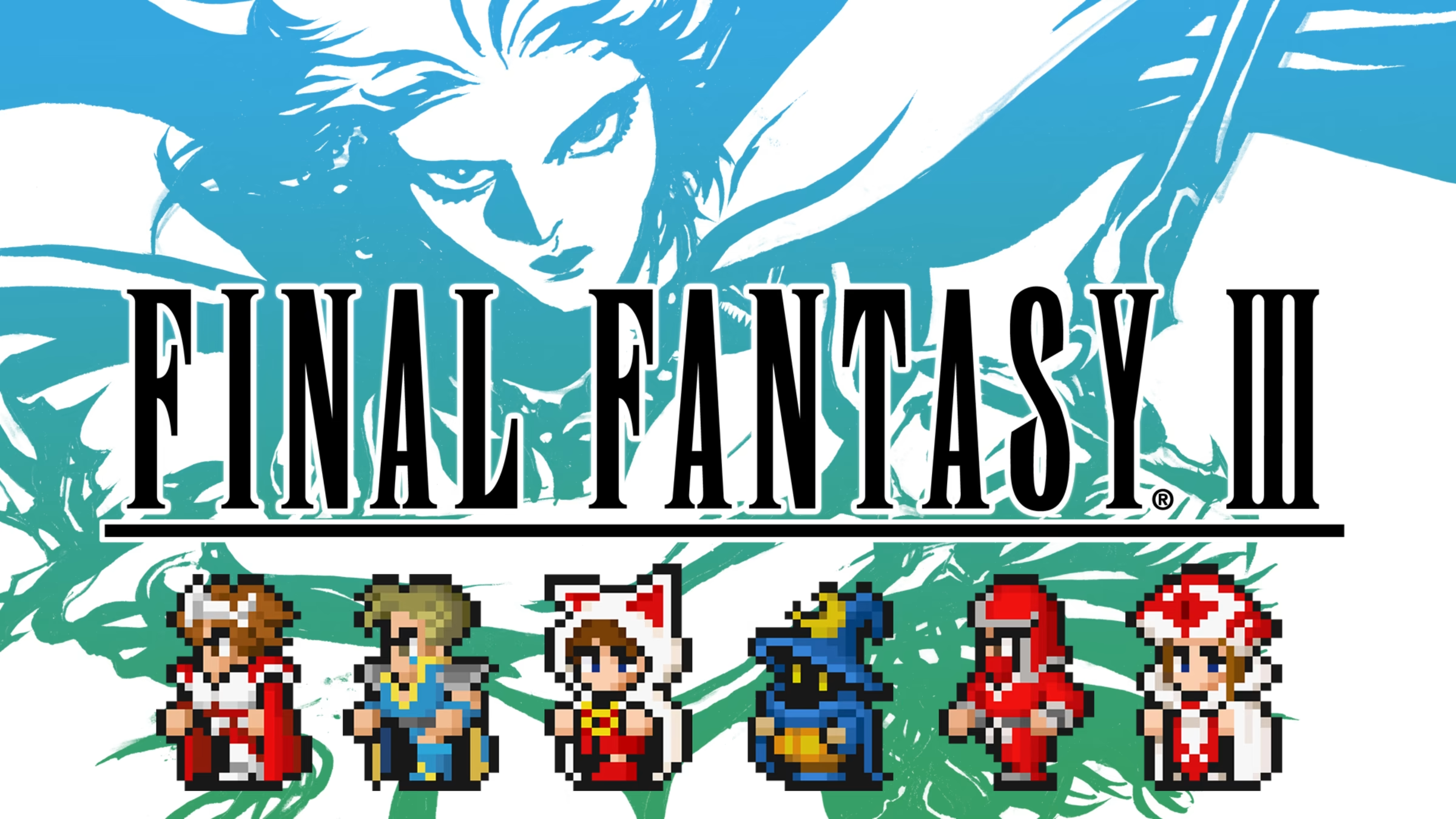
    You start the adventure as four small children, all the same Job (the oddly named, Onion Knight), and you fall into a chasm beneath your home village wherein you find a magical crystal that grants them great power and access to the Jobs. With each crystal you find throughout the game, a batch of new Jobs gets unlocked, totaling in twenty-three unique classes for your characters to play, but we’ll come back to that.

    OK, you might think, so this was a cute little introduction and now I pick my four Jobs that my party members will master as the game progresses. Probably gonna need to some balance so not too many mages but we can’t have none. That classic party composition math begins ticking away in your head. Maybe they’ll advance to new forms like in the first game, but this is the configuration I’m working with, right?

    Wrong. Because in a masterstroke of design genius, FFIII allows you to freely change Jobs at will, meaning you can have a party of all White Mages, realize that this is untenable, and switch them around to various martial classes. Felt like switching one of your characters over to Red Mage for a while but now you’re not sure it’s working out the way you wanted? Switch them to something else! Try a Ranger! As the Job list expands periodically, you’re given multiple opportunities to entirely reconfigure your party and their skills, experimenting with different combinations, trying out the new mechanics that Jobs like the Bard and the Evoker bring to the table. And you’re encouraged to try all of these, since the only real cost is the time it takes to figure out if you like the Job for your character. You level up your party members separate from your level in a Job, meaning that while your mastery of a Job grows and you get new abilities, your stats are influenced by the equipped Job, but not pigeonholed by it. If you switch to a Knight from a Geomancer, get ready to watch your HP climb at a better rate. In theory, you could have a White Mage with more HP and Defense than your Knight. I don’t why you would do that but hey, it’s your game.

    Each Job also has a unique feel to it that changes how you approach combat, and the ability to swap these around freely is such a gift to the player, which is really no surprise when you look at the game’s structure as a whole.

    Because Final Fantasy III is the most impressive game I’ve played for this series and it’s not even close.

    And it’s weird how much of what good was in Final Fantasy II they are able to wring out and restructure for this game, because like FFII this one has a much greater focus on the narrative than the original game. There are distinct characters with motivations and stories of their own, and lots of them join your party for a brief while to go on some quest together. And while your party members also speak and have ideas of their own, none of it feels like the game is taking all the roleplaying out of your hands. You are still given enough empty space to fill in with your imagination that the creative expression of the game (although extremely rudimentary by today’s standards) works in a way that is not only similar to the first game, but that actually surpasses it.

    Advancement no longer feels like you need to be juggling spreadsheets and formations. Just grind for a bit. Level up. Watch your stats climb the way they’re supposed to. Sure, you can’t get as granular as you could in FFII (although for whom that is a problem I can’t imagine), but you still have a bounty of options at your disposal.

    Except when the game hems you into making all your characters the same Job for a dungeon, lest you face endlessly replicating monsters. Or when you are forced to make yourself small using the Mini spell, but now your physical attacks and defense are pitiful and you need to rely on magic or successfully escaping every encounter. Or when a boss can be defeated if you grind for a while and just brute force it, but it goes much smoother if everyone just switches to the one Job that’s kind of tailor-made for this situation. And I could be wrong, but in this specific instance I found that particular Job, the Dragoon, to be mostly useless outside of that fight.

    These kinds of setups are limited, but they are such a strange misstep in the design. It would be cool if one Job had a moment to shine, but the difficulty of these fights and areas for those not using that Job becomes frustrating and feels rather arbitrary.

    The game is also… like… really long? There were times when fatigue started to set in, and the amount of optional content (while impressive) started to resemble a chore list. This probably has more to do with my own brain chemistry than the design of the game, but a little quicker pacing would’ve appealed to me quite a bit.

    The story is mostly forgettable, being presented not so much as a continuous plot with growing stakes but instead as a series of small narrative arcs, usually revolving around an NPC you meet or the problems of a single town. It manages to evoke a kind of D&D feel, having your party bounce from location to location fighting various unrelated baddies and solving magical crises, but it lacks the kind of cohesion that would really elevate the emotional attachment you might get toward your characters and the setting. Ironically, it is this point that seems to undergo a complete turnaround in future games, though I’ll save my opinions for when I’ve actually played them.

    Perhaps my biggest criticism is the game’s final dungeon. It’s massive, gruelingly difficult even for a high level party, and there is almost nothing in the way of checkpoints, meaning that failure is going to send you really, really far back. And the final boss, while managing to capture my interest, is more of a brute force blast-fest than anything else, and there isn’t a ton of mechanical depth to the fight, which – to be fair – is true of most of the game’s combat.

    We’re still in an era where technological limits are tight, where modes of combat design that will become iconic to fantasy RPGs down the road simply haven’t been imagined yet.

    It’s sad to say, but the lack of depth to the combat, the lack of variety in what it is that you’re doing moment to moment, makes a lot of this game fairly monotonous to play. We seem to have settled into a rhythm here, a pattern that while enjoyable is beginning to get a bit stale. Now, playing them back-to-back is a far flung experience from what most folks would’ve had when these games were new, but my motivation to continue if things stay relatively fixed will definitely slip away.

    But don’t let that fool you into thinking that I had a bad time with this game. I didn’t. I had a great time, in fact! Much like the first game, it’s incredible to see the design methodology of fantasy games so clearly laid down so early on in the medium’s lifetime. I’m overjoyed at the game’s quality even when viewed from a modern lens, but I wonder if they will continue to innovate in ways that make the games interesting, or if they’ll fall into a repetitive rhythm that slowly fades into drudgery.

    Only one way to find out, eh?

    Next month: Final Fantasy IV

  • The DNF Report – Ni No Kuni

    The DNF Report – Ni No Kuni

    There are many reasons not to finish a game. For working adults like myself, free time is a luxury I can rarely afford, and I’d rather spend it playing a game that is interesting or exceptionally fun than one that isn’t really grabbing me. In other cases, a game can simply fail to entertain me at all, or can even go so far as to leave me irritated, frustrated, or disappointed.

    Or maybe I once tried getting into a gacha game and watched hundreds of dollars slip from my bank account before I grabbed hold of the emergency release lever and deleted the game, and now I have to live in fear of micro-transactions or other exploitative practices prevalent in the industry, sometimes starting to play whatever new, flashy game comes out only to run in abject terror the first time it asks you to pay $10 for blupee gems or bing-bong crystals.

    Just as a general example.

    Here on The DNF Report (DNF standing for Did Not Finish), I seek to work through why certain games fell apart like sand in a windstorm, losing my attention and ending up on the pile of games whose endings I will never reach.

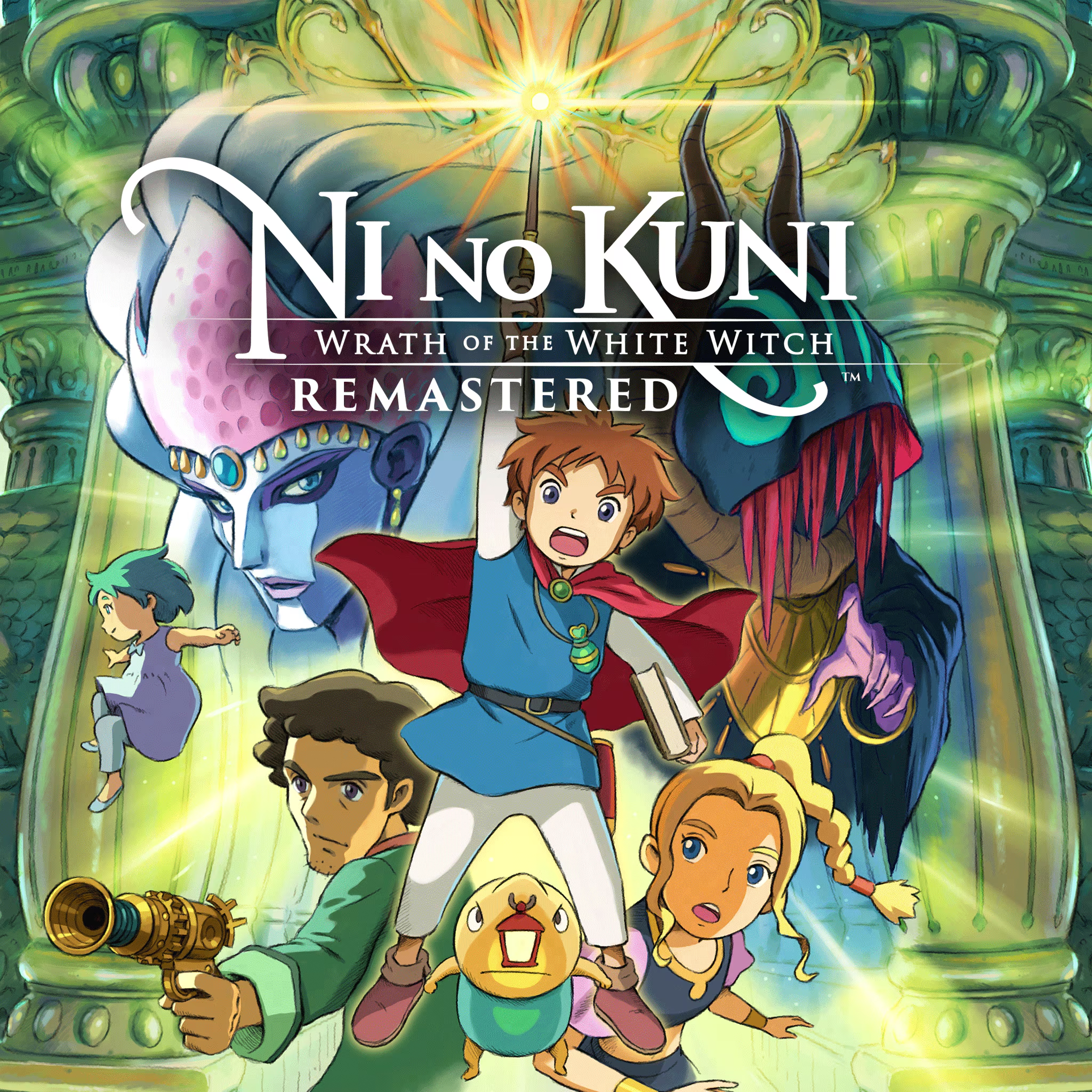
    To inaugurate this new series, let’s take a look at my most recent DNF, Ni No Kuni: Wrath of the White Witch.

    This game has been out for several years now, but I somehow remained mostly unaware of the specifics. I knew the big selling point: that the art and many cutscenes were lovingly designed in collaboration with the highly acclaimed Studio Ghibli, famous for such movies as Spirited Away and Howl’s Moving Castle. I was also vaguely aware going in that it was designed in the style of classic Japanese RPGs.

    What I didn’t know, importantly, is that it is boring.

    There’s something to be said about what it means to be a game “for kids” in the modern era, where games designed to be appealing to kids are often full of collection plate passing tactics like custom skins, battle passes, gacha pulls, etc. These games tend to be flashy, aimed at producing the most consistent dopamine hits that the medium can offer, and fast-paced to prevent kids from getting bored. And while Ni No Kuni is most definitely a game that seems eager to appeal to children, it is shockingly dull and slow-paced.

    The game’s basic premise is very familiar. A young boy in a humble town embarks on an adventure to magical world living in parallel to his own, guided by a jovial companion (in this case, a smart-mouthed fairy named Drippy), whereupon he fights monsters, an evil sorcerer, and teams up with additional allies he encounters along the way. There is a lot of charm in the early hours of the game, from the pleasant visuals to the inoffensive (but certainly insignificant) music which evokes a sort of classic ideal of fantasy stories for children. Characters tell jokes, there are anthropomorphic animal folk, and the action of combat is bloodless and cartoonish.

    It’s also, despicably clunky.

    You never feel like you have enough time to react to the attacks of enemies, as combat is set in a strange combination of active time and turn-based styles that more often than not leaves you on the back foot, reacting instead of pushing the enemy into a corner and committing to attacks that often leave you vulnerable to a swift pummeling. To summarize, the members of your party can fight as themselves, or send familiars to fight in their place. These familiars are admittedly charming in their visual design, evoking a sort of Pokemon/Digimon sort of style, and they function similarly to the monsters in those games, having elemental weaknesses and resistances, a set number of special movies to use in combat, and even evolution paths that change their form and grant them new abilities. The familiars are the same monsters you fight on your journey, but a random roll upon defeating a monster can grant you the opportunity to claim them for your party’s collection.

    When I first encountered the familiars, I was sort of surprised. I hadn’t expected this kind of gameplay, but I was open to it and kind of interested to see what the different monsters would play like.

    It didn’t take long to find out that the system is needlessly complicated and clumsy. You have to feed them to up their stats, with specific kinds of food granting specific upgrades. But don’t feed them too much or they get full and can’t eat anymore! And don’t raise their abilities with food too far, because there is a hard limit to how much they can increase their stats! And don’t let them get stronger without evolving them because they drop back to level one when entering a new form, leaving them almost always weaker than they were before with the promise of long-term benefits, benefits that never feel meaningful because you are (most likely) continuing to advance through the game and therefore encountering harder and more dangerous monsters that will wallop on your poor little under-leveled creatures with precision and brutality.

    And there are hundreds to collect but your party members can only hold 3! And for some reason, THEY ALL SHARE THE SAME HEALTH AND MANA. This means that if you send one familiar out and find that they’re getting absolutely stomped by the enemies you’re fighting, you have no recourse but to use items or spells to heal before you can switch to another creature, but that mana could have been better used on the other familiar if you had sent them out in the first place.

    Battles are also more often than not unavoidable, and enemies work with much more focus and aggression than you (and certainly more than a child for whom this might be their first RPG) can manage with the clumsy controls and interface.

    The story does even less to keep the player interested. The problems your party must solve are often connected to one of the game’s main antagonists only in a vague way, and the only real thread tying the events of the game together are the machinations of the aforementioned White Witch, whom you get remarkably far into the game before learning ANYTHING about. The dungeons are boring and might as well be gray hallways for as fun as they are to traverse.

    And I unfortunately got very far into the game before finally reaching the conclusion that it wasn’t going to suddenly get better. For all of protagonist Oliver’s magical acumen, he couldn’t make the game entertaining.

    He also can’t move at higher speeds than a brisk walk. Oliver, I have to work tomorrow! MOVE!!