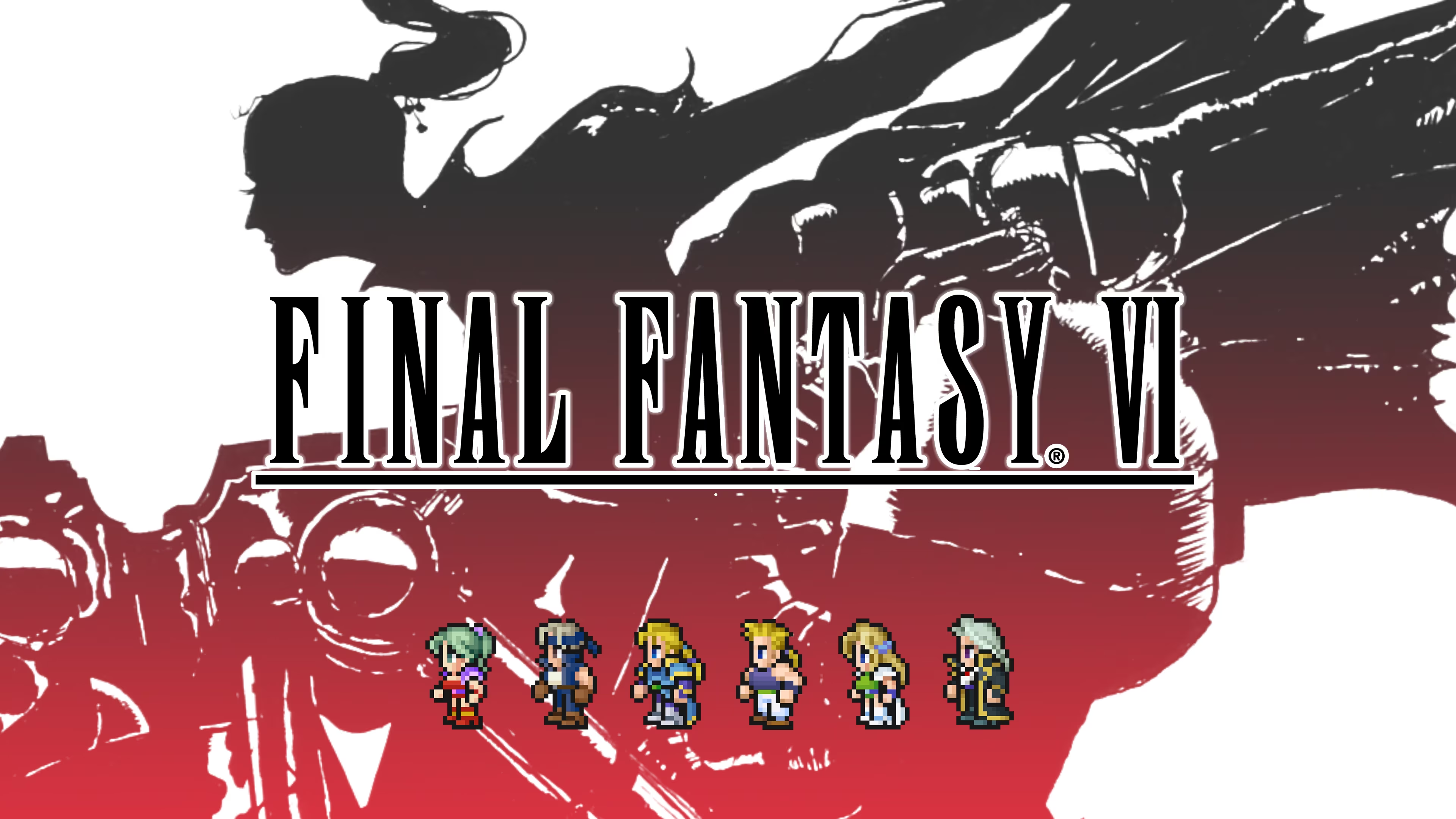
I talk a lot about legacy in this series. It makes sense; these games are a franchise that is continually evolve as technology and industry standards change, as expectations of audiences shift toward bigger and bolder experiences and more and more competitors appear with each passing year. Naturally, a key aspect of looking back at the history of the franchise is examining the ways in which the games are in deep conversation with previous entries, present concerns, and an effort to look ahead to what big moves they can make next.
Returning from previous Final Fantasy games are the Active Time Battle system, a more rigid narrative structure than is found in the first game, and a party of prescribed characters with their own histories, mechanics, and who rotate in and out of the player’s control. With Final Fantasy VI, it feels like we’ve reached solid ground and the feelings we tend to associate with franchise entertainment (formulaic construction, familiar themes, returning characters/names, references to other titles in the series) are starting to settle in. For North American players at the time in 1994, this feeling was probably a ways off since this was only the third mainline FF game we got (FFIV was called FFII for us and VI was titled FFIII which, interestingly enough, has never confused anyone ever).
But what’s new about Final Fantasy VI? What makes it breath? What makes it live in the hearts and minds of gamers all these years later? I think these question have two distinct sets of answers, because FFVI is very explicitly segmented into two sections.
In the first, you are introduced piecemeal to the world and to each character you will have in your party (a whopping 10 characters with 4 additional secret ones). At times, these characters split into different groups and you are given the option of which story path you will follow first. The world is extremely narrow and linear, with very little side-content and few places to explore that aren’t on the critical path, but the pacing is pretty tight and there is a lot of variety in the environments and the tonal content of these chapters.
The game introduces unique abilities for each character that to greater and lesser extents radically change the way you utilize them in your party. One character has a list of special moves that require you to perform fighting game button combos. Another is your standard thief with the ability to swipe items and additional gil from enemies. Celes (my favorite) has the ability to forgo attacking entirely to stand guard and block the next incoming magical attack, absorbing it for a quick boost to her MP. Gau (my least favorite and the objective worst member of the party) can be released from the party temporarily to go into the wild like the feral child he is, only to return hours later with a handful of new abilities learned from the same monsters you’ve been fighting. The variety gives each member of the party a signature feel that gives much needed life to the starting-to-stagnate combat system and cements the identities of each character in a way that significantly contributes to their iconic status in a lot of people’s minds.
The linear feel is at times stifling, and sudden spikes in difficulty are frustrating but are mitigated by a very generous system in which game overs do not actually remove any experience or new abilities gained between death and your last save. This means that if you’re stuck on a particularly challenging boss and you’re locked into a section that you cannot leave, you can grind against weaker enemies as long as it takes for you to overpower the boss. It ends up killing the pacing, and it’s a compromise for a problem introduced by the game’s structure, but it technically solves the issue and I can’t complain about it too much all told.
In the second part of the game…
OK, huge spoilers incoming.
Midway through the game, the primary antagonist, a fucked up clown wizard named Kefka, unleashes UNLIMITED POWER and destroys the whole world, rupturing the land and scattering the party, leaving them in a dark and miserable post-apocalyptic setting filled with deadlier monsters and the traumas of the cataclysm fresh in everyone’s mind.
The real Final Fantasy VI starts here, and it is
You take control of a single character, Celes, who is living in isolation and awash in grief at the party’s failure to save the world. They were the heroes! How could things have gone this way? How could Kefka win? How could the world end up like this, broken and inhospitable, crushed under the boots of an egomaniacal literal clown?
What makes Final Fantasy VI truly special to so many players, myself among them, is the story of this second act. In a world in ruins, how do we find the hope to keep going? How do we continue to fight when the fight seems over, when so much has been taken from us and the harm can’t be undone?
We can keep fighting because it’snotover. We’re still here. So is our enemy.
As Celes, you set off into the World of Ruin, a remixed and greatly expanded version of the game’s overworld which is now stuffed with optional content and tons of secrets to find that will empower your party for the final showdown.
Oh yeah, your party!
A key element of Celes’ quest in the second act is to find and reunite with the members of your party, helping to rescue them from danger, aid them in their own adventures to try and put the pieces of the world and their own lives back together. Importantly, you don’t have to get all of them back in order to face the final boss (though… why wouldn’t you?). You can collect powerful Espers, this game’s biggest mechanical addition, spirits which can be bound to party members that guide the way their stats increase on level ups and allow them to learn powerful abilities and magics. You are given the freedom to swap these around, so you can shore up your party members’ weaknesses or play to their natural strengths.
It’s a beautiful synthesis between the Job system and the designated character builds, one that blends freedom and character identity seamlessly. Plus, some of the Espers are gated behind challenging optional dungeons, quest-lines, or even secret encounters, making them really fun and rewarding to find. Mechanically, it’s easily the best part of the game.
Once you’ve reached a certain point in the story, you are given the option to go and face Kefka whenever you’re ready.
There’s something powerful about this freedom.
Take your time. Make sure you’re prepared, that you know what you’ll be up against and how to protect yourself. It’s never too late. It’s never too late.
It’s NOT TOO LATE. We’re still here. We’re alive and we can fight back. We can’t fix everything, we can’t save everyone, we can’t undo the damage that has been done.
We can get better. We can heal. We can show each other the love and forgiveness we so desperately need, extending that grace to those around us and, hopefully, to ourselves. We can take time for ourselves, for those who need us because above all we know that we can’t do it alone.
We can build life among the ashes. We can protect those who we can reach.
And we can stop the fuckers responsible.
Next month: Final Fantasy VII
 Vulpes Valentine's Video Game Valley