Tag: fantasy

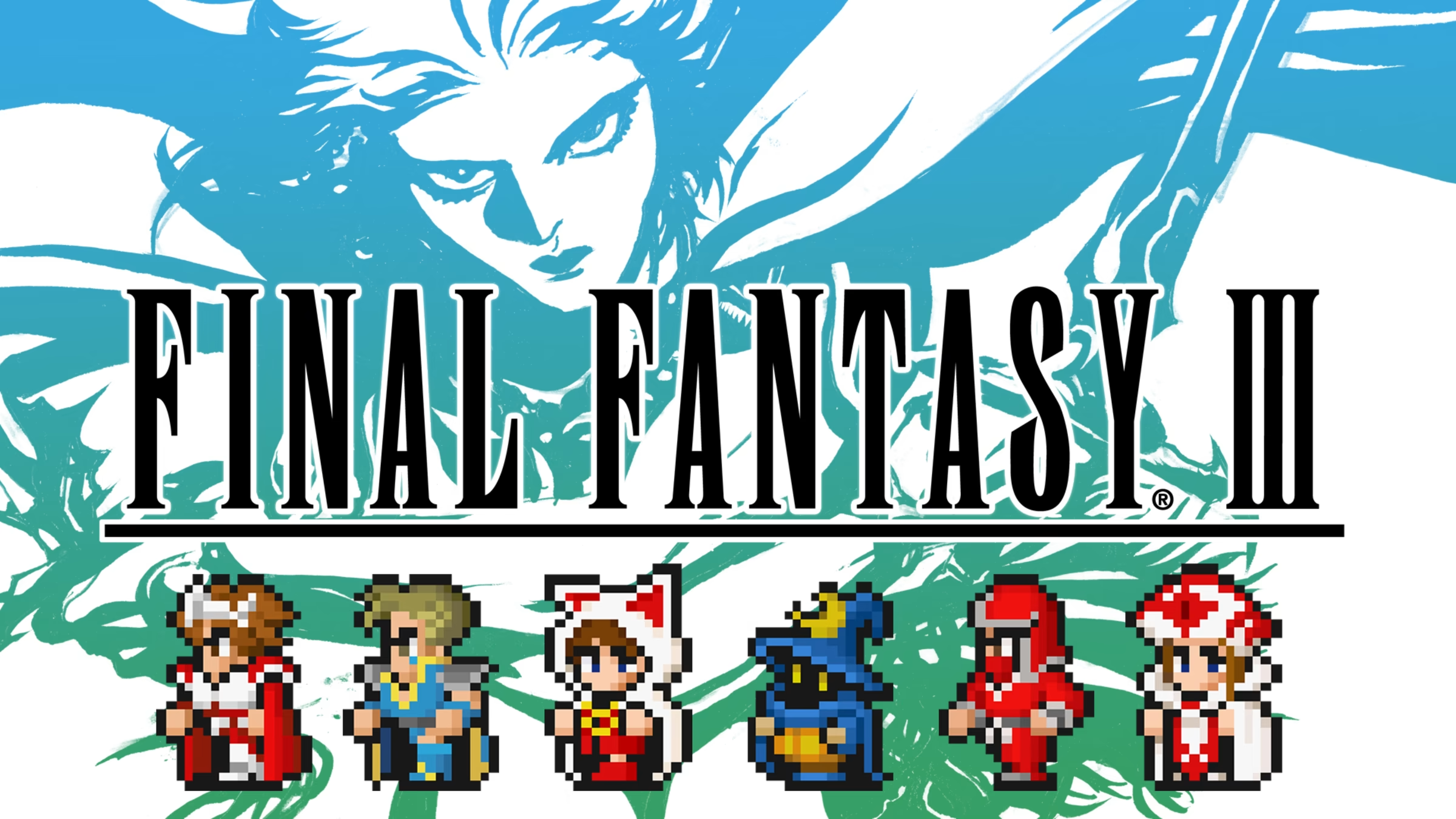
  • First Time Final Fantasy – Final Fantasy VI

    First Time Final Fantasy – Final Fantasy VI

    I talk a lot about legacy in this series. It makes sense; these games are a franchise that is continually evolve as technology and industry standards change, as expectations of audiences shift toward bigger and bolder experiences and more and more competitors appear with each passing year. Naturally, a key aspect of looking back at the history of the franchise is examining the ways in which the games are in deep conversation with previous entries, present concerns, and an effort to look ahead to what big moves they can make next.

    Returning from previous Final Fantasy games are the Active Time Battle system, a more rigid narrative structure than is found in the first game, and a party of prescribed characters with their own histories, mechanics, and who rotate in and out of the player’s control. With Final Fantasy VI, it feels like we’ve reached solid ground and the feelings we tend to associate with franchise entertainment (formulaic construction, familiar themes, returning characters/names, references to other titles in the series) are starting to settle in. For North American players at the time in 1994, this feeling was probably a ways off since this was only the third mainline FF game we got (FFIV was called FFII for us and VI was titled FFIII which, interestingly enough, has never confused anyone ever).

    But what’s new about Final Fantasy VI? What makes it breath? What makes it live in the hearts and minds of gamers all these years later? I think these question have two distinct sets of answers, because FFVI is very explicitly segmented into two sections.

    In the first, you are introduced piecemeal to the world and to each character you will have in your party (a whopping 10 characters with 4 additional secret ones). At times, these characters split into different groups and you are given the option of which story path you will follow first. The world is extremely narrow and linear, with very little side-content and few places to explore that aren’t on the critical path, but the pacing is pretty tight and there is a lot of variety in the environments and the tonal content of these chapters.

    The game introduces unique abilities for each character that to greater and lesser extents radically change the way you utilize them in your party. One character has a list of special moves that require you to perform fighting game button combos. Another is your standard thief with the ability to swipe items and additional gil from enemies. Celes (my favorite) has the ability to forgo attacking entirely to stand guard and block the next incoming magical attack, absorbing it for a quick boost to her MP. Gau (my least favorite and the objective worst member of the party) can be released from the party temporarily to go into the wild like the feral child he is, only to return hours later with a handful of new abilities learned from the same monsters you’ve been fighting. The variety gives each member of the party a signature feel that gives much needed life to the starting-to-stagnate combat system and cements the identities of each character in a way that significantly contributes to their iconic status in a lot of people’s minds.

    The linear feel is at times stifling, and sudden spikes in difficulty are frustrating but are mitigated by a very generous system in which game overs do not actually remove any experience or new abilities gained between death and your last save. This means that if you’re stuck on a particularly challenging boss and you’re locked into a section that you cannot leave, you can grind against weaker enemies as long as it takes for you to overpower the boss. It ends up killing the pacing, and it’s a compromise for a problem introduced by the game’s structure, but it technically solves the issue and I can’t complain about it too much all told.

    In the second part of the game…

    OK, huge spoilers incoming.

    Midway through the game, the primary antagonist, a fucked up clown wizard named Kefka, unleashes UNLIMITED POWER and destroys the whole world, rupturing the land and scattering the party, leaving them in a dark and miserable post-apocalyptic setting filled with deadlier monsters and the traumas of the cataclysm fresh in everyone’s mind.

    The real Final Fantasy VI starts here, and it is

    You take control of a single character, Celes, who is living in isolation and awash in grief at the party’s failure to save the world. They were the heroes! How could things have gone this way? How could Kefka win? How could the world end up like this, broken and inhospitable, crushed under the boots of an egomaniacal literal clown?

    What makes Final Fantasy VI truly special to so many players, myself among them, is the story of this second act. In a world in ruins, how do we find the hope to keep going? How do we continue to fight when the fight seems over, when so much has been taken from us and the harm can’t be undone?

    We can keep fighting because it’snotover. We’re still here. So is our enemy.

    As Celes, you set off into the World of Ruin, a remixed and greatly expanded version of the game’s overworld which is now stuffed with optional content and tons of secrets to find that will empower your party for the final showdown.

    Oh yeah, your party!

    A key element of Celes’ quest in the second act is to find and reunite with the members of your party, helping to rescue them from danger, aid them in their own adventures to try and put the pieces of the world and their own lives back together. Importantly, you don’t have to get all of them back in order to face the final boss (though… why wouldn’t you?). You can collect powerful Espers, this game’s biggest mechanical addition, spirits which can be bound to party members that guide the way their stats increase on level ups and allow them to learn powerful abilities and magics. You are given the freedom to swap these around, so you can shore up your party members’ weaknesses or play to their natural strengths.

    It’s a beautiful synthesis between the Job system and the designated character builds, one that blends freedom and character identity seamlessly. Plus, some of the Espers are gated behind challenging optional dungeons, quest-lines, or even secret encounters, making them really fun and rewarding to find. Mechanically, it’s easily the best part of the game.

    Once you’ve reached a certain point in the story, you are given the option to go and face Kefka whenever you’re ready.

    There’s something powerful about this freedom.

    Take your time. Make sure you’re prepared, that you know what you’ll be up against and how to protect yourself. It’s never too late. It’s never too late.

    It’s NOT TOO LATE. We’re still here. We’re alive and we can fight back. We can’t fix everything, we can’t save everyone, we can’t undo the damage that has been done.

    We can get better. We can heal. We can show each other the love and forgiveness we so desperately need, extending that grace to those around us and, hopefully, to ourselves. We can take time for ourselves, for those who need us because above all we know that we can’t do it alone.

    We can build life among the ashes. We can protect those who we can reach.

    And we can stop the fuckers responsible.

    Next month: Final Fantasy VII
  • Absolum – Review

    Absolum – Review

    Rogue-likes have a certain kind of magic to their design: this stationary threat at the end of the road that sits, patient and menacing, for you to walk into its lair and claim victory over the game’s greatest challenge. The final boss in a rogue-like is often the thing you think about the most, and actually encounter the least. In a game like Nightreign, you plan which locations to strike and what kind of build to work toward based on your knowledge of the Nightlord you’ll be facing at the end of the cycle. In Hades, you repeat the path through the rest of the game so frequently and with such speed that you can reach a flow state wherein you start thinking less about what’s happening in the immediate present and more about how everything you’re doing is going to save or condemn you later on. Hades himself is at the end of the line no matter what, so it’s best to have a plan. Through a more narrative-centric lense, The Binding of Isaac puts the game’s primary antagonist not only at the heart of the game’s loop but at the heart of its story. Mom is a vicious, unpredictable threat in the literal text of the game and in the ways that the runs themselves are so incredibly chaotic and deadly.

    These are games that really test the player, forcing you to repeat sections over and over and over again, to grind your blade to dust against the bosses until you break through just once, then again, and then again to the point of it being a foregone conclusion. They are often brutally difficult and punishing to those who do not think tactically, but by necessity they need to be pleasant to look at, hear, and play because the nature of the game demands an incredible amount of repetition.

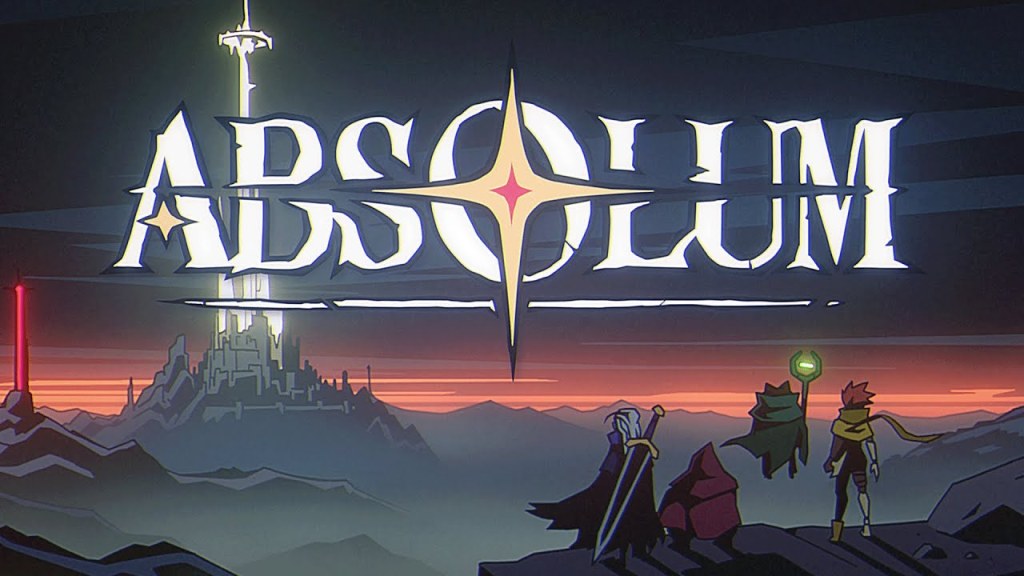
    So along comes Absolum, a fantasy beat’em up rogue-like from developer Dotemu, and a game that not only understands the concept of the “run”, but heightens the enjoyment of each run to a degree I haven’t felt in a long time within the genre.

    There is so much about this game that brings me immense joy, from the intense and driving soundtrack (with a few extremely catchy tracks), to the delightful aesthetic that calls to mind various fantasy comics and cartoons, and the deep wealth of randomized and systematized events which can curve a run in unique directions or give the player special goals to try and achieve.

    Perhaps most noteworthy is the option to use what is called the “Active Assist” mode. This function allows you to raise or lower the amount of damage each player both outputs and receives, meaning that if you just want to goof around and experience the story you can drop the threat all the way down to zero and just have fun. The game features online and couch co-op, and Active Assist can be set to effect the players to different degrees for a truly custom experience.

    Absolum takes place in a somewhat typical fantasy setting: a vast and magical land overtaken by the shadowy forces of an evil ruler, this time being Azra the Sun King. Each run, you pick from between your available characters, select a special move, and set off on a quest to defeat two of Azra’s top soldiers before storming the capitol. You know, assuming you make it that far.

    What makes each run special is the amount of variety. Not only are there multiple branching paths to take on your journey (the first phase of the game offers almost a dozen unique combinations of levels to reach the first major boss) but with subsequent runs, new paths will open up and new events will play out in levels you’ve already passed through. One of the early levels is a dense forest full of scarlet trees and a horde of goblins to fight your way past. Standard fare, yes, but once I’d gone through it two or three times, an NPC pointed out that a new path had been cleared away by some loggers and a secret level was unlocked. Excited and intrigued, I took that path and found an alternate route to the Underking, the first of Azra’s most loyal subjects. Pretty neat on its own, but what really sealed the deal was that when I came back on another run through the secret level, a new NPC appeared with a special side-quest that took us to new parts of the level with some fun secrets to be found.
    It was, in a word, delightful. And if I had to pick one word to describe this game, that’s what I’d go with: delightful.

    There are so many secrets to uncover, new characters to unlock, skills to master, alternate routes and random events that’ll mix things up in exciting ways. Perhaps most important for Dotemu to nail was the combat (I mean, it’s what you’re doing basically the entire time) and nail it they most certainly did. Combos flow nicely together and characters feel agile and strong. Launching enemies into the air before unleashing a series of aerial attacks makes you feel like a god. Gaining a power that spawns throwing daggers when you successfully deflect an enemy attack and then hurling those daggers at your foes like an M60 machine gun at full force is one of the greatest beat ‘em up experiences I’ve ever had. Take into account that the Active Assist function lets you increase and decrease the difficulty to fit your preferences and this game oozes satisfaction.

    Perhaps my only real criticism is that it is occasionally a little buggy. I encountered two rather nasty glitches in my time with the game, one being when a group of chickens launched my character into the air and suddenly the framerate dropped to about 2 per second and it couldn’t seem to recover. On another occasion, talking to one of my other characters in the game’s central hub opened a dialogue box that was completely empty and impossible to escape, resulting in me having to reload the game. I didn’t lose any progress, but I can’t shake the feeling that I might be missing out on one of the few hidden questlines I have yet to unlock.

    The few nitpicks really aren’t worthy of much discussion though. Playing this game co-op is a frenetic rush, and the pure tactile joy of fighting through hordes of enemies was enough to keep me coming back until I snagged that platinum trophy. Not to mention, the game is nowhere near the cost of big releases, so there’s really no excuse not to make what will likely make my top ten games of the year.

    Absolum is, in essence, the primary reason why we play games. It’s just so damn fun.

  • Wanderstop and The Necessity of Play

    Wanderstop and The Necessity of Play

    Video games can be their own kind of chore. Free-to-play games laden with micro-transactions will supply dozens of reasons to log in every single day: Daily Login bonuses (which, of course, get better the more days in a row you log in), Daily and Weekly Objectives, Season Passes, Limited Time Banners, the list goes on. They take the structure of a game, typically a turn-based strategy game, an idle game, or an open world game, and hollow out the bones, filling them with ways to empty your wallet and capture your attention and time.

    There is a ghoulish efficiency to it, and a nightmarish level of effectiveness. If you play video games even on the most casual level, there is a solid chance that you’ve given more than $50 to a Fortnite, a Genshin Impact, or even a simple puzzle game on your phone.

    Something that is fun becomes an obligation, which becomes a recurring charge to your credit card. For some people, it leads to bankruptcy and divorce as their time and money are sucked away by the endlessly nagging desire to keep playing: people with impulse control issues, addictive personalities, or loads of free time and few social obligations are usually not only the victims but the intended targets of these games. For the developers that create them, it’s a daily grind of their own. They pump out new content, new mechanics, new features, with such shocking regularity that it’s a wonder their own employees have time to do anything else, and if you know anything at all about video games as an industry you know that they probably don’t.

    Outside of video games, our culture has become obsessed with the notion of the “grindset” AKA hustle culture. If you use any form of social media, you’ve come across this stuff. Hell, if you’ve ever ordered food from Uber Eats or Doordash you’ve brushed elbows with it. There are millions of videos, articles, and podcasts where the focus is how to maximize profits and financial growth in nearly every aspect of your everyday life. How to take your limited time on this Earth and turn it too, like everything else under capitalism, into a venue where the focus is the money coming in and the show is a strictly regimented cookie cutter carbon copy of every other hustler out there. Input money, output slop. Worse than making additional swill for the trough, you can find new and exciting ways to reach into peoples’ pockets while whispering false promises (whether or not you believe them is sort of irrelevant, eh?) about how wealthy they’re going to be, you know, once their money is in your hands. Sure, you can definitely make money driving Uber on the side, just forget that the pay is peanuts, you use your own car (which will require additional gas and maintenance, things not covered by Uber), and its hours upon hours of low physical activity, no social interaction with customers or coworkers to meet those needs, and there’s no way in hell you’re getting insurance out of the deal. Never mind that you need to set aside sufficient time to do any of these “side-hustles”, time that has to magically appear between your more regular job, sleep, your basic bodily needs, and any kind of social life.

    You have been sold a lie. Wealth is not just beyond your grasp. If you weren’t born near it or neck deep in it, you’ll likely never get there, and if you do, take into account that the thousands of coincidences and occurrences specific to your situation and are not universal rules anyone can follow. There are thousands of “self-made millionaires”, if you set aside that they often came from money or were simply close enough to people who were willing to offload some of theirs. Prosperity gospel (the idea that if you are moral and good, money will follow) implies that poverty is a moral failing. If being good turns into financial gain, than what does that say about those who have nothing? Are they too wicked to deserve an income, a home, food?

    Wealth can solve some problems, but happiness isn’t bought or made in a factory, and fulfillment takes more time to find than you might ever give yourself to find it. You can’t sweat and grind away the days to become a full person. It’s not one simple trick away. If it was, everyone would do it, and… well, does it look like everyone is doing it? Diamonds are made at great depths, not on the surface.

    “I’m different,” you think. “I’m stronger, smarter, more committed. This is my life’s ambition, the key that will unlock the whole thing. This is who I am.”

    And then, life is in the past. Where did the time go? You used it up. Existence is material: we use things and they are gone. One minus one is zero.

    Did it work? Did you find what you were looking for?

    Are you whole?

    … I promise this is about a video game.

    Wanderstop is the newest game from writer and designer Davey Wreden, who you might know from his sensational hit The Stanley Parable or it’s less popular but still excellent (I’m told) follow up, The Beginner’s Guide.

    In it, you take on the role of Alta, a woman living in a fantasy world (think knights and dragons but also smartphones for some reason?) who has spent her entire young life training to be the world’s greatest fighter. She spent months with a blacksmith helping them forge the perfect sword. For years, she traveled the world and competed in tournaments, roundly defeating every foe that stood in her way and becoming the greatest champion of all time, a beast with a blade on a winning streak that felt seemed endless. This was everything she wanted. This was what gave her life purpose.

    Then, before the game has even begun, she lost.

    So she pulled herself back up. She trained harder than ever before, forced herself to work more diligently, to study technique, to get back on top and-

    Then she lost again. And again. And again. Each defeat more crushing, more humiliating than the one before it.

    When the game properly begins, she is racing through a strange and magical forest in search of someone who can help her reclaim her glory, but instead she starts experiencing anxiety attacks which leave her debilitated. Her sword grows impossibly heavy and falls to the grassy floor, and she follows it shortly after, as she loses consciousness.

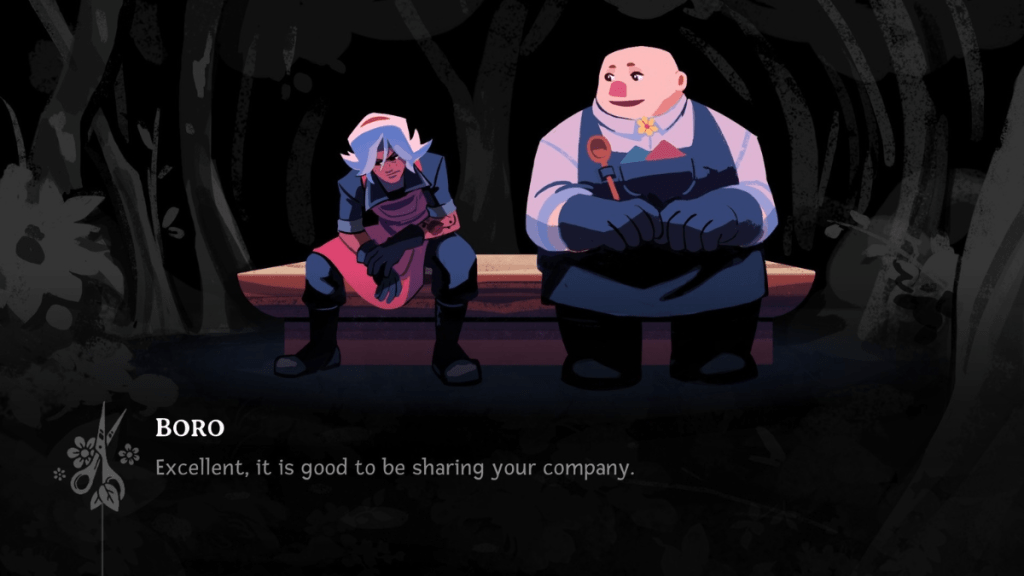
    A large man finds her, and when she wakes up he has brought her to the safety of a pleasant clearing. He introduces himself as Boro, the owner of a teashop called Wanderstop situated in the clearing. He speaks to Alta gently and with bottomless compassion, in spite of your ability to respond in the following ways: biting sarcasm or begrudging indifference. Seriously, she is such a bitch and I LOVE her.

    In spite of this, Boro offers her some tea and invites her to stay a while and relax. He’s brought her sword to the clearing, but she remains unable to move it even an inch. “In the meantime,” he says, “Why doesn’t Miss Alta help me with the shop?”

    And, in spite of her protestations, that is exactly what you do.

    You trim the bushes, gather herbs, collect mushrooms, talk to customers, decorate the shop, and (obviously) make tea. At first glance, this seems entirely unremarkable. There are literally hundreds of games about running a small business in a fantastical setting. I could name over a dozen right now off the top of my head.

    (Actually, let me do that. Moonlighter, Stardew Valley, Harvest Moon, Story of Seasons, Graveyard Keeper, Animal Crossing Happy Home Designer, Fantasy Life, Tavern Keeper… ok you get it.)

    A simple difference changes everything, and it’s a design choice completely in sync with the themes of the game.

    Alta can, at any time, ask Boro what she should be doing. Boro will always answer with the same response. “Miss Alta can do anything she likes.”

    You don’t HAVE to garden. You don’t HAVE to tidy up. You don’t even HAVE to make tea! You can, if you feel so inclined, throw an entire potted plant in into the mixture and drink that, or serve it to your customers. They won’t like it all that much, but there’s no money you have to manage, no reputation points or experience points. No skills, no leveling up.

    You just do what feels right.

    As Alta gets to know the customers who wander in and out of the clearing, she learns about their struggles and fears. One of the becomes afflicted with a magical curse, another hides her insecurities behind delusions of being an incredible businesswoman in spite of having (checking my notes here) zero customers. After a certain point, Alta even starts to open up about her own anxieties. But at eventually, each customer leaves and never returns, sometimes in what feels like the middle of a story rather than the end. When this causes Alta to worry, Boro gives her an important piece of wisdom. “I need you to know that everyone has their own story, and sometimes you won’t be there for all of it, even if you care.” You can’t save everyone. This isn’t the kind of a game where every character is reduced to a series of objectives. You’re not always there when you’re needed, and you’re not always needed to begin with.

    You are yourself with all of your own fears, your own regrets, your own desires. At times, it can seem like a lot, like a weight you can’t lift no matter how much force or how much will you put in.

    But you can relax. You can take time to reflect, to think about what it is that you want and who it is that you are. Who you want to be. What defines you? How have you failed, and are those failures really so existentially devastating as they feel? Alta spends a lot of the game blaming other people, blaming herself most of all, but it’s only towards the end that she starts to think forward rather than backwards.

    You can’t keep going all the time. You can’t define yourself by one thing you’ve done, one passion you’ve followed, one dream achieved or abandoned. To do so is a profound disservice to what it means to be a fucked up, beautiful, and infinitely strange human being.

    Sometimes, you need to sit down. You need to stop running towards something.

    Sometimes, what you really need is to just drink some tea.

  • First Time Final Fantasy – Final Fantasy V

    First Time Final Fantasy – Final Fantasy V

    Folks, we’re back.

    What a rollercoaster this has been. Five games into the series and we’ve seen some of the highest highs and the lowest lows, and at the heart of it all are ideas and questions surrounding the core identity of the RPG as a genre: narrative, or rather, how can narrative can be conveyed through the structure of a game.

    Final Fantasy I gave you a world and took its hands mostly off the reigns as far as your player characters go. That freedom can feel empty if you’re not willing to fill the spaces left with your imagination, the same way we can imagine a handful of colored squares on a TV screen are a dragon.

    Final Fantasy II grabbed you by the wrists and dragged you through a lifeless story while trudging through the death by a thousand cuts that is the gameplay.

    Final Fantasy III restored balance to the Force, giving you mechanical expression through the Jobs system and telling a (mostly boring, yes) story that focused on how your characters propel events forward.

    Final Fantasy IV took an odd back-step, trying to tell a more structured, focused story with almost no chance to express your own narrative through gameplay. The presentation was better, characters underwent arcs, but neither half of the experience felt fully coherent or enjoyable enough to really take my breath away.

    Now we have arrived. Final Fantasy V takes the series’ innovations and iterations, its confident strides and its clumsy staggers, and reaches newfound heights in nearly every aspect of the experience.

    So why am I so bored?

    Starting from the beginning, we are introduced to our main cast in fairly quick succession: Bartz (a wandering… uh, guy), Galuf (an amnesiac old man with his fair share of secrets), Lenna (the princess of the kingdom of Tycoon), and Faris (a pirate captain with a mysterious past). These are not your clay figures to mold into characters of your imagining. They are well-defined, they have a lot to say, and (most importantly) they are good characters.

    FFV is the first game in the series that makes an effort to have the characters move around in cutscenes. To emote, to react, to interact with one another in ways that are genuinely funny or heartfelt or that help to solidify the feeling that they are on an adventure together, developing bonds and gaining a sense of familiarity that comes with sharing so many experiences. While there aren’t many standout moments of characterization (all-in-all, these people are mostly one-note) there is far more effort made than in any of the previous games to endear them to the player. Cecil was a buffoonish loser, and the majority of other characters in FFIV ranged from annoying at worst to underutilized at best.

    There are arcs for these characters. Reveals, moments of genuine affection, stories that intertwine. This is by far the best character work in the franchise, easily.

    And now we reach an interesting point of contention. This game brings back the Job system from FFIII, only expanded and with the ability to mix and match abilities that you have mastered to create some truly fun and powerful combinations. Leveling up really only raises your HP; it’s the Job levels that make the difference. In practice, I adore this system and I am thrilled to see that it returned. It made the gameplay a lot more fun than some of the previous entries, probably the most fun yet in terms of digging into the mechanical structure of the game. But there is a downside and it’s that because any character can be any Job, some of the work done to give them a sense of identity is slightly undercut by giving the player free reign over how each character plays.

    There is a prevailing feeling in games criticism (what little of it remains) that player freedom is paramount, the primary goal and objective moral good of game design. To me, this is a baffling perspective. While freedom can be an exhilarating feeling and can lead to some of gaming’s best experiences (see the immersive sim genre) there is profound beauty in a tightly designed and carefully prepared linear experience. When a game lets you do anything, the things you can do become equally valuable by default. Sure, FFV locks away its more interesting and powerful Jobs behind story progression, but they become immediately available to all members of your party whether or not there is a narrative (written or implied) reason for them to take on this new role.

    So, yes, Galuf is an interesting character, but functionally there is nothing to separate him from the other characters and this feels like it was an over-correction from FFIV’s setup.

    It’s a strange, living contradiction. On one hand, the customization feels really good and lets you do a lot of fun things. On the other, it undermines a story that could’ve used a little bit of a boost.

    The story does play with some interesting ideas though. In this entry, the power of the crystals is not treated as sacred or divine, so much as they are batteries for industry and the conveniences of comfortable living. They are constrained, consumed, and ultimately destroyed by the people in power who have taken them for granted. The antagonist (yes, he’s really named Exdeath) is a being born of the natural world able to take on the shapes of trees and… a splinter. He is an avatar for the elements fighting back against the abuses of humans, and the many environments of the game often strive to show how the natural world is undergoing a state of turmoil.

    And wow, some of the most fun locales we’ve gotten to explore thus far are here. Ghost ships, other dimensions, massive castle sieges featuring an aggressively paced and epic struggle on an enormous bridge, and a truly cursed palace made of flesh and bones. The visuals are quite nice in these areas and the game world is suitably massive for a franchise that continues to make enormous leaps in scope with nearly every entry.

    But it’s almost too massive.

    A level of fatigue had started to settle in by the time I was in the game’s final act, and there was a lot of side content I very intentionally left out of my playthrough. With each time the game’s world expanded I felt myself growing less impressed and, frankly, more intimidated. Is the fact that I’m playing all of these massive JRPGs in a row partially to blame? Probably. But I couldn’t escape the feeling that some of this stuff could’ve been pared down a bit.

    Final Fantasy V is a great game. It has a fun story with fun characters, a level of mechanical complexity that is deep and enjoyable even by today’s standards, and for those who want it there is a ton of content. It’s biggest failing, oddly enough, is that it doesn’t quite manage to coalesce into a finished product that leaves a big emotional impact or introduces enough unique and new experiences. We’ve reached the “franchise fatigue” step in the arc that much of media undergoes. Will FFVI be able to breathe new life into the series?

    Next month: Final Fantasy VI

  • First Time Final Fantasy – Final Fantasy IV

    First Time Final Fantasy – Final Fantasy IV

    I stated early on in this project that I suspected that with each entry in the franchise there would be new and interesting innovations, not only within the context of Final Fantasy itself but in the wider field of RPGs and games writ large. Four entries in and I can say with confidence that so far my hypothesis is looking more and more likely to be true. Final Fantasy IV takes enormous swings in nearly every aspect of its design, breaking from conventions established by the previous three games. And I say nearly every aspect because, in a lot of ways, the game seems to slip into old pitfalls.

    Whereas the first three games in the series felt like they were always advancing, always iterating, adding new features and expanding its scope in both a narrative sense and a mechanical sense Final Fantasy IV seems to go hurtling backwards towards a some of the bad concepts from Final Fantasy II, heedless of the danger, the futility of the act. II took on a more story-centric approach. It was linear but let you wander into dangerous areas only to immediately die to trick you into thinking it wasn’t. One of my biggest complaints, aside from the extremely lackluster narrative content, was that it couldn’t make its characters special and well thought out OR blank slated enough that it was fun to tinker with their abilities. Unfortunately, IV seemed not to hear my complaints… decades before I made them.

    IV begins with the story front and center. An introductory sequence introduces us to the Kingdom of Baron, the Red Wings airship brigade, and our …hero? OK, we’ll circle back to that, trust me. Cecil (our protagonist) is a member of the Red Wings, and has just returned from a mission wherein he massacred the peaceful inhabitants of a village of mages, stealing their elemental crystal. He laments that he has done this to his lover Rosa and questions the morality of his actions (big thinker, this Cecil) with his comrade-in-arms, Kain. However, for expressing doubts in his King’s methods, Cecil is stripped of his title, removed from the Red Wings, and given another assignment: to deliver a package (a totally NOT suspicious task to give to a, as of seconds ago, disgraced military commander).

    This package is a bomb. Like, the monster. Capital B, Bomb. It blows up another village (sick kill count, Cecil) and leaves one survivor, Rydia, whose mother dies before her very eyes while Cecil looks on in horror at what he has unwittingly done. Cecil takes her with him and flees the village, headed towards… I don’t remember. Honestly, aside from some highlights, I remember very little at all about the story of this game, and I JUST played it.

    So, this might be the right time to tell you: I think this story is bad, and a lot of it has to do with the way the game integrates party members.

    Because Final Fantasy IV is trying its best to tell a more complicated story, the game returns to Final Fantasy II’s notion of giving you characters with predetermined identities, but doubles down to remove any element of customization for how these characters play by essentially making each one their own Job. This makes them stand out, yes, and makes your party varied and gives you lots of new mechanics to play with each time you get a new member of the crew, and (perhaps most importantly for this series) begins a new era for Final Fantasy, one in which the party members are all unique characters with unique abilities and personalities. Aside from, you know, the MMOs, Final Fantasy mainline games are never going to be about you and your band of self-insert adventurers again. It’s about… these guys.

    And in Final Fantasy IV, these guys suck. But don’t worry, none of them stick around for more than a few hours! Because, in a staggering display of misunderstanding which parts of FFII were good and which were bad, the game is constantly shuffling characters in and out of your party, never giving you a chance to go through more than a few areas with a consistent party at a time. Furthermore, you know the mage Rydia who has perhaps the most classic fantasy backstory of all time? She is essentially side-lined until late in the game where she returns as a powerful mage who has spent time living among divine creatures of myth from another world and learning to summon them in battle, on a quest for self-discovery and revenge against the evil empire which destroyed her home and family. This is a way more interesting story than, “guy who does genocide feels bad about the genocide he already did”, but the game doesn’t seem to want to engage with it all that much.

    But you know what this game does want to try its hand at? The brand spankin’ new and flashy ACTIVE TIME BATTLE SYSTEM. <The crowd goes absolutely ballistic with applause>

    Yes, folks, not only have we arrived at one of the most defining features of Final Fantasy’s storytelling, but at the combat system which has essentially become the franchise’s identity, and one of the critical ways it distinguishes itself from other JRPGs.

    I may have mentioned in the past that I have ADHD. This can make turn-based combat a little tricky for me, as it’s easy to get a little bored and have my attention and motivation slide off the game like the screen has been freshly buttered. So, with the combat taking a more urgent pace, I should be thrilled rig- WRONG.

    The active time battle is the bane of my existence, the enemy of my already frantically hamster wheel spinning brain. “Oh, you were having trouble paying attention? How about pay rigorous attention or lose hours of progress?”

    Hey, FFIV, screw you, man!

    The menus are already a little clunky to maneuver, and the fact that many boss fights have weaknesses and reactions that change depending on how you time your attacks (while genuinely a very good idea) ends up feeling clumsy and hard to manage. You can’t just sit and wait for a good opportunity to strike, because if you idle the enemies keep whacking you regardless. And if you’re waiting to time something correctly you’re giving up any opportunity to protect yourself or heal up with some items. There is also a brief windup period before spells are cast, making it even more difficult to gauge the timing.

    This would suck even worse, were the game not stupidly easy. Not once in my playthrough did I get a single Game Over, and I did minimal grinding between dungeons. And how are those dungeons?

    Boring, mostly. While there is a higher degree of aesthetic variation between locales (at the end of the game, you go to the FUCKING MOON, dude), there still has yet to be much difference in how you navigate these dungeons. FFI had some puzzles and environmental hazards in its dungeons, and FFIII had a… fun(?) boss rush at the end which you could take on in any order you wished. FFIV has a few neat moments, and the world maps are pretty cool, but so much of the presentation is focused on a story that simply can’t hold my attention. Nonsensical twists, characters popping in and out so often that it’s hard to get attached (to anyone but Rydia; Rydia rules).

    The other thing I need to keep in mind is that I play a lot of games… a LOT of games. And playing other long games including other JRPGs while also playing Final Fantasy at a near constant rate can at times drag me down. That being said, I don’t think that playing this after a several month gap in FF games would’ve made much of a difference.

    The attempts at something new and fresh are interesting on the surface, but the game ends up feeling overly structured. There’s no experimentation, no real exploration for much of the runtime, and the story is so scattershot and dull with characters who rarely feel like they’re getting enough time to say much of anything.

    I think FFIV is probably a fine game, but for me it only barely beats out II and pales in comparison to both I and III. And the other one, the secret one I’ve already played. We’ll get to that.

    It sets a lot of precedents for the series going forward, or so I am led to believe. This gives me some anxiety. How will the next entry grapple with the changes to FF? And how will it draw on the games further back in its lineage?

    And will there be anyone nearly as cool as Rydia?

    Next month: Final Fantasy V

  • Sword of the Sea – Review

    Sword of the Sea – Review

    One of the most important factors in my enjoyment of a game tends to be how it feels to move around. Perhaps my biggest criticism against Dark Souls II is how floaty and weightless everything feels whereas you would expect a warrior in metal armor with a stupidly large sword to trudge and lumber around. Playing Destiny feels smooth and the added movement options allow you to elegantly leap and glide around the battlefield like an angel of death. Monster Hunter Wilds gives you what is essentially an auto-pilot capable raptor mount that can climb, leap, and sprint across the wide-open spaces and navigate cave systems with impeccable ease, but dismounting changes your movement style to be slow and heavy yet more precise, perfect for facing down giant monsters in highly technical combat with hard-hitting attacks. And who could forget the heaving, struggling, gratifying feeling of scaling cliffs in Breath of the Wild?

    Keep this in mind when I tell you the pitch for Giant Squid’s Sword of the Sea: “What if Journey was a game about hover-boarding?”

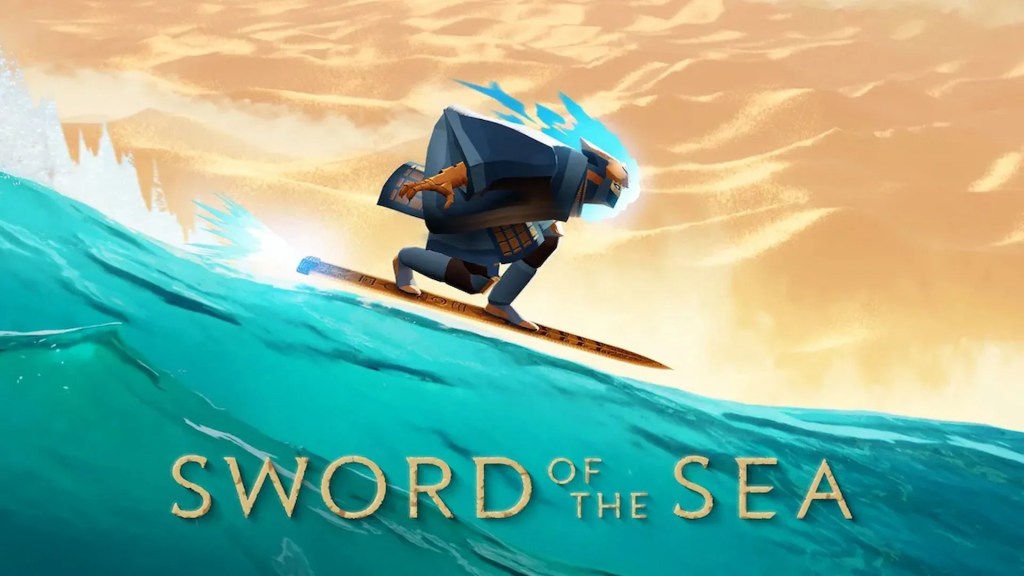
    It’s no surprise that this particular developer would produce a game which draws so heavily on the aesthetics of Journey and their previous game, Abzu, combining the two almost literally in many cases. You play as the Wraith, a being of mysterious origin and granted with a powerful hoverblade (you read that right) that allows them to glide over the vast desert or snowfields while also slicing apart obstacles. As the game progresses, you transform the various environments into a roiling ocean, schools of fish and pods of whales springing up from beneath the earth and taking… flight?

    Confusing physics aside, the game is visually stunning in ways that are both familiar for the developers’ previous works, and altogether new and creative. The final two chapters of the game in particular were a feast for the eyes: glittering starscapes and lakes of blazing magma that are beautiful to the point of tears and treacherous to cross respectively.

    Equally impressive is Austin Wintory’s score, sweeping and glorious like his work on Journey, giving what might otherwise seem a little sillier of a gameplay experience an air of majesty.

    Similar to Journey, the threats you encounter are… alright, how much longer am I going to do this? I can’t just keep comparing it to Journey but… I mean, come on, it’s so similar! The way the story is presented through records from ages past, the dusty desert ruins decorated with similar deep red rugs which sway in the wind. Giant serpentine creatures of stone and fire are your adversary, and a silent protagonist is joined by a silent companion (although this time it’s a character and not an interesting form of ambient multiplayer). Furthermore, the game seems similarly fixated on aesthetic references to another past game, Abzu, what with all the fish that come blossoming into existence whenever you open a new path. Sword of the Sea even features the same secret shell collectibles from Abzu. Upon discovery of this fact, I said aloud, “Oh… again?”

    So, with a game that’s seemingly unable to move on from the developer’s past projects, can it really stand on its own? How can it establish its own identity?

    Because hoverboarding over deserts, tundras, and magma lakes looks and feels fucking awesome.

    And that’s honestly enough to make this game stand out among its peers, because where Abzu and Journey were meditative and slow with occasional bursts of excitement, Sword of the Sea feels exhilarating from start to finish. Even when things take a more contemplative turn, you’re still zipping around these massive spaces, grinding on rails, riding the walls, and doing all manner of flips and jumps to collect Tetra (the game’s currency which you use to unlock new abilities) and secret shells. If you spot a little crevice in the distance, you think might have a secret, you simply zip over and check it out, and most of the time you’ll be rewarded for exploring.

    There’s also a lot more spectacle here. The final chapters of this game leave me breathless, even on repeat playthroughs. And yes, I played through multiple times. In an age of loot boxes, card packs, and daily quest grinds, there is something remarkable about playing a game over and over simply because it feels good. And Sword of the Sea feels so good that I’ll probably play it a few more times, will likely even go for the platinum trophy.

    You can finish the game in a few hours, so I encourage you to take an afternoon or evening where the weather sucks and the blankets are clean and cozy, and get transported to the rolling dunes and gorgeous seascapes of this little adventure that leaves a big impact. In a world that demands so much of your time, nothing about my time with Sword of the Sea felt wasted.

    Giant Squid: What else ya got cookin’?

    Update: Between the time of writing and the time of editing, I have – in fact – acquired the platinum trophy. Game good.

  • First Time Final Fantasy – Final Fantasy III

    First Time Final Fantasy – Final Fantasy III

    There is a moment in Final Fantasy I where you’ve just finished rebuilding the bridge that spans a narrow channel separating two continents. You’ve spent a few hours fighting monsters, learning the structure of the game, and exploring the small portion of the world you’ve been given access to, so at this point you’re understanding of the game’s world feels like it’s filling out. You step across the bridge and a splash screen comes up showing your party of adventurers overlooking a gorgeous pixelated landscape and the iconic music plays, accompanied by this feeling that here, right here, is where the adventure of a lifetime truly begins.

    It’s an incredible moment. The world that seemed so small before suddenly explodes outward in all directions, expanding your understanding of the scale and scope of the game to an almost intimidating and certainly awe-inspiring degree. They even manage to repeat this trick three more times, once with the acquisition of the ship coupled with the opening of the channel taking you to the open sea, again with the canoe giving you the ability to sail along the currents of rivers, and again with the airship, taking not only the method of traversal but the speed at which you travel to unseen heights.

    Final Fantasy III looks back at the legacy of Final Fantasy I, the experiments and failures (and there are many) of Final Fantasy II, and says with a smile: “Yeah, I can top that.”

    And it does.

    There is a moment very early in the game where you acquire an airship. I remember thinking, “Wow, that was really soon! I wonder how they’ll incorporate this into-” and then it explodes into a million pieces and becomes unusable. It’s a gag that works because it’s completely unexpected, and when the game starts to build its traversal systems and overworld exploration back out again, there’s always this little chuckling voice in the back of your head that remembers the airship and wonders if it’ll happen again.

    It doesn’t, and that’s probably for the best, because the ways in which Final Fantasy III continues to expand its world are frankly astounding.

    You start the game on a continent that seems like a densely packed and populated realm. There are multiple dungeons (even some late-game optional areas), several towns, castles, and big set-pieces to capture your imagination. It feels like a complete game. So when the camera pulls back, you get a proper, functioning airship again, and you set out over the continent’s edge for the first time you discover that all that has taken place thus far took place on a floating island above a far more massive world than you could’ve predicted would await you. It’s jaw-dropping.

    AND THEY DO IT AGAIN. Late in the game you get access to a submarine and now there are multiple underwater dungeons to explore, mostly optional, with tons of cool treasures to find, new enemies to face, and environments to explore.

    There’s an interesting parallel between the world’s constant expanding and the game’s mechanics similarly growing, because Jobs are back from the first one and they’ve been totally reworked from something passably interesting to a full on highlight of the game.

    You start the adventure as four small children, all the same Job (the oddly named, Onion Knight), and you fall into a chasm beneath your home village wherein you find a magical crystal that grants them great power and access to the Jobs. With each crystal you find throughout the game, a batch of new Jobs gets unlocked, totaling in twenty-three unique classes for your characters to play, but we’ll come back to that.

    OK, you might think, so this was a cute little introduction and now I pick my four Jobs that my party members will master as the game progresses. Probably gonna need to some balance so not too many mages but we can’t have none. That classic party composition math begins ticking away in your head. Maybe they’ll advance to new forms like in the first game, but this is the configuration I’m working with, right?

    Wrong. Because in a masterstroke of design genius, FFIII allows you to freely change Jobs at will, meaning you can have a party of all White Mages, realize that this is untenable, and switch them around to various martial classes. Felt like switching one of your characters over to Red Mage for a while but now you’re not sure it’s working out the way you wanted? Switch them to something else! Try a Ranger! As the Job list expands periodically, you’re given multiple opportunities to entirely reconfigure your party and their skills, experimenting with different combinations, trying out the new mechanics that Jobs like the Bard and the Evoker bring to the table. And you’re encouraged to try all of these, since the only real cost is the time it takes to figure out if you like the Job for your character. You level up your party members separate from your level in a Job, meaning that while your mastery of a Job grows and you get new abilities, your stats are influenced by the equipped Job, but not pigeonholed by it. If you switch to a Knight from a Geomancer, get ready to watch your HP climb at a better rate. In theory, you could have a White Mage with more HP and Defense than your Knight. I don’t why you would do that but hey, it’s your game.

    Each Job also has a unique feel to it that changes how you approach combat, and the ability to swap these around freely is such a gift to the player, which is really no surprise when you look at the game’s structure as a whole.

    Because Final Fantasy III is the most impressive game I’ve played for this series and it’s not even close.

    And it’s weird how much of what good was in Final Fantasy II they are able to wring out and restructure for this game, because like FFII this one has a much greater focus on the narrative than the original game. There are distinct characters with motivations and stories of their own, and lots of them join your party for a brief while to go on some quest together. And while your party members also speak and have ideas of their own, none of it feels like the game is taking all the roleplaying out of your hands. You are still given enough empty space to fill in with your imagination that the creative expression of the game (although extremely rudimentary by today’s standards) works in a way that is not only similar to the first game, but that actually surpasses it.

    Advancement no longer feels like you need to be juggling spreadsheets and formations. Just grind for a bit. Level up. Watch your stats climb the way they’re supposed to. Sure, you can’t get as granular as you could in FFII (although for whom that is a problem I can’t imagine), but you still have a bounty of options at your disposal.

    Except when the game hems you into making all your characters the same Job for a dungeon, lest you face endlessly replicating monsters. Or when you are forced to make yourself small using the Mini spell, but now your physical attacks and defense are pitiful and you need to rely on magic or successfully escaping every encounter. Or when a boss can be defeated if you grind for a while and just brute force it, but it goes much smoother if everyone just switches to the one Job that’s kind of tailor-made for this situation. And I could be wrong, but in this specific instance I found that particular Job, the Dragoon, to be mostly useless outside of that fight.

    These kinds of setups are limited, but they are such a strange misstep in the design. It would be cool if one Job had a moment to shine, but the difficulty of these fights and areas for those not using that Job becomes frustrating and feels rather arbitrary.

    The game is also… like… really long? There were times when fatigue started to set in, and the amount of optional content (while impressive) started to resemble a chore list. This probably has more to do with my own brain chemistry than the design of the game, but a little quicker pacing would’ve appealed to me quite a bit.

    The story is mostly forgettable, being presented not so much as a continuous plot with growing stakes but instead as a series of small narrative arcs, usually revolving around an NPC you meet or the problems of a single town. It manages to evoke a kind of D&D feel, having your party bounce from location to location fighting various unrelated baddies and solving magical crises, but it lacks the kind of cohesion that would really elevate the emotional attachment you might get toward your characters and the setting. Ironically, it is this point that seems to undergo a complete turnaround in future games, though I’ll save my opinions for when I’ve actually played them.

    Perhaps my biggest criticism is the game’s final dungeon. It’s massive, gruelingly difficult even for a high level party, and there is almost nothing in the way of checkpoints, meaning that failure is going to send you really, really far back. And the final boss, while managing to capture my interest, is more of a brute force blast-fest than anything else, and there isn’t a ton of mechanical depth to the fight, which – to be fair – is true of most of the game’s combat.

    We’re still in an era where technological limits are tight, where modes of combat design that will become iconic to fantasy RPGs down the road simply haven’t been imagined yet.

    It’s sad to say, but the lack of depth to the combat, the lack of variety in what it is that you’re doing moment to moment, makes a lot of this game fairly monotonous to play. We seem to have settled into a rhythm here, a pattern that while enjoyable is beginning to get a bit stale. Now, playing them back-to-back is a far flung experience from what most folks would’ve had when these games were new, but my motivation to continue if things stay relatively fixed will definitely slip away.

    But don’t let that fool you into thinking that I had a bad time with this game. I didn’t. I had a great time, in fact! Much like the first game, it’s incredible to see the design methodology of fantasy games so clearly laid down so early on in the medium’s lifetime. I’m overjoyed at the game’s quality even when viewed from a modern lens, but I wonder if they will continue to innovate in ways that make the games interesting, or if they’ll fall into a repetitive rhythm that slowly fades into drudgery.

    Only one way to find out, eh?

    Next month: Final Fantasy IV

  • Recency Bias Volume 3

    Recency Bias Volume 3

    Sinners

    I try to watch movies I’ve never seen before fairly often. At least once a week, if circumstances permit. These can be movies from any era, but when I’m watching something with my mother (as I was a few weeks ago) we like to try something more recent. So, having no context for the film other than my vague recollection that Patrick Klepek who writes for Crossplay and Remap said he really enjoyed it, we tried our luck with Ryan Coogler’s newest feature, Sinners.

    Holy shit. This movie rules.

    It’s hard to talk about the plot without spoiling it, but I will say that the movie had me growing more and more invested not only by the literal text of the film, but by the ideas that were being explored, ideas of ownership, the freedom of Black folks in America to own what’s rightfully theirs. I’ve not been a fan of much of Coogler’s body of work, caring very little for the Black Panther movies, and I can say without a doubt that not only is this his best film, but it’s one of the best films I’ve seen in a long while.

    And the performances from all involved are top-tier. Michael B. Jordan stuns as twin gangsters Smoke and Stack, separating the brothers with subtle physical characteristics that make it immediately clear which brother is on screen and how they differ as people.

    Also they wear red and blue respectively, in case subtlety is not your thing.

    Alan Wake 2

    I am a latecomer to Finnish developer Remedy’s games. My first foray into their weird sensibilities was 2019’s Control, a really fun action game that plays in the same sort of narrative flavor as The SCP Foundation, the Cthulu mythos, and shows like Fringe or the X-Files. Shadowy government agencies battling world-ending paranormal threats, you know the deal. At the time I remember hearing about the ways in which Control made reference to the events of another game, Alan Wake, but a cursory google search of the game did little to sell me on it and I disregarded the game.

    But with the recent remaster and the sequel out and having gotten a fair deal of praise, I decided to dip my toe in the water and try it out.

    I enjoyed the first game in the way that one does when the game is equal parts campy charm and serious jank. I chuckled at the various Stephen King references and the Twin Peaks elements sprinkled throughout, but nothing could’ve prepared me for what awaited in the sequel.

    This next bit I will address to Sam Lake directly.

    Dude. I also loved Twin Peaks: The Return.

    And that show is so tightly woven into the fabric of this game that one could argue it is perhaps its sole influence. There are repeated visual and thematic references to Twin Peaks’ incredible revival season that listing them all would be it’s own series of posts.

    And for the most part, I liked this aspect of the game. The visuals are gorgeous, the same campy voice acting and writing are back and bolder than before, and there are new game mechanics and optional objectives which are interesting if not rather repetitive. Actually, placing notes and photos on the case board in new protagonist Saga Anderson’s mind became actively annoying towards the end of the experience because there were times where the path forward was locked off simply because I didn’t bother to have her repeat to me plot points I’d already had explained to me.

    But one thing puts this game so far up in my esteem that it can never be diluted by any other aspect of the experience. If you’ve played the game, you know what it is.

    The thirteen minute long prog-rock musical number featuring live-action actors performing the dorkiest choreography you have EVER seen. I cackled the whole way through and will never forget it.

    The Witcher

    Many years ago, I was given a copy of The Witcher 3 for Christmas. I booted it up, played an hour of the game, and turned it off. I had no fucking clue what was happening.

    A month later, a friend of mine told me that while the first two games weren’t too critical to understanding the story of The Wild Hunt, they informed me that the books were really important context to have. As a bonus, the books were really good.

    I read them all.

    They are really good.

    So good, in fact, that after I read them all I jumped right back into the game and had an absolute blast. So when I found out recently that Andrzej Sapkowski was going to be releasing a new standalone Witcher novel (“Crossroads of Ravens”) I decided that now was a great time for a re-read of the series.

    It’s always a treat when something you loved before holds up upon revisiting, and I couldn’t be more pleased with these books. Sapkowski strikes the perfect balance between world building exposition and following the emotional and narrative journeys of his protagonists. Entire chapters will be devoted to characters you will never see again, or only hear very little from in the future, yet none of these feel like padding for length or overly expository or indulgent. Complex political mechanisms are depicted in such accessible detail which is honestly shocking to see in a fantasy novel.

    Furthermore, Geralt’s arc from being a stoic neutral actor to realizing how truly inescapable the gravity of world politics is and deciding to take a stance, to protect those he loves and those who otherwise cannot defend themselves is just as relevant today as it was when it was written. In America, it is perhaps more relevant.

    And that will close out this month! Lots of fun stuff coming next month, including our next entry in my First Time Final Fantasy series, out next Tuesday! See ya then!

  • Clair Obscur and Art as Escape

    Clair Obscur and Art as Escape

    *FULL STORY SPOILERS AHEAD*

    Near the end of Clair Obscur: Expedition 33, there is a pretty major twist. Maelle, the adoptive sister to early-game protagonist Gustave (may he rest in peace) is revealed to be Alicia Desendre, daughter to Renoir and Aline (AKA the Paintress), and sister to Verso and Clea. The game goes a step further to say that not only is Maelle not her real name, but she isn’t even from this reality. This entire world we’ve explored and inhabited for the game, from Lumiere to the Monolith, all the people we’ve met along the way including our own party members, all of them are creations of the enigmatic beings called, the Painters, who can create worlds infused with life to the point that they become indistinguishable from reality. This world is the creation of Verso Desendre, who perished tragically in what appears to be an arson enacted on the family home, and is the last surviving relic of his life.

    The Verso we’ve been traveling with this whole time is actually a fabrication by Aline, who in her grief entered the world of Verso’s Canvas and refused to return to her true family, creating new versions of them to protect her. Renoir, her husband, came in after her to try and bring her home, but the two became locked in an endless battle of wills as Renoir tried to destroy the Canvas from the inside and Aline did everything to protect it. You see, the Paintress doesn’t cause the gommage. She’s been holding it back. But as her power wanes and her sorrow deepens, her grip is slipping and she can no longer contain Renoir.

    The Verso we’ve been playing as (or as Esquie puts it, Verso who is Verso’s cousin) has been working towards a singular goal this entire time: to defeat the Paintress, defeat Renoir (both the painted version and the authentic one) and to destroy the Canvas, dooming this world to obliteration and finally putting an end to this life he does not want, the life of a shadow of a dead man, cursed to immortality and unable to cope with the perceived meaninglessness of his existence.

    Alicia, disfigured by the fire and left with the inability to speak, dove into the Canvas to try and rescue her parents, only to lose her sense of self during the process and wind up trapped there as a new being with none of her memories intact. She is born to new parents, painted ones. She is named Maelle. Her parents gommage and she is raised by Gustave and his sister. She learns to fight, and she becomes and Expeditioner to stop the gommage from ruining their world.

    In this strange, turnabout manner, Alicia has approached the conflict of Aline’s inability to deal with the loss of her son from both sides, and when all becomes clear to her and her memories are restored she remains resolute in this quest with one additional goal: to stop her father from destroying the Canvas, the last piece of Verso’s legacy, this world he created as a young Painter where he would play with Monoco and Esquie who remember him with deep fondness.

    This puts her and Verso in direct conflict with one another, though he refuses to admit what his true endgame is until the last moment.

    After defeating Renoir and convincing him that this Canvas matters, that it ought to be preserved, that mourning Verso does not have to mean either losing oneself to the despair of his death or destroying all evidence of his life. That she can live in this world, and return to her reality. That she can grieve and heal from that grief.

    Verso has other plans, and with his betrayal the true final battle begins, one in which the player is tasked with choosing a side and in doing so must answer a question for them self:

    “How real is this world and its inhabitants? And is it worth preserving? Or is the lure of ultimate escapism to great a temptation to allow one to reckon with?”

    Because one of the main themes behind Clair Obscur is that art is a double-edged sword. It is beautiful. It is terrible. It can take you away from your burdens, but it can also reflect them back at you. It can distract you from your reality, but it can’t save it.

    Art, even video games who go above and beyond in many cases to cement that sense of immersion, that feeling of embodying another person’s experiences, cannot replace your life. Art and creation can enrich it, give it additional meaning, but they cannot erase the fact that you are a material being in a material reality, with pressures both physical and social placed upon you at all times.

    Art is not an escape.

    But it doesn’t have to be.

    If you choose Maelle’s stance, you defeat Verso and remain in the Canvas. Not only that, but you undo the gommage, bringing Gustave and even Sofie back to life. In a deeply haunting cutscene, you see that even Verso has found something to live for, pursuing his true passion, music, and playing before an assembled audience of Lumiere’s citizens including Gustave, Sofie, Lune, Sciel, and Maelle.

    Then a horror movie stinger accompanies an image of Maelle degrading under the effects of remaining in a Canvas too long as a Painter. In the end, she failed to escape her grief not just for Verso but for Gustave as well. She stays here, in this fabricated world, and it is implied that she will never leave. At any time, she has the power to, but she simply won’t.

    And to be clear, while this is deeply tragic for Maelle, I think this is the good ending, at least in terms of being the most positive outcome for the most people. Because when all is said and done, you can argue over what counts as “real” but try playing the beginning of the game, seeing Gustave tell Sofie “I’m here.” as she gommages in his arms, hear her say “I know… I know.” and tell me that their feelings, their experiences, none of that matters because they were creations of someone else.

    Aren’t we creations of our parents? And if you’re a religious individual, aren’t you the fabrication of a divine being?

    It’s hard to define what is “real” because the word means so many different things, but to say that the lives of these people don’t matter and ought to be discarded simply because there exists another plane of being seems… well, deeply bleak.

    Which takes us to Verso’s ending.

    He defeats Alicia and destroys the Canvas, watching as Lune, Sciel, Monoco, and the entire world all fades away. His friends watch him with thinly suppressed hatred as he callously destroys their lives in an instant (Lune’s expression being particularly hard to watch). The Canvas world dissolves and we see a glimpse of Alicia in her real world, standing beside her brother’s grave. She turns to see her friends as an illusory image one last time before they fade away. She can move on, but that grief remains.

    Either ending to this game is heartbreaking. No one comes out of this unscathed, and the player is left with a bitter pill to swallow. Pain is real, it follows you, it lingers, and you can lose yourself to destruction, even that of the self, in order to be free of it, or you can create and create and create anew, hoping each time that this will be what saves you.

    But it won’t.

    That’s not to say we shouldn’t create. We absolutely should! It can help us to heal, can help us to grow and understand ourselves and even cope with the agonies of our reality. Creation, particularly art-making, is one of the things that most gladdens the spirit and pleases the mind, even when the work is difficult. Expression makes one feel the most them self they can feel.

    Art is not an escape.

    But it can help you to be free. At least, for a little while.

    Is that not precious enough to be worth fighting for?

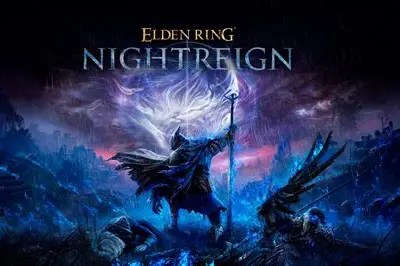
  • Elden Ring: Nightreign – Review

    Elden Ring: Nightreign – Review

    You have played Elden Ring. You know the score. This is different, that much is obvious, but Elden Ring is in the name! It can’t be that hard to adjust, and you’ve played the other Soulsborne games. You pick a character based on a build style you’re familiar with and begin.

    Then you soar through the air on a spectral bird, drop into Limveld from an obscene height, and the chaos begins.

    Your party members go running off, seeming to execute complex mathematics in their heads as they go. The truth is, they know the score. You’re the newbie. You’re just along for the ride. You follow, getting used to the slightly tweaked controls, the speed of the new sprint feature, maybe you take some time to fiddle with your character’s unique skills. Perhaps you chose the Wylder, with his greatsword, his grappling hook and his all-around playstyle. Or maybe you wanted to try your hand at the easy to learn, difficult to master Recluse, with her recharging FP and her powerful elemental spells that rely on careful planning and memorization. No matter which Nightfarer you chose for your first run, you will quickly realize, just from watching your allies play, that each one of them is technically complex and surprising in how unique their identities are.

    Runes start pouring in and it becomes clear that you are being carried. You scoff. You’re the expert here, right? You leap into the fray. Enemies you recognize rush you in mobs and you take a couple hits but you come back swinging. “Alright,” you say to yourself. “I can do this! Just need some time to adjust.” This has happened throughout the franchise! Each entry is just different enough to feel familiar but a little disorienting. But those were all hurdles you overcame in a matter of minutes, hours at most!

    Your party is gone again, already rushing to their next target while you’re stuck trying to decipher which rewards you should be choosing, struggling with incomplete context. You try your best to make value judgments knowing you might not get another chance to take the rewards you don’t pick.

    The storm begins to close in. A lot faster than you expected. Man, this game is paced really fast! Kind of hard to keep up, especially when Souls games tend to be slow marches through dangerous, hand-crafted levels. This feels so much more chaotic, so much more hurried and frantic. Your party is launching spells, wielding weapons you vaguely recognize but with new abilities.

    And now it’s time to face your first boss, and like the weapons, items, and other enemies in the game you recognize this one too! Alright, you take a few licks, get downed once… maybe twice. But your party members seem to have a grip on the situation and you prevail. A big boost in runes and a handy buff come your way, or perhaps a new weapon.

    Then Day Two comes.

    Far more dangerous enemies (which were there before but are now marked on your map) seem to draw your party’s attention and you struggle through some challenging fights. You visit a few more areas, some ruins themed around a certain damage type/status effect, Limveld’s central feature: a castle with two powerful bosses and a bunch of high level enemies. The runes come flooding in and you watch your level climb up over ten and closer to the maximum level of fifteen. You’re beginning to truly grasp the flow of the game, this deadly rhythm of efficiently hunting the enemies most likely to provide more runes and better drops. You’re assembling an arsenal of powerful weapons, many of them carrying passive buffs that benefit you in one way or another simply by being in your inventory.

    Another boss encounter, this one much harder and the fight is won only through determination and a quick study of the enemy’s abilities. You drain every last flask you have, expend your consumables, get downed and get back up with a vengeance.

    Then the final stage begins. You are teleported to a small chamber free of threats. You have one last opportunity to level up, maybe purchase a few items that will help you in what’s coming (if anything can help).

    The door opens once your party is assembled. It’s your first, truly devastating encounter and it seems like victory is unattainable. You’ve used your items, you’ve been downed and revived twice now, and you realize that your build just simply isn’t up to par.

    And if you’re anything like me, you fail. It’s back to the beginning, but not without anything gained. The game gives you Relics, which can be applied to your Nightfarers and provide passive buffs and subtle (or sometimes significant) changes to the way they play. You realize how staggeringly little you understand about this game, despite having played From Software’s RPGs going back over a decade.

    In many ways, Elden Ring: Nightreign is a familiar beast. Many series staples are present, and the use of classic bosses means you have a shot at beating many of these on your first try if your memories of battles past are intact, the timing of dodges and opportunities to retaliate deeply ingrained in the deft movements of your hands.

    Yet the game is also shockingly unique when compared to other entries, not only for its multiplayer focus but the way it seems to grasp on to many modern conventions of games like Apex Legends and Fortnite, and somehow put them all to shame with the way it executes them with that classic combo of design genius and From Software jank.

    Not to mention, that familiar hook has already sunk deep beneath your skin and right into your brain. Ever since the first boss encounter way back in Demons’ Souls, that same psychological trap has been there, lying dormant until the next boss, and the next one, and the next one after that. In some ways, it’s an old friend.

    You bet you can beat it next time.

  • First Time Final Fantasy – Final Fantasy II

    First Time Final Fantasy – Final Fantasy II

    Well. That got weird fast.

    Final Fantasy I, for its faults, left an impact on me I could never have predicted from the outset of this project. I was astounded by its inventiveness, its creativity, and how memorable each set piece was, and I developed the belief that each mainline entry in the series would likely feel as innovative (for the time) as each one before it. After finishing Final Fantasy II, I think that the game being innovative is probably the nicest thing I can say about it.

    And also, the only nice thing I can say about it.

    It’s interesting to see how the oft thrown about criticism of video games being too cutscene heavy and taking too much control away from the player, subjecting one to a story which happens around their choices rather than because of them, has roots that go as far back as 1988. The game has a ton of non-interactive sequences where events unfold and characters appear, join up with your party, leave the party, blow up half of the towns in the game (really), or straight up die. I’m not asking for branching narratives, not in this era of games and I’m not even sure of the inherent value of such designs, but the characters you embody within the story seem to have almost nothing to add other than performing errands for all the other characters. You know, the ones with actual narratives?

    And yet, this lack of control or input is completely reversed in the combat and advancement. You have total free reign over what kinds of weapons, magic and armor your party is specialized in, and can build their stats accordingly, although (as we’ll get into) that might be too much freedom.

    Interestingly, there’s also an entire mechanic around conversations: a system for learning important nouns and keeping them in a list which you can later pull from to ask other characters questions that will guide you on your quest. This is a really simple and creative way of getting you to interact with the story, but it’s a far cry from what we nowadays consider to be conversation mechanics. The primary problems with Final Fantasy II are not that the game is taking enormous leaps away from the established mode of FFI, but in how those changes and experiments interact.

    FFI begins with an extremely simple character creation screen and then *plop* you’re in the overworld. FFII eschews any notion of jobs or the ambiguity of the low-detail sprites in favor of four explicit characters whose names you can change but whose appearances suggest little to nothing about how they are going to function mechanically. They’re also more specifically gendered, and the matching hair color on two of the characters suggests a familial relationship to anyone who has played a video game before. Right from the jump, FFII has taken some of the expression from the player, prescribing characters rather than having you create a party of custom ones. This is not an inherent flaw, but it’s a decision that’s indicative of a more tailored experience. You’re not telling stories in your head about who your four little heroes are, you’re putting names to people with predetermined identities.

    Immediately after this, we’re introduced to what I consider to be one of game design’s most tricky maneuvers to pull off: the forced failure. Your four characters are tossed into an encounter with some baddies, although this time they are not classic fantasy monsters. Your attackers are human soldiers in dark armor. Whatever conflict is happening in the world of FFII, it does not at first appear to be caused by demonic entities or creatures of myth, but by human beings, by nations and rulers, suggesting a more grounded narrative about people and the kinds of conflicts people engage with.

    And you instantly get wiped with no hope of success.

    Now, obviously, this is an extremely small portion of the game. It’s over in about a minute, but the problem is that this is the very first thing you experience. And boy, is it ever indicative of what’s to come.

    This can be done well. In Sekiro: Shadows Die Twice, you play through a basic tutorial section where you learn combat, stealth, and traversal mechanics, before you face down your first boss who almost certainly kills you with ease. Should you manage to succeed, likely on another playthrough, the protagonist is bested in a cutscene because this is a scripted narrative event. You play the game, then – armed with context for how the game operates – you get a taste of the sheer might the types of enemies you will be asked to best later can unleash. Failure in this fight teaches you a lesson: some enemies are going to take serious skill, and dying is part of the process. Additionally, From Software’s contemporary games are known for this sort of opening, so players experienced with their games are expecting it.

    At the start of FFII, you have no tangible experience playing the game and are therefore sort of taken aback when your very first encounter is essentially a cutscene of you getting your ass handed to you with no recourse. You have no context, so all that this tells you is that you’re weak. Don’t bother. You can’t beat them. Again, this isn’t inherently bad design, but it does leave the player with a much different taste in their mouth. First impressions are everything and FFII fails to make a good one.

    And it only gets worse.

    Because the game’s philosophy of customizing your character’s abilities is so granular, and progression so awkward that you never feel like you’re getting what you want, and certainly not at the rate you would desire. Gone is the simple gain EXP to get levels. Seriously, a JRPG without EXP. Instead, the game tracks certain values, such as MP consumed, hits taken, etc., and upon a successful combat encounter it checks to see if you’ve reached any milestones to get a stat increase. It’s interesting in concept and in narrative design, for example: your HP increases from taking damage in battle and your MP increases from using spells in combat. This makes a kind of sense, you get stronger the more you endure, better at efficient spellcasting with practice. OK, simple and easy to understand. The issues start to arise when you realize that your characters who are a little more fragile, are likely only going to get more fragile, because you naturally want to protect them from taking damage, so their HP isn’t increasing nearly as fast as the other party members. And to make matters more confusing, there are no clear ways to track how close you are to getting these stat increases, making it difficult to find a useful method for grinding. Gone are the days of just tossing a few mildly challenging enemies in the meat grinder for the experience points, because if all you do is fight weaklings, no one is getting hit and you’re not hitting things often enough or casting enough spells to get any benefit.

    Furthermore, all weapon types are their own skill to grind out, and (even worse), so is every single spell in the game. Fire strengthens separate from Blizzard which advances separate from Cure, and as the power of each spell increases, so does its cost, meaning there are actually disadvantages to using Cure to heal your party rather than potions, but if you abstain from spellcasting to preserve MP, you’re not getting Intelligence stat upgrades or more maximum MP.

    This creates a royal clusterfuck of improvement and growth whereas the straightforward job system offered clear archetypes and varied abilities for your party members. Now, your characters are likely to become extremely skilled at one or two things, and useless at everything else if you’re not willing to put in some serious, SERIOUS, grinding time. It’s interesting in theory, but the way you advance ends up being so time-consuming, so needlessly complicated and frustrating, that when you finally DO get some improvements and they end up being small, you just wanna give up.

    And boy did I want to give up at times. From an extremely lackluster story with no emotional weight and poor presentation, to the dungeons which are often too long, too confusing to navigate, and so overloaded with enemies way above your weight class, there are so many reasons that Final Fantasy II fails to make a good impression.

    As I close this piece, I want to tell you about a specific moment in the game which perfectly encapsulates the experience of playing FFII.

    Near the closing chapters of the game, you embark on a lengthy quest to recover the most powerful spell in all of existence, one that will surely be the key to defeating the great evil facing the world. The journey takes you all across the many lands of FFII (nearly all of which are open plains by the way), through different dungeons, requiring you to face many dangers and endless annoyances. Finally, at the end of an excruciatingly long tower climb, you reclaim the spell, one that would become an icon of the franchise: Ultima. Only one character may learn the spell, chosen to wield ultimate power that was so dangerous to had to be sealed away from the hands of mortal beings, for fear of the destruction it would wreak upon the world.

    But you haven’t leveled it, so it’s weaker than your other spells if you’re a decent spellcaster, and takes just as long to improve.

    And in that way, Final Fantasy II summarizes itself. Lots of buildup with some concepts that at first glance appear interesting, followed by a depressingly underwhelming experience.

    The flaws of FFII are honestly too numerous to really delve into in a short post like this so now we move on. Suffice to say, I was pretty let down by this entry and I hope it doesn’t prove an ill omen for the future of this series. Our journey continues into (I hope) greener pastures! And more Jobs!

    Maybe we’ll be 2 for 3 on good Final Fantasy games?

    Next month: Final Fantasy III

  • Recency Bias Volume 2

    Recency Bias Volume 2

    Welcome, one and all to the celebration of our first full month of posting content! Woohoo! Mom, you said I couldn’t do it, called me a failure, lobbed several hundred dollars worth of rotten vegetables at me from your seat directly behind my office chair, but I sure showed you!

    For real though, it has been really gratifying to make these little posts and to work on these writing projects. Getting some of my thoughts on games on to the page is really fun in a “it’s work but it’s therapeutic” kind of way. And now we’ve come to that time again, that end of the month tradition (this is the second time, so it’s officially a tradition now) where we wrap up all of the little odds and ends of media I’ve been enjoying but didn’t feel the urge to write a specific feature about.

    Let’s cruise on down the list.

    Spy x Family

    You know that thing when you’re watching a show and you get so swept up that without realizing it you’ve stopped having thoughts like, “hmm what an interesting narrative choice” or “ah, this comments on the Japan’s anime industry because…” and you find yourself grinning, cheering, weeping, and feeling like you’re just having the best god damn time? Because that’s how this show makes me feel.

    I wouldn’t consider anime a huge part of the entertainment I enjoy, though I have had my fair share of it. I’d say I have a slightly above average American level of interest in it, but I’m not like IN IT. That said, if this had been the first series I’d watched when I was a teenager just getting interested in anime, my god, what a different life path that would’ve set me on.

    Spy x Family is one of those shows that just COOKS. Every choice made by the production team is the exact best decision, be it the way lines are delivered, the animation for a badass action sequence, or the clever ways the series plays with the dramatic irony of none of the characters fully realizing what’s actually happening in any given scene. It’s also a deeply heartwarming show, one that cares about its characters and has no trouble getting you to do the same. Adapted from the manga of the same name, Tatsuya Endo has mastered the comedy and romance of the romantic comedy, to the point that they should just retire the genre altogether.

    The premise is simple: a spy has to form a fake family as part of his mission, so he adopts a child (secretly one with telepathy) and finds a desperate young woman (secretly an assassin who is just as much using him for cover as he is her). With these pieces set in place, what follows is a show that will stop at nothing to fulfill every possibly delightful circumstance you could dream up, my favorite episode being one where one character has taken a non-lethal (but highly painful) injury from their secret career, and has to endure a romantic evening while trying to cover up the fact they’ve literally just hours ago been shot in the ass.

    Even if you have only a passing interest in anime, please check this show out. You won’t be disappointed.

    Baldur’s Gate 3

    So I’ve actually been playing this for over a year now and have completed two separate playthroughs already, but after a few months away from the game the siren call of the platinum trophy drifted from beyond the waves of the Sword Coast and pulled me back in for one, highly organized, efficiently designed, and carefully planned out final run through the game, on the highest difficulty no less!

    And I’ve learned that I am much too ADHD-brained to get really good at this game. Thank god for the gifts of RNG, save-scumming, and brute forcing!

    I’m a big opponent to the idea that these methods are somehow “less real” or “dishonorable” ways to beat a game. A game is, at its very base, a series of systems working in tandem to produce an experience, and if you can manipulate those systems to have a better time, you should do so! I summon for fights in Souls games. I also have the platinum trophy for Sekiro: Shadows Die Twice and earned it through sheer grit and skill. Play games the way you want.

    But what I mainly want to highlight in this section is just how truly dense this game is. You’d think after having beaten the game two times through and having gone out of my way to do nearly all of the side content I could find, there are still events and bends in certain scenarios that I have never come across before, and every time I find one I am left gobsmacked.

    Act One is by far the best portion of the game. It certainly feels the most fleshed-out. But this is one of those RPGs that truly allow you to play a role that feels personal to your specific experience. Which is kind of the whole point of an RPG and yet so many games miss this mark but so wide a margin you wonder how things got to this point.

    Look forward to my update next month where I complain about how brutal it was to keep all the tieflings alive through Act Two and rescue the prisoners of Moonrise Towers on Tactician Difficulty.

    Stephen King’s The Dark Tower Series

    I would say I am a fan, generally of Stephen King. Bold statement, I know, but I think he simply has the juice. Sure, his political ideology and mine are, let’s say, incompatible (by this I mean I am so far left that the center looks like the eastern horizon), and he has certain fixations that I find unpleasant to indulge in, but to purity test every writer is to find out that “good books” are virtually nonexistent. You truly can write anything (not that you should) and Stephen King must have heard that at some point in his early life because boy does he write ANYTHING.

    And of the several dozen King works I’ve read and to greater or lesser extents enjoyed, there is simply no greater embodiment of this method than the The Dark Tower books. As of the writing of this piece I have just finished Wizard and Glass (probably my least favorite of the series so far but still rather good) and the way that these books just… go places? Light spoilers but the way that elements and characters from other King stories get woven into the threads of this series are at times baffling and at other times immensely entertaining. Early on in this particular entry, I was the Leonardo DiCaprio pointing meme for a good long while when I recognized the term, “Captain Trips”.

    I’ve heard mixed things about the remaining books but I will likely be starting up Wolves of the Calla soon and intend to finish the series before the year is up.

    Side note: I also read Doctor Sleep recently and is it just me or is the movie actually better than the book?

    And that’s all for this month! I’m thrilled to be keeping up with this project. I’ve always said that even if no one sees it, I believe in the restorative effect this work has on my spirit and when even one person views something I’ve written it’s a bonus. And a genuine thrill! Look forward to more reviews, game design news, and other various pieces in the future!

  • The DNF Report – Ni No Kuni

    The DNF Report – Ni No Kuni

    There are many reasons not to finish a game. For working adults like myself, free time is a luxury I can rarely afford, and I’d rather spend it playing a game that is interesting or exceptionally fun than one that isn’t really grabbing me. In other cases, a game can simply fail to entertain me at all, or can even go so far as to leave me irritated, frustrated, or disappointed.

    Or maybe I once tried getting into a gacha game and watched hundreds of dollars slip from my bank account before I grabbed hold of the emergency release lever and deleted the game, and now I have to live in fear of micro-transactions or other exploitative practices prevalent in the industry, sometimes starting to play whatever new, flashy game comes out only to run in abject terror the first time it asks you to pay $10 for blupee gems or bing-bong crystals.

    Just as a general example.

    Here on The DNF Report (DNF standing for Did Not Finish), I seek to work through why certain games fell apart like sand in a windstorm, losing my attention and ending up on the pile of games whose endings I will never reach.

    To inaugurate this new series, let’s take a look at my most recent DNF, Ni No Kuni: Wrath of the White Witch.

    This game has been out for several years now, but I somehow remained mostly unaware of the specifics. I knew the big selling point: that the art and many cutscenes were lovingly designed in collaboration with the highly acclaimed Studio Ghibli, famous for such movies as Spirited Away and Howl’s Moving Castle. I was also vaguely aware going in that it was designed in the style of classic Japanese RPGs.

    What I didn’t know, importantly, is that it is boring.

    There’s something to be said about what it means to be a game “for kids” in the modern era, where games designed to be appealing to kids are often full of collection plate passing tactics like custom skins, battle passes, gacha pulls, etc. These games tend to be flashy, aimed at producing the most consistent dopamine hits that the medium can offer, and fast-paced to prevent kids from getting bored. And while Ni No Kuni is most definitely a game that seems eager to appeal to children, it is shockingly dull and slow-paced.

    The game’s basic premise is very familiar. A young boy in a humble town embarks on an adventure to magical world living in parallel to his own, guided by a jovial companion (in this case, a smart-mouthed fairy named Drippy), whereupon he fights monsters, an evil sorcerer, and teams up with additional allies he encounters along the way. There is a lot of charm in the early hours of the game, from the pleasant visuals to the inoffensive (but certainly insignificant) music which evokes a sort of classic ideal of fantasy stories for children. Characters tell jokes, there are anthropomorphic animal folk, and the action of combat is bloodless and cartoonish.

    It’s also, despicably clunky.

    You never feel like you have enough time to react to the attacks of enemies, as combat is set in a strange combination of active time and turn-based styles that more often than not leaves you on the back foot, reacting instead of pushing the enemy into a corner and committing to attacks that often leave you vulnerable to a swift pummeling. To summarize, the members of your party can fight as themselves, or send familiars to fight in their place. These familiars are admittedly charming in their visual design, evoking a sort of Pokemon/Digimon sort of style, and they function similarly to the monsters in those games, having elemental weaknesses and resistances, a set number of special movies to use in combat, and even evolution paths that change their form and grant them new abilities. The familiars are the same monsters you fight on your journey, but a random roll upon defeating a monster can grant you the opportunity to claim them for your party’s collection.

    When I first encountered the familiars, I was sort of surprised. I hadn’t expected this kind of gameplay, but I was open to it and kind of interested to see what the different monsters would play like.

    It didn’t take long to find out that the system is needlessly complicated and clumsy. You have to feed them to up their stats, with specific kinds of food granting specific upgrades. But don’t feed them too much or they get full and can’t eat anymore! And don’t raise their abilities with food too far, because there is a hard limit to how much they can increase their stats! And don’t let them get stronger without evolving them because they drop back to level one when entering a new form, leaving them almost always weaker than they were before with the promise of long-term benefits, benefits that never feel meaningful because you are (most likely) continuing to advance through the game and therefore encountering harder and more dangerous monsters that will wallop on your poor little under-leveled creatures with precision and brutality.

    And there are hundreds to collect but your party members can only hold 3! And for some reason, THEY ALL SHARE THE SAME HEALTH AND MANA. This means that if you send one familiar out and find that they’re getting absolutely stomped by the enemies you’re fighting, you have no recourse but to use items or spells to heal before you can switch to another creature, but that mana could have been better used on the other familiar if you had sent them out in the first place.

    Battles are also more often than not unavoidable, and enemies work with much more focus and aggression than you (and certainly more than a child for whom this might be their first RPG) can manage with the clumsy controls and interface.

    The story does even less to keep the player interested. The problems your party must solve are often connected to one of the game’s main antagonists only in a vague way, and the only real thread tying the events of the game together are the machinations of the aforementioned White Witch, whom you get remarkably far into the game before learning ANYTHING about. The dungeons are boring and might as well be gray hallways for as fun as they are to traverse.

    And I unfortunately got very far into the game before finally reaching the conclusion that it wasn’t going to suddenly get better. For all of protagonist Oliver’s magical acumen, he couldn’t make the game entertaining.

    He also can’t move at higher speeds than a brisk walk. Oliver, I have to work tomorrow! MOVE!!

  • Clair Obscur: Expedition 33 Review

    Clair Obscur: Expedition 33 Review

    Some games, particularly those in the RPG genre, take their time to really get the player invested. The worlds can feel so dauntingly large, the number of new proper nouns to learn can leave one confused and turned off. In some cases, whole chunks of the mechanical structure of a game can be locked off until several hours in, and narratives can take their sweet ass time to really get going. It’s so common, that there is a well-known joke in the games community that goes, “the game gets good after x hours” and usually that x is a number in the double digits.

    In Sandfall Interactive’s Clair Obscur: Expedition 33, there was no need to wait, no toughing it out for the good stuff. Within the first 15 minutes, I was deeply intrigued by the setting, invested in the characters’ to the point of deep, gasping sobs when things turned to tragedy, and fully locked in on the satisfying and technically dense combat. It’s been a long time since a game had me so hooked so early on, that I knew immediately that I was going to see this one to the end.

    And I did! Here I am, many hours later with the platinum trophy and enough thoughts to write a whole book on this game, though – for now – I will stick to just this simple essay.

    This will be a spoiler free review, but if you want to go in completely blind I will say these things up front.

    Should you purchase Clair Obscur: Expedition 33? Yes.

    Should you finish Clair Obscur: Expedition 33? Yes.

    Is Clair Obscur: Expedition 33 my current pick for Game of the Year? Absolutely.

    From its opening moments the game’s music, visuals, writing, and voice acting are top-of-the-line. Themes of decay, loss, and perseverance in the face of impossible odds weave elegantly into ideas around child-rearing in a world that will not be able to support future generations. Existential dread is the name of the game here, and yet somehow the characters and the writers of the game find time for some of the most hilarious lines I’ve encountered in an RPG.

    Each character feels has a distinct personality and look which gives the player an immediate sense of their identity, and they are complex and well-realized characters with differing motivations and ideas on the nature of life and the struggles therein. And they somehow all find time to crack jokes, to be intimate with one another, to express doubt, fear, and admiration. To look at the terrors they face with a deeply human combination of abject horror and profound amazement.

    To put forth the very basic premise of the game, Clair Obscur takes place in a world that was literally fractured: broken into chunks with the land scattered apart and many people left dead or utterly at a loss as to the cause of this calamity. Furthermore, there now stands a great monolith at the far edge of the horizon, impossibly visible from the distant city of Lumiere, where our story begins, and at its base sits a weeping, huddled figure known only as The Paintress. Above her, luminous as the sun, is the number 33.

    This number, as we soon come to realize, refers to a sort of literal deadline for human life. Every year, like some grim holiday, the Paintress paints a new number, sequentially moving downward towards 0, and anyone whose lifespan has passed this limit is near-instantly killed, dissolved into withering flower petals in a process called, gommage (a real life practice of removing dead skin cells). The true terror of this premise is twofold.

    One, every human being knows exactly how long their life has the potential to be.

    And two…

    That number is getting smaller.

    It is an incredible premise, and everything in the first few minutes of the game solidifies the tragedy and complexity of a world living under such bleak and absolute tyranny, exploring the painful realities of child-rearing in a doomed world, questions many of us in our own dying world often come to grips with.

    And it’s only the beginning of this game’s astounding journey, one that is beautiful both in its narrative content, its presentation, and its mechanical cohesion, because Clair Obscur is not only deeply engaging in terms of its story, but in the gameplay as well.

    The game’s combat starts simple: it’s turn-based with a dodge mechanic during enemy attacks that lets you evade incoming damage entirely, or a more precise parry that can result in a powerful counterattack, creating an effective risk vs reward scenario during every enemy turn that never stops being engaging. Add in a light bit of resource management (balancing usage and creation of AP – action points – to use special abilities or fire off ranged attacks to pick at an enemy’s weakness or deal that last little bit of damage to finish them off.

    Right from the outset this is an effective system that keeps the fights interesting and tempts you with that ever-present challenge: “Can I do this without getting hit a single time?” The answer, for every fight in the game’s lengthy runtime, is an emphatic yes. The timing can get tricky, but once you start to internalize the patterns of your enemies’ attacks, the momentum of a fight can shift dramatically in your favor.

    That’s barely scratching the surface.

    Because for all of its many, MANY wonderful aspects, Clair Obscur’s gameplay is primarily focused on the many additional layers to the combat which get added as the game progresses.

    First off, each member of your party has an entirely unique set of skills, weapons (each with unique passive buffs and traits) and equipable powers from the game’s Pictos, which require a limited resource to equip and grant passive or active bonuses and tweaks to the way your characters play. Essentially, these work like badges from the old Paper Mario games, and if you aren’t familiar with those, come back once you’ve played them, you rube. These all combine to give the player a staggering degree of control and depth, creating unique builds which are fun to poke around with and fine tune as the game progresses and more choices become available. The combat becomes so deep that it can start to feel intimidating, and the admittedly poor UI design doesn’t do much to help in that regard. However, mastering the dodges and parries can allow you to brute force your way through combat where your constructed builds aren’t working, and you have an enormous amount of freedom and opportunities to undo potential mistakes in your characters’ advancement.

    Not only that, but each character plays so distinctly from the others, with unique mechanics and specialties. These make them stand out not only in a narrative sense, but in the way they interact with the change how you think about their turns and how they work in tandem with your other party members. This does a lot to foster strong feelings of attachment to your the characters, because not only are they interesting in the way they are presented through writing, visual design, and voice work, but in the way they play to certain strengths and weaknesses.

    For example, the first party member you get is presented as being analogous to a mage in a more traditional fantasy setting (she even floats rather than walking when outside of combat). Suitably, her abilities are all about elemental attacks that can chain together with the elements you’ve used in previous turns to unleash even more devastating attacks or to grant buffs and debuffs that can change the course of a battle in an instant.

    And you can create some seriously incredible combos to deal astronomical amounts of damage. A guide online taught me how to construct three characters to work in tandem so that the game’s most powerful optional boss can be defeated in a mere TWO HITS.

    Incredible.

    I could easily go on for several thousand words about why Clair Obscur’s story and themes are so incredibly well-explored, so powerful and meaningful, so evocative and brilliant and tragic and beautiful…

    But that would be so full of spoilers as to ruin it for those of you that are sensitive to such things, so I will refrain. I will simply leave you with the way I felt upon reaching the credits of Clair Obscur.

    My god. I’ve just finished one of the best games I’ve ever played.

  • First Time Final Fantasy – Final Fantasy I

    First Time Final Fantasy – Final Fantasy I

    We begin our epic journey with a series of admissions.

    Firstly, for the original 6 mainline entries in the series, I will be playing the Pixel Remasters of the games. I made this choice for a few reasons, chief among them being that I have serious ADHD and the idea of sitting through the painfully slow and dated combat and traversal of the original games sounds like a nightmare realm that would make Hades cry with fear.

    Secondly, as I stated in the introduction post, I have only played two of the mainline games before (no, I’m not telling you which ones yet, just WAIT). Seriously, I have no idea how this happened but this was the strange childhood I had and now the world will have to bear the consequences. I will probably revisit these over the course of my expedition.

    Lastly, I will attempt to get one of these out each month, but with my real job and the fact that these games tend to get progressively longer as the series goes on, and boy oh boy are there some impressive run times in store.

    That being said, I think it’s time we get into the adventure proper, and talk about Final Fantasy I.

    When I first envisioned this project, one of my biggest worries was that I wouldn’t really gel with these games, that their age and my lack of any nostalgic connection to the series would make it difficult to enjoy the experience, to really get something out of it.

    I’ve been a fool.

    Not only did I absolutely adore Final Fantasy I, but I adored it on my first, and subsequent three playthroughs. That’s right, I played it not only once but four times start to finish, even netting myself the platinum trophy. But even having become so familiar with the game, I find it difficult to put into words exactly what about the game truly stands the test of time.

    As most of you have probably known for years but I’ve known for only weeks now, the game begins with you choosing the names and classes of your four party members, then plops you down without a moment of fanfare. Boom, game is starting, idiot. Get in. And from the jump it’s immediately earning its reputation as one of the foundational JRPGs, its influence resonating into the modern era of gaming without a shred of doubt in the fact that it just works. You fight random encounters in turn-based combat, explore a huge (and yeah, mostly empty) world map, crawl through dungeons, and stop in at towns to get some clues as to where to head next and stock up on gear, spells, and items. The real action of this loop occurs when you poke your heads into a dungeon and spend a while exploring its darkened corners, scouring each environment for valuable treasures and new monsters, before the climax of an encounter with a boss monster that advances the story and rewards you with one metric boatload of experience and gold. Or gil, or whatever.

    What really amazes me, particularly in the age of bloated open world games with repetitive activities and staggering amounts of checklist style tasks to complete, is just how fresh and unique each dungeon is under the limitations of its time. One dungeon will have cracks in its icy floor which drop you down into lower regions of the cavern, while another is full of locked doors hiding valuable loot you have to return hours later to claim. The volcano dungeon is full of lava tiles which deal damage to your party while stepping over them, and the fortress up in the sky has a series of teleportation pads and a secret material necessary to craft the ultimate sword, Excalibur. Not only do they offer small, but unique, ways of interacting with the levels themselves, but each of them bear an aesthetic design that is specific to each location. This philosophy extends to the towns and villages as well, giving each one tiny visual signifiers, a personality that goes a long way even at such a small scale.

    The music… do I actually need to talk about this? I feel like nearly everyone at every level of interest in gaming has at least heard the original battle theme and the iconic “Prelude”. Suffice to say: it slaps, it goes, it cooks, it owns.

    Now, the game hasn’t escaped its age in all respects. Combat is simple, and there is an almost elegant quality to its simplicity, but there comes a time when you are so powerful that nothing can stand in the way of mindlessly mashing the Fight command, having your mages spam their most powerful offensive and healing spells over and over until they need to drink one of your *checks notes* 30,000 ethers give or take. At the outset (and even moreso in the original release of the game from my understanding), there is a small degree of strategy to be deployed, namely, conserving your MP and carefully selecting your targets so as to mitigate incoming damage. Some weapons even have special traits that make them more effective against certain kinds of enemies, but these hardly make any practical difference by the time you get most of them (and, hilariously, most of them actually didn’t work as intended at all in the original version).

    It happens to everyone. You reach a certain point where no enemy, no status effect, no environmental hazard can do little more to hinder you than make you open the menu to use an item. Trolls, dragons, giants, mind flayers, all of them are momentary distractions to mow down so you can harvest that sweet EXP and become even more of an unstoppable god of destruction.

    And it’s not like the developers of the remaster are unaware of this. My heart soared to heights undiscovered at the site of the Auto-Battle button, which instructs your party members to repeat whatever their last manual command was until you toggle Auto-Battle off again. It even (blessings continue) accelerates the speed of the game. They know. You know. Combat is a formality after the first third or so.

    This isn’t even really a negative in my view, and that’s mostly because the game is so short. I was able to finish it in three or four sittings of a couple hours, and that was without a guide. Because the experience races by, the sped up, mindless combat takes on a new shape: a glimpse into the rising power of your characters like a sentence in a book describing some fantasy hero smackdown of another grunt-type foe. It’s quick, it’s concise. There are no unnecessary frills. Number go up.

    Yet the game retains, even after all this time, a sense of wonder and epic heroism. You meet a dragon king who sends you on a perilous quest across a dangerous continent, the reward for which is a massive spike in power and abilities. You unearth a long-buried airship from the sands of a lonely desert, using a crystal stolen from the monsters of a hidden cave beside a maze of rivers. These things play out just as excitingly as they sound in part because the game lacks the ability to overindulge itself on visual flair. As has often been said of old pixel art: the beauty is in its minimalism, its lack of detail, because the mind is a powerful thing which is eager and overjoyed to fill those gaps with the limitless embellishment of your imagination.

    It is in this low-fidelity that the game remains frozen in amber in some ways. Final Fantasy I can spark the imagination of a player with no pretext, no strong emotional ties to the game aside from its legacy (and, honestly, a mild skepticism of the merits of that legacy). It’s the kind of game that makes you want to pick up a book when it’s over, or to draw your favorite monsters in the margins of your notebook. It’s the kind of game that sticks with you in a small, kindly way, leaving a mark on your heart and mind of a journey overcome and a quest now ended.

    As far as beginnings go, it’s hard to imagine a better first impression on a franchise than this, and the fears I felt at the sheer size of this undertaking have been mostly stripped away by the simple fact that Final Fantasy I remains a true classic, one which I will no doubt revisit when there is as much distance for me as there is for the players who experienced the original, and to which I will likely feel a bit of that same reverent love.

    Next month: Final Fantasy II

  • First Time Final Fantasy – Our Story Begins

    First Time Final Fantasy – Our Story Begins

    The greatest stories ever told have but one thing in common, one shared pillar of their creation that elevates them beyond the reach of all other stories, towering above the petty works of lesser mortals.

    They were written by someone other than me.

    It can be strange to look at the totality of creative work that has survived to the present day and think, “Now what kind of a shot do I have of making something that lasts even a fraction of that lifespan in the social consciousness?” Well, statistically speaking, and with ever-shrinking attention spans being a major factor, your odds aren’t good. They’re abysmal actually. But take heart! For though it is a quieter, more solitary path, one crowded with undergrowth and shade-dappled by heavy trees overhead, there is still a way to achieve a kind of creative immortality.

    Influence.

    And it is hard to argue that there are many franchises in the video game space as influential on the medium and on video game storytelling writ large, as Final Fantasy.

    Or, so I’ve been told.

    Alright, grandiose language aside, all of this stuff about legacy and influence is more of a called shot, a belief formed by cultural osmosis. To really throw myself to the wolves of the gamer-verse, I must make an honest confession.

    I’ve never finished a mainline Final Fantasy. Well, there are two exceptions to that rule, but we’ll come back to that at a later date.

    Tactics Advance? Absolutely! One of my all-time favorites!

    Crystal Chronicles? You know I was there for that shit!

    Revenant Wings? Hey man, why you gotta bring that up, my mom got it for me, alright? She didn’t know any better.

    Crystal Bearers for the Nintendo Wii? Now you’re just being mean.

    But seriously, having spent basically my entire life immersed in gaming, Final Fantasy has somehow always been a weird blind spot for me. Until now.

    Because friends, we’re going back to the start.

    As a fun, monthly segment on this little archive of mine, I’m going to be playing the mainline Final Fantasy games in order from I to XVI, with the likely exclusion of XI because it sounds like a ginormous pain to setup and I’m already cashing in my one MMO token for XIV. Sound good?

    So come along with me, as we embark on an epic journey through one of gaming’s biggest franchises, Final Fantasy, starting (of course!) with Final Fantasy I.