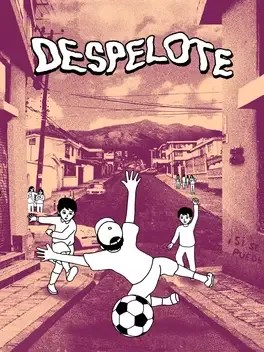
How does one review someone else’s childhood? This is the task presented to me now, having finished Julián Cordero and Sebastian Valbuená’s indie hit, Despelote, a game which tells a slightly re-imagined version of Cordero’s own childhood living in Ecuador during a time of great political and economic strife, which also happened to be a period in which the country’s national identity was bolstered by their football team’s chances at qualifying for the World Cup for the first time in history. This became a unifying event that captured the attention of Ecuador’s people and culture, giving them hope and joy in a time where it seemed (to hear Cordero tell it) in short supply.
Immediately, I was captivated by the game’s art style: a strange and yet comforting mix of photo-realism and black and white cartoonism that not only helps to distinguish which objects are ones you can interact with but also gives the game a unique visual charm that I’ve never encountered before. There is something intimidating about the towering, colorless structures surrounding young Julián, especially since they are presented from the eyes (read: height) of an eight year old boy, but the warm smiles and kind voices of his family, classmates, and various locals around him slip over the experience like a blanket.
The audio of Despelote has a similar quality, with voices speaking authentic Spanish and always sounding natural and close, and with the ambiance of the city’s environments feeling deeply personal and immersive. There are times when it truly felt that I was looking out from Julián’s eyes at a world just as real as the one I inhabit, a feeling that whenever it is encountered in games I consider it to be both astonishing and deeply moving.
And the primary mode of interaction with the game, fittingly, is kicking a soccer ball around, whether its playing with your friends in the schoolyard, exploring the local park and getting into mischief against your mother’s warnings, or playing a beloved video game that everyone seems bound and determined to shut off when you’re in the middle of a match. Man, every kid went through this, huh?
But how does one, review this game in the sense that one assigns quantifiable virtues/flaws to it, the way most reviews are written? How does one give it some kind of qualitative statement that wraps it in a bow as being either a good game or a bad one, a game worth your money or not? It’s a difficult question because the game is so personal, so closely wrapped up in the lives of real people with real experiences, that the lines between the game and reality are so blurred as to become transparent at times.
I don’t think I can say that the game is good or bad. I can say I had a good time with it, and I certainly did. An incredible time, really, one that was meaningful in ways I’m not sure I understand fully, the same way that it is generally meaningful to connect with people, to hear their stories, to tease at the lines that divide us and realize how illusory they really are.
I suppose, what I can say, is that Despelote is authentic and heartfelt in a way that an increasingly corporate world seems ill at odds to handle. And, like my own blurred memories of childhood, it will remain with me for a very long time.
 Vulpes Valentine's Video Game Valley