Tag: clair obscur

  • Clair Obscur and Art as Escape

    Clair Obscur and Art as Escape

    *FULL STORY SPOILERS AHEAD*

    Near the end of Clair Obscur: Expedition 33, there is a pretty major twist. Maelle, the adoptive sister to early-game protagonist Gustave (may he rest in peace) is revealed to be Alicia Desendre, daughter to Renoir and Aline (AKA the Paintress), and sister to Verso and Clea. The game goes a step further to say that not only is Maelle not her real name, but she isn’t even from this reality. This entire world we’ve explored and inhabited for the game, from Lumiere to the Monolith, all the people we’ve met along the way including our own party members, all of them are creations of the enigmatic beings called, the Painters, who can create worlds infused with life to the point that they become indistinguishable from reality. This world is the creation of Verso Desendre, who perished tragically in what appears to be an arson enacted on the family home, and is the last surviving relic of his life.

    The Verso we’ve been traveling with this whole time is actually a fabrication by Aline, who in her grief entered the world of Verso’s Canvas and refused to return to her true family, creating new versions of them to protect her. Renoir, her husband, came in after her to try and bring her home, but the two became locked in an endless battle of wills as Renoir tried to destroy the Canvas from the inside and Aline did everything to protect it. You see, the Paintress doesn’t cause the gommage. She’s been holding it back. But as her power wanes and her sorrow deepens, her grip is slipping and she can no longer contain Renoir.

    The Verso we’ve been playing as (or as Esquie puts it, Verso who is Verso’s cousin) has been working towards a singular goal this entire time: to defeat the Paintress, defeat Renoir (both the painted version and the authentic one) and to destroy the Canvas, dooming this world to obliteration and finally putting an end to this life he does not want, the life of a shadow of a dead man, cursed to immortality and unable to cope with the perceived meaninglessness of his existence.

    Alicia, disfigured by the fire and left with the inability to speak, dove into the Canvas to try and rescue her parents, only to lose her sense of self during the process and wind up trapped there as a new being with none of her memories intact. She is born to new parents, painted ones. She is named Maelle. Her parents gommage and she is raised by Gustave and his sister. She learns to fight, and she becomes and Expeditioner to stop the gommage from ruining their world.

    In this strange, turnabout manner, Alicia has approached the conflict of Aline’s inability to deal with the loss of her son from both sides, and when all becomes clear to her and her memories are restored she remains resolute in this quest with one additional goal: to stop her father from destroying the Canvas, the last piece of Verso’s legacy, this world he created as a young Painter where he would play with Monoco and Esquie who remember him with deep fondness.

    This puts her and Verso in direct conflict with one another, though he refuses to admit what his true endgame is until the last moment.

    After defeating Renoir and convincing him that this Canvas matters, that it ought to be preserved, that mourning Verso does not have to mean either losing oneself to the despair of his death or destroying all evidence of his life. That she can live in this world, and return to her reality. That she can grieve and heal from that grief.

    Verso has other plans, and with his betrayal the true final battle begins, one in which the player is tasked with choosing a side and in doing so must answer a question for them self:

    “How real is this world and its inhabitants? And is it worth preserving? Or is the lure of ultimate escapism to great a temptation to allow one to reckon with?”

    Because one of the main themes behind Clair Obscur is that art is a double-edged sword. It is beautiful. It is terrible. It can take you away from your burdens, but it can also reflect them back at you. It can distract you from your reality, but it can’t save it.

    Art, even video games who go above and beyond in many cases to cement that sense of immersion, that feeling of embodying another person’s experiences, cannot replace your life. Art and creation can enrich it, give it additional meaning, but they cannot erase the fact that you are a material being in a material reality, with pressures both physical and social placed upon you at all times.

    Art is not an escape.

    But it doesn’t have to be.

    If you choose Maelle’s stance, you defeat Verso and remain in the Canvas. Not only that, but you undo the gommage, bringing Gustave and even Sofie back to life. In a deeply haunting cutscene, you see that even Verso has found something to live for, pursuing his true passion, music, and playing before an assembled audience of Lumiere’s citizens including Gustave, Sofie, Lune, Sciel, and Maelle.

    Then a horror movie stinger accompanies an image of Maelle degrading under the effects of remaining in a Canvas too long as a Painter. In the end, she failed to escape her grief not just for Verso but for Gustave as well. She stays here, in this fabricated world, and it is implied that she will never leave. At any time, she has the power to, but she simply won’t.

    And to be clear, while this is deeply tragic for Maelle, I think this is the good ending, at least in terms of being the most positive outcome for the most people. Because when all is said and done, you can argue over what counts as “real” but try playing the beginning of the game, seeing Gustave tell Sofie “I’m here.” as she gommages in his arms, hear her say “I know… I know.” and tell me that their feelings, their experiences, none of that matters because they were creations of someone else.

    Aren’t we creations of our parents? And if you’re a religious individual, aren’t you the fabrication of a divine being?

    It’s hard to define what is “real” because the word means so many different things, but to say that the lives of these people don’t matter and ought to be discarded simply because there exists another plane of being seems… well, deeply bleak.

    Which takes us to Verso’s ending.

    He defeats Alicia and destroys the Canvas, watching as Lune, Sciel, Monoco, and the entire world all fades away. His friends watch him with thinly suppressed hatred as he callously destroys their lives in an instant (Lune’s expression being particularly hard to watch). The Canvas world dissolves and we see a glimpse of Alicia in her real world, standing beside her brother’s grave. She turns to see her friends as an illusory image one last time before they fade away. She can move on, but that grief remains.

    Either ending to this game is heartbreaking. No one comes out of this unscathed, and the player is left with a bitter pill to swallow. Pain is real, it follows you, it lingers, and you can lose yourself to destruction, even that of the self, in order to be free of it, or you can create and create and create anew, hoping each time that this will be what saves you.

    But it won’t.

    That’s not to say we shouldn’t create. We absolutely should! It can help us to heal, can help us to grow and understand ourselves and even cope with the agonies of our reality. Creation, particularly art-making, is one of the things that most gladdens the spirit and pleases the mind, even when the work is difficult. Expression makes one feel the most them self they can feel.

    Art is not an escape.

    But it can help you to be free. At least, for a little while.

    Is that not precious enough to be worth fighting for?
  • Clair Obscur: Expedition 33 Review

    Clair Obscur: Expedition 33 Review

    Some games, particularly those in the RPG genre, take their time to really get the player invested. The worlds can feel so dauntingly large, the number of new proper nouns to learn can leave one confused and turned off. In some cases, whole chunks of the mechanical structure of a game can be locked off until several hours in, and narratives can take their sweet ass time to really get going. It’s so common, that there is a well-known joke in the games community that goes, “the game gets good after x hours” and usually that x is a number in the double digits.

    In Sandfall Interactive’s Clair Obscur: Expedition 33, there was no need to wait, no toughing it out for the good stuff. Within the first 15 minutes, I was deeply intrigued by the setting, invested in the characters’ to the point of deep, gasping sobs when things turned to tragedy, and fully locked in on the satisfying and technically dense combat. It’s been a long time since a game had me so hooked so early on, that I knew immediately that I was going to see this one to the end.

    And I did! Here I am, many hours later with the platinum trophy and enough thoughts to write a whole book on this game, though – for now – I will stick to just this simple essay.

    This will be a spoiler free review, but if you want to go in completely blind I will say these things up front.

    Should you purchase Clair Obscur: Expedition 33? Yes.

    Should you finish Clair Obscur: Expedition 33? Yes.

    Is Clair Obscur: Expedition 33 my current pick for Game of the Year? Absolutely.

    From its opening moments the game’s music, visuals, writing, and voice acting are top-of-the-line. Themes of decay, loss, and perseverance in the face of impossible odds weave elegantly into ideas around child-rearing in a world that will not be able to support future generations. Existential dread is the name of the game here, and yet somehow the characters and the writers of the game find time for some of the most hilarious lines I’ve encountered in an RPG.

    Each character feels has a distinct personality and look which gives the player an immediate sense of their identity, and they are complex and well-realized characters with differing motivations and ideas on the nature of life and the struggles therein. And they somehow all find time to crack jokes, to be intimate with one another, to express doubt, fear, and admiration. To look at the terrors they face with a deeply human combination of abject horror and profound amazement.

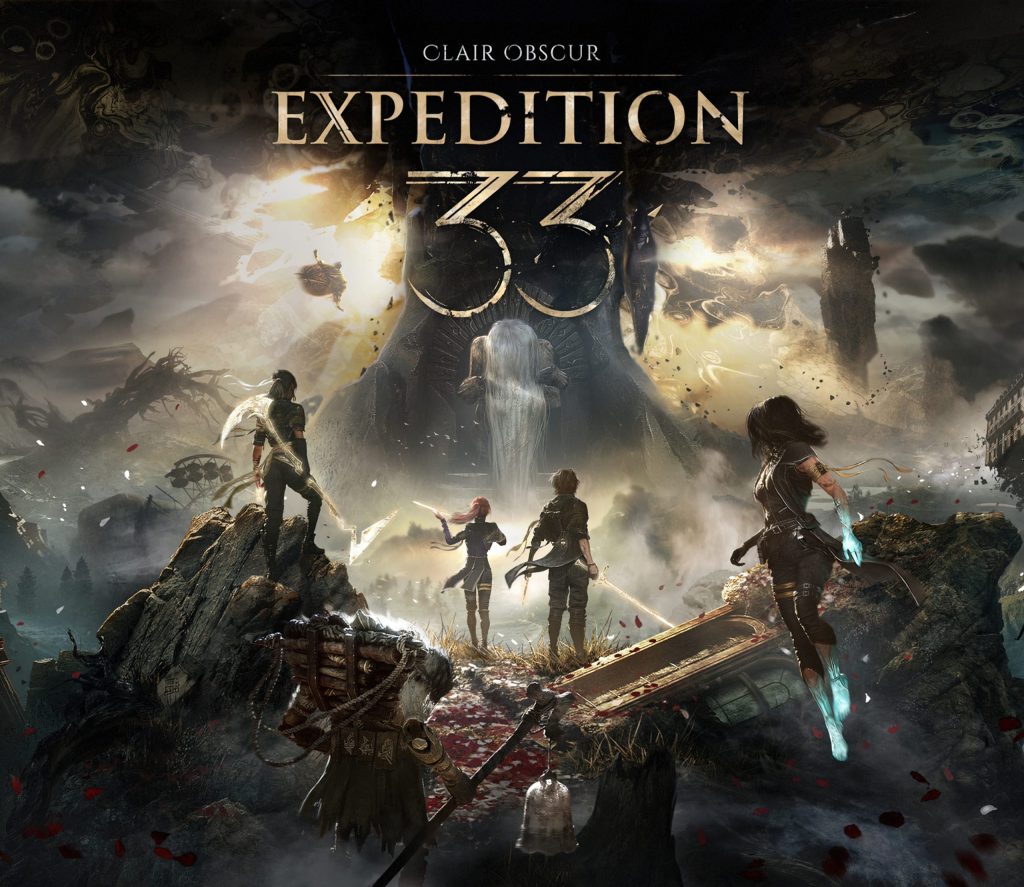
    To put forth the very basic premise of the game, Clair Obscur takes place in a world that was literally fractured: broken into chunks with the land scattered apart and many people left dead or utterly at a loss as to the cause of this calamity. Furthermore, there now stands a great monolith at the far edge of the horizon, impossibly visible from the distant city of Lumiere, where our story begins, and at its base sits a weeping, huddled figure known only as The Paintress. Above her, luminous as the sun, is the number 33.

    This number, as we soon come to realize, refers to a sort of literal deadline for human life. Every year, like some grim holiday, the Paintress paints a new number, sequentially moving downward towards 0, and anyone whose lifespan has passed this limit is near-instantly killed, dissolved into withering flower petals in a process called, gommage (a real life practice of removing dead skin cells). The true terror of this premise is twofold.

    One, every human being knows exactly how long their life has the potential to be.

    And two…

    That number is getting smaller.

    It is an incredible premise, and everything in the first few minutes of the game solidifies the tragedy and complexity of a world living under such bleak and absolute tyranny, exploring the painful realities of child-rearing in a doomed world, questions many of us in our own dying world often come to grips with.

    And it’s only the beginning of this game’s astounding journey, one that is beautiful both in its narrative content, its presentation, and its mechanical cohesion, because Clair Obscur is not only deeply engaging in terms of its story, but in the gameplay as well.

    The game’s combat starts simple: it’s turn-based with a dodge mechanic during enemy attacks that lets you evade incoming damage entirely, or a more precise parry that can result in a powerful counterattack, creating an effective risk vs reward scenario during every enemy turn that never stops being engaging. Add in a light bit of resource management (balancing usage and creation of AP – action points – to use special abilities or fire off ranged attacks to pick at an enemy’s weakness or deal that last little bit of damage to finish them off.

    Right from the outset this is an effective system that keeps the fights interesting and tempts you with that ever-present challenge: “Can I do this without getting hit a single time?” The answer, for every fight in the game’s lengthy runtime, is an emphatic yes. The timing can get tricky, but once you start to internalize the patterns of your enemies’ attacks, the momentum of a fight can shift dramatically in your favor.

    That’s barely scratching the surface.

    Because for all of its many, MANY wonderful aspects, Clair Obscur’s gameplay is primarily focused on the many additional layers to the combat which get added as the game progresses.

    First off, each member of your party has an entirely unique set of skills, weapons (each with unique passive buffs and traits) and equipable powers from the game’s Pictos, which require a limited resource to equip and grant passive or active bonuses and tweaks to the way your characters play. Essentially, these work like badges from the old Paper Mario games, and if you aren’t familiar with those, come back once you’ve played them, you rube. These all combine to give the player a staggering degree of control and depth, creating unique builds which are fun to poke around with and fine tune as the game progresses and more choices become available. The combat becomes so deep that it can start to feel intimidating, and the admittedly poor UI design doesn’t do much to help in that regard. However, mastering the dodges and parries can allow you to brute force your way through combat where your constructed builds aren’t working, and you have an enormous amount of freedom and opportunities to undo potential mistakes in your characters’ advancement.

    Not only that, but each character plays so distinctly from the others, with unique mechanics and specialties. These make them stand out not only in a narrative sense, but in the way they interact with the change how you think about their turns and how they work in tandem with your other party members. This does a lot to foster strong feelings of attachment to your the characters, because not only are they interesting in the way they are presented through writing, visual design, and voice work, but in the way they play to certain strengths and weaknesses.

    For example, the first party member you get is presented as being analogous to a mage in a more traditional fantasy setting (she even floats rather than walking when outside of combat). Suitably, her abilities are all about elemental attacks that can chain together with the elements you’ve used in previous turns to unleash even more devastating attacks or to grant buffs and debuffs that can change the course of a battle in an instant.

    And you can create some seriously incredible combos to deal astronomical amounts of damage. A guide online taught me how to construct three characters to work in tandem so that the game’s most powerful optional boss can be defeated in a mere TWO HITS.

    Incredible.

    I could easily go on for several thousand words about why Clair Obscur’s story and themes are so incredibly well-explored, so powerful and meaningful, so evocative and brilliant and tragic and beautiful…

    But that would be so full of spoilers as to ruin it for those of you that are sensitive to such things, so I will refrain. I will simply leave you with the way I felt upon reaching the credits of Clair Obscur.

    My god. I’ve just finished one of the best games I’ve ever played.