Category: Essay

  • Can I Platinum 2026?

    Can I Platinum 2026?

    I have, let’s call it, a sickness.

    That sickness is that I will play most games until I hit end credits, regardless of when in the process of playing that the experience has become an insufferable nightmare. Worse still, is the hunger deep within me that yearns for the dopamine rush of a platinum trophy. I need them, I dream of them, I make obsessively detailed plans for how to acquire them. I stopped enjoying Ghost of Tsushima about four hours in, but when I peeked at the trophies (a blunder I repeat with every game I buy) I realized just how attainable that platinum trophy was.

    So I got it. Every step of the way I was battling with reason, with decency, with my knowledge that my time on Earth grows shorter with each enemy encampment cleared, with every haiku composed. Was it worth it? Probably not.

    Does my heart gleam with joy when I see that (at time of writing) I have 61 platinum trophies to my name? YES.

    Outside of gaming, I have become a goals oriented person in the last few years. I write to-do lists every day (a useful method of coping with my severe and unmedicated ADHD), that will remind me to do basic things like shower or write an email I’ve been meaning to send, or to spend a few minutes reading or outlining my next post. It’s remarkably effective, and is a practice which I’ve been thinking may lead to some big growth and possible successes in 2026.

    I turned 30 at the tail end of 2025 and with it came a lot of angst but also a sudden drive to get more of my big picture goals out of the way by the time I turn 31. I decided that the best way to achieve these goals would probably be to make a long-term to-do list and check them off one-by-one, breaking them down into a lot of attainable milestones rather than vague, nebulous idealized dreams of success.

    Like… a trophy list.

    <sicko mode engaged>

    So here we are. It’s 2026 and I have only one thing on my mind. Can I platinum the year?

    Below I have organized my goals for the year into the typical trophy categories. Bronze trophies are things that are most likely to just happen with little input or extra effort on my part. Silver trophies take a little more time and energy, and have the potential to be missable by certain deadlines if not adequately planned and prepared for. Gold trophies are the real difficult tasks, things that might not even be up to me and my efforts entirely and may rely partly on a bit of universe-scale RNG.

    Some of these are silly. Some of them are deeply personal. All of them will benefit me in some way.

    Here is how we get there.

    Bronze Trophies

    Wolfing it Down – Read Gene Wolfe’s “The Book of the Long Sun” and “The Book of the Short Sun”

    Simba, Remember – Finish all Elden Ring Nightreign Remembrance Quests

    Not A Waste of Money – Finish my backlog of unwatched DVDs

    Cyber New Type – Watch Mobile Suit Gundam ZZ and the film Char’s Counterattack

    Explorer – Visit 10 previously unvisited local bookstores

    Mysterious Benefactor – Back 5 TTRPG crowdfunding campaigns

    FINAL-LY – Finish and write about all remaining mainline Final Fantasy games

    Cleaning House – Clean out my closet and dressers of old clothes and donate them

    Silver Trophies

    Ooh Shiny – Acquire 15 more Platinum Trophies (how meta!)

    Bookbound – Finish 50 books

    Consistency – Publish a new episode of “Table for Two” every single week

    Number Go Up – Reach 1,000 downloads for “Table for Two”

    Do it For Them – Finish and publish my next game, “For the Flock”

    A Real Game Dev – Reach 50 downloads on itch.io

    Cooking Papa – Cook 20 new recipes from the various cookbooks I received for Christmas

    It’s An Investment – Purchase a Steam Deck

    Gold Trophies

    It’s For Your Own Good – Exercise Daily (at least 10 minutes, work counts)

    People Are Talking About This – Reach 20 patrons on the “Table for Two” Patreon (that’s patreon.com/tablefortwopod)

    Whisper – Publish a short story

    Speak – Publish a novella

    Shout – Complete a first draft of a novel

    Tables Squared – Launch a secondary series on the “Table for Two” feed

    Platinum Trophy

    2026 – The Year of the Celestial Fox – Acquire all other trophies

    So there it is: my trophy list for the year 2026, due no later than 11:59pm on December 31st.

    Wish me luck.

  • Wanderstop and The Necessity of Play

    Wanderstop and The Necessity of Play

    Video games can be their own kind of chore. Free-to-play games laden with micro-transactions will supply dozens of reasons to log in every single day: Daily Login bonuses (which, of course, get better the more days in a row you log in), Daily and Weekly Objectives, Season Passes, Limited Time Banners, the list goes on. They take the structure of a game, typically a turn-based strategy game, an idle game, or an open world game, and hollow out the bones, filling them with ways to empty your wallet and capture your attention and time.

    There is a ghoulish efficiency to it, and a nightmarish level of effectiveness. If you play video games even on the most casual level, there is a solid chance that you’ve given more than $50 to a Fortnite, a Genshin Impact, or even a simple puzzle game on your phone.

    Something that is fun becomes an obligation, which becomes a recurring charge to your credit card. For some people, it leads to bankruptcy and divorce as their time and money are sucked away by the endlessly nagging desire to keep playing: people with impulse control issues, addictive personalities, or loads of free time and few social obligations are usually not only the victims but the intended targets of these games. For the developers that create them, it’s a daily grind of their own. They pump out new content, new mechanics, new features, with such shocking regularity that it’s a wonder their own employees have time to do anything else, and if you know anything at all about video games as an industry you know that they probably don’t.

    Outside of video games, our culture has become obsessed with the notion of the “grindset” AKA hustle culture. If you use any form of social media, you’ve come across this stuff. Hell, if you’ve ever ordered food from Uber Eats or Doordash you’ve brushed elbows with it. There are millions of videos, articles, and podcasts where the focus is how to maximize profits and financial growth in nearly every aspect of your everyday life. How to take your limited time on this Earth and turn it too, like everything else under capitalism, into a venue where the focus is the money coming in and the show is a strictly regimented cookie cutter carbon copy of every other hustler out there. Input money, output slop. Worse than making additional swill for the trough, you can find new and exciting ways to reach into peoples’ pockets while whispering false promises (whether or not you believe them is sort of irrelevant, eh?) about how wealthy they’re going to be, you know, once their money is in your hands. Sure, you can definitely make money driving Uber on the side, just forget that the pay is peanuts, you use your own car (which will require additional gas and maintenance, things not covered by Uber), and its hours upon hours of low physical activity, no social interaction with customers or coworkers to meet those needs, and there’s no way in hell you’re getting insurance out of the deal. Never mind that you need to set aside sufficient time to do any of these “side-hustles”, time that has to magically appear between your more regular job, sleep, your basic bodily needs, and any kind of social life.

    You have been sold a lie. Wealth is not just beyond your grasp. If you weren’t born near it or neck deep in it, you’ll likely never get there, and if you do, take into account that the thousands of coincidences and occurrences specific to your situation and are not universal rules anyone can follow. There are thousands of “self-made millionaires”, if you set aside that they often came from money or were simply close enough to people who were willing to offload some of theirs. Prosperity gospel (the idea that if you are moral and good, money will follow) implies that poverty is a moral failing. If being good turns into financial gain, than what does that say about those who have nothing? Are they too wicked to deserve an income, a home, food?

    Wealth can solve some problems, but happiness isn’t bought or made in a factory, and fulfillment takes more time to find than you might ever give yourself to find it. You can’t sweat and grind away the days to become a full person. It’s not one simple trick away. If it was, everyone would do it, and… well, does it look like everyone is doing it? Diamonds are made at great depths, not on the surface.

    “I’m different,” you think. “I’m stronger, smarter, more committed. This is my life’s ambition, the key that will unlock the whole thing. This is who I am.”

    And then, life is in the past. Where did the time go? You used it up. Existence is material: we use things and they are gone. One minus one is zero.

    Did it work? Did you find what you were looking for?

    Are you whole?

    … I promise this is about a video game.

    Wanderstop is the newest game from writer and designer Davey Wreden, who you might know from his sensational hit The Stanley Parable or it’s less popular but still excellent (I’m told) follow up, The Beginner’s Guide.

    In it, you take on the role of Alta, a woman living in a fantasy world (think knights and dragons but also smartphones for some reason?) who has spent her entire young life training to be the world’s greatest fighter. She spent months with a blacksmith helping them forge the perfect sword. For years, she traveled the world and competed in tournaments, roundly defeating every foe that stood in her way and becoming the greatest champion of all time, a beast with a blade on a winning streak that felt seemed endless. This was everything she wanted. This was what gave her life purpose.

    Then, before the game has even begun, she lost.

    So she pulled herself back up. She trained harder than ever before, forced herself to work more diligently, to study technique, to get back on top and-

    Then she lost again. And again. And again. Each defeat more crushing, more humiliating than the one before it.

    When the game properly begins, she is racing through a strange and magical forest in search of someone who can help her reclaim her glory, but instead she starts experiencing anxiety attacks which leave her debilitated. Her sword grows impossibly heavy and falls to the grassy floor, and she follows it shortly after, as she loses consciousness.

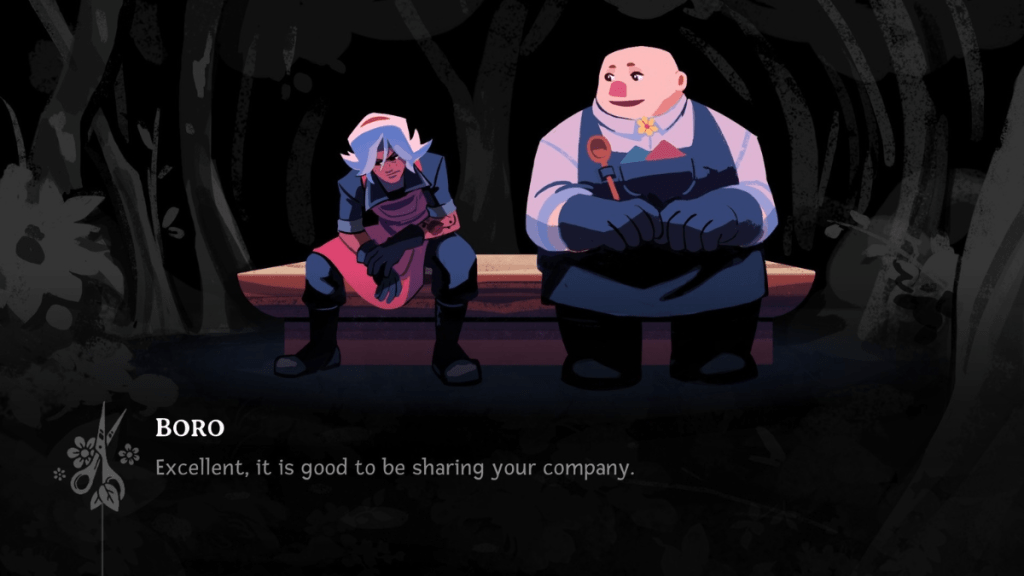
    A large man finds her, and when she wakes up he has brought her to the safety of a pleasant clearing. He introduces himself as Boro, the owner of a teashop called Wanderstop situated in the clearing. He speaks to Alta gently and with bottomless compassion, in spite of your ability to respond in the following ways: biting sarcasm or begrudging indifference. Seriously, she is such a bitch and I LOVE her.

    In spite of this, Boro offers her some tea and invites her to stay a while and relax. He’s brought her sword to the clearing, but she remains unable to move it even an inch. “In the meantime,” he says, “Why doesn’t Miss Alta help me with the shop?”

    And, in spite of her protestations, that is exactly what you do.

    You trim the bushes, gather herbs, collect mushrooms, talk to customers, decorate the shop, and (obviously) make tea. At first glance, this seems entirely unremarkable. There are literally hundreds of games about running a small business in a fantastical setting. I could name over a dozen right now off the top of my head.

    (Actually, let me do that. Moonlighter, Stardew Valley, Harvest Moon, Story of Seasons, Graveyard Keeper, Animal Crossing Happy Home Designer, Fantasy Life, Tavern Keeper… ok you get it.)

    A simple difference changes everything, and it’s a design choice completely in sync with the themes of the game.

    Alta can, at any time, ask Boro what she should be doing. Boro will always answer with the same response. “Miss Alta can do anything she likes.”

    You don’t HAVE to garden. You don’t HAVE to tidy up. You don’t even HAVE to make tea! You can, if you feel so inclined, throw an entire potted plant in into the mixture and drink that, or serve it to your customers. They won’t like it all that much, but there’s no money you have to manage, no reputation points or experience points. No skills, no leveling up.

    You just do what feels right.

    As Alta gets to know the customers who wander in and out of the clearing, she learns about their struggles and fears. One of the becomes afflicted with a magical curse, another hides her insecurities behind delusions of being an incredible businesswoman in spite of having (checking my notes here) zero customers. After a certain point, Alta even starts to open up about her own anxieties. But at eventually, each customer leaves and never returns, sometimes in what feels like the middle of a story rather than the end. When this causes Alta to worry, Boro gives her an important piece of wisdom. “I need you to know that everyone has their own story, and sometimes you won’t be there for all of it, even if you care.” You can’t save everyone. This isn’t the kind of a game where every character is reduced to a series of objectives. You’re not always there when you’re needed, and you’re not always needed to begin with.

    You are yourself with all of your own fears, your own regrets, your own desires. At times, it can seem like a lot, like a weight you can’t lift no matter how much force or how much will you put in.

    But you can relax. You can take time to reflect, to think about what it is that you want and who it is that you are. Who you want to be. What defines you? How have you failed, and are those failures really so existentially devastating as they feel? Alta spends a lot of the game blaming other people, blaming herself most of all, but it’s only towards the end that she starts to think forward rather than backwards.

    You can’t keep going all the time. You can’t define yourself by one thing you’ve done, one passion you’ve followed, one dream achieved or abandoned. To do so is a profound disservice to what it means to be a fucked up, beautiful, and infinitely strange human being.

    Sometimes, you need to sit down. You need to stop running towards something.

    Sometimes, what you really need is to just drink some tea.

  • You are God / You are the Devil – Analyzing Indika

    You are God / You are the Devil – Analyzing Indika

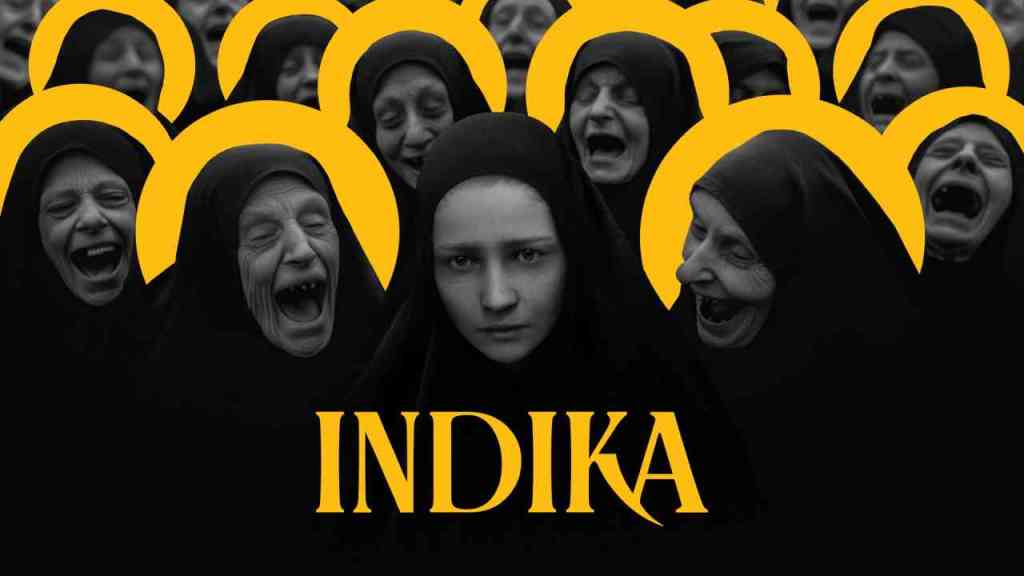
    I’m going to talk about the end of Indika, a surreal indie game from Russian developer Odd Meter about a nun who leaves her cloister on an errand which turns into a psychedelic adventure in search of a miracle. It’s an interesting game, and it only takes about 4 hours to complete, so if you haven’t checked it out and you feel even an inkling of interest, I encourage you to stop reading this and go play it. Full spoilers begin now.

    Indika(the character, not the game) is a young nun living in a remote convent who is… not exactly popular with the sisters. She is regularly treated as burdensome, a nuisance, and it is quickly revealed that this is because Indika harbors a dark connection to what she (and likely others) believes is the Devil himself, resulting in strange visions that blur her sense of reality and cause her to act in ways that are disturbing to others. As the player controlling her and experiencing the world from her perspective, you hear the voice of the Devil speaking to you directly, and speaking to Indika, taunting her with the language of anxiety, pulling on her fears and insecurities at every opportunity. He mocks her, tells her that the sisters have nothing but contempt for her, and whittles away at the foundations of her faith with questions of logic and philosophy.

    There are even segments throughout where reality fractures and turn a hellish red. His voice becomes louder than all other sounds, drowning Indika in his laughter, his mockery, all on a loop which plays over and over until she can at last silence him through prayer and perseverance. She clings to faith, even as he breaks her platitudes and scripture apart with nothing shy of glee.

    Along the way, Indika encounters a man named Ilya, an escaped convict with a diseased arm that is at risk of killing him via sepsis. He tells her that he has heard messages from God since the arm became infected, telling him to go to the town of Spasov where a relic of the church called the Kudets is being shown to the faithful so they may pray at it and ask for miracles of their own. The voice of God, which the player does not hear, insists that he must not treat his injury, that only the Kudets will heal him. Ilya is a believer, and Indika takes a liking to him. He’s honest, upfront, and relentlessly dedicated to his quest.

    However, as their time together continues, Indika does not revel in their shared faith. Quite the opposite, in fact. She shares with him some of the ideas the voice in her head has spoken to her, sometimes in the form of questions and others as direct statements. It’s clear that she is searching for some kind of exchange, some kind of reassurance from Ilya, yet he offers very little, remaining focused on the immediate dangers they’re facing and the task he’s been given by God.

    During a quiet moment following a rather harrowing trek through a fish cannery, Ilya falls unconscious. Indika, with some medical education, believes that the arm will kill him unless it is removed at once. Unable to watch him die, and in direct contrast with his wishes, with the supposed word of God, she amputates.

    Ilya awakens and is horrified at what she has done. He chastises her, and seems not only outraged but deeply sorrowful, feeling like his journey has been for nothing, that he has betrayed God. The normally talkative man becomes quiet, resigned. Yet, this game’s surreal elements remain at the forefront.

    His severed arm, which he has slung across his back in the sling which had held it steady all this time, is still moving. It points, it gestures, it closes into a fist. And despite believing he has disobeyed the word of God, Ilya persists. He chases the Kudets still. In spite of everything, he still wants a miracle.

    Indika’s final sequence feels truly cinematic. Following a dramatic few scenes where they beg the local priest of Spasov to let them behold the Kudets, only for Ilya and Indika to be accosted by the authorities on account of his being, you know, an escaped convict, the priest is shot in the ensuing chaos and Indika is held responsible while Ilya manages to escape.

    While in prison, the devil’s voice haunts Indika, and an offer is made. Not the kind of Faustian contract one might expect, not even really any kind of exchange. He simply instructs her to let him help her escape. The specific means are obscured, but Indika overpowers the guard and escapes the prison to go in search of Ilya.

    Abruptly, the perspective changes. The whole game, we’ve been playing from a third person point-of-view, but without warning we are brought inside Indika’s head in a physical sense, changing to a first person viewpoint as she walks the muddy streets of Spasov and finds Ilya outside a cramped pawn shop. He is drunk. He stole and pawned the Kudets for a measly sum which he traded for an instrument he plays with the expected low skill level. His quest was fulfilled and abandoned in almost the same moment. No miracle saved his arm or his life. He’s a drunk, wasting his freedom and now in greater trouble than ever.

    Was it spiritual guidance which led him to the Spasov? Or was it just a physical impulse? Something purely internal? The arm being somewhat alive shows us that there might not be a difference. Even when cut from the body, when it becomes an external object, little about the arm changes. The force outside of him and the drive within were always the same.

    Indika enters the pawn shop, asking for the Kudets, a request the pawnbroker quickly denies. Ilya reenters and causes a commotion, outraged over the instrument he was sold, insisting he was scammed. In the confusion, Ilya grabs the Kudets and…

    And nothing. Nothing happens. What did she think would happen? Did she even have an idea? The faintest imagining? Was this to be the ascendant moment for her faith? Where all doubts were dashed away and God would reveal himself to her, fully and beyond questioning? Would the voice inside at last be silenced?

    Indika opens the relic and finds that it is empty. She falls to the floor, her prayer beads shattering as they slip from her grasp. Looking up, she is face-to-face with a mirror, but the only thing staring back at her is the demon. The one that has been with her all along.

    Its voice takes over, another one of its lectures on faith and morality while she tries to argue in vain. She slips away from reality, into an abstract space where she is literally and emotionally spiraling downward, lost.


    And we are returned to the beginning of the game, to the strange mini-game with the falling woman. Because the adventure didn’t change anything for Indika.

    She’s always had this doubt, this demon inside. From the start it was an internal force, an entity within her being, part and parcel.

    Indika suggests that, bleak as it may be, perhaps there is no God to count on for miracles, and no Devil to torment you into sin. Maybe God and the Devil aren’t even different. Maybe there’s just us.

  • Clair Obscur and Art as Escape

    Clair Obscur and Art as Escape

    *FULL STORY SPOILERS AHEAD*

    Near the end of Clair Obscur: Expedition 33, there is a pretty major twist. Maelle, the adoptive sister to early-game protagonist Gustave (may he rest in peace) is revealed to be Alicia Desendre, daughter to Renoir and Aline (AKA the Paintress), and sister to Verso and Clea. The game goes a step further to say that not only is Maelle not her real name, but she isn’t even from this reality. This entire world we’ve explored and inhabited for the game, from Lumiere to the Monolith, all the people we’ve met along the way including our own party members, all of them are creations of the enigmatic beings called, the Painters, who can create worlds infused with life to the point that they become indistinguishable from reality. This world is the creation of Verso Desendre, who perished tragically in what appears to be an arson enacted on the family home, and is the last surviving relic of his life.

    The Verso we’ve been traveling with this whole time is actually a fabrication by Aline, who in her grief entered the world of Verso’s Canvas and refused to return to her true family, creating new versions of them to protect her. Renoir, her husband, came in after her to try and bring her home, but the two became locked in an endless battle of wills as Renoir tried to destroy the Canvas from the inside and Aline did everything to protect it. You see, the Paintress doesn’t cause the gommage. She’s been holding it back. But as her power wanes and her sorrow deepens, her grip is slipping and she can no longer contain Renoir.

    The Verso we’ve been playing as (or as Esquie puts it, Verso who is Verso’s cousin) has been working towards a singular goal this entire time: to defeat the Paintress, defeat Renoir (both the painted version and the authentic one) and to destroy the Canvas, dooming this world to obliteration and finally putting an end to this life he does not want, the life of a shadow of a dead man, cursed to immortality and unable to cope with the perceived meaninglessness of his existence.

    Alicia, disfigured by the fire and left with the inability to speak, dove into the Canvas to try and rescue her parents, only to lose her sense of self during the process and wind up trapped there as a new being with none of her memories intact. She is born to new parents, painted ones. She is named Maelle. Her parents gommage and she is raised by Gustave and his sister. She learns to fight, and she becomes and Expeditioner to stop the gommage from ruining their world.

    In this strange, turnabout manner, Alicia has approached the conflict of Aline’s inability to deal with the loss of her son from both sides, and when all becomes clear to her and her memories are restored she remains resolute in this quest with one additional goal: to stop her father from destroying the Canvas, the last piece of Verso’s legacy, this world he created as a young Painter where he would play with Monoco and Esquie who remember him with deep fondness.

    This puts her and Verso in direct conflict with one another, though he refuses to admit what his true endgame is until the last moment.

    After defeating Renoir and convincing him that this Canvas matters, that it ought to be preserved, that mourning Verso does not have to mean either losing oneself to the despair of his death or destroying all evidence of his life. That she can live in this world, and return to her reality. That she can grieve and heal from that grief.

    Verso has other plans, and with his betrayal the true final battle begins, one in which the player is tasked with choosing a side and in doing so must answer a question for them self:

    “How real is this world and its inhabitants? And is it worth preserving? Or is the lure of ultimate escapism to great a temptation to allow one to reckon with?”

    Because one of the main themes behind Clair Obscur is that art is a double-edged sword. It is beautiful. It is terrible. It can take you away from your burdens, but it can also reflect them back at you. It can distract you from your reality, but it can’t save it.

    Art, even video games who go above and beyond in many cases to cement that sense of immersion, that feeling of embodying another person’s experiences, cannot replace your life. Art and creation can enrich it, give it additional meaning, but they cannot erase the fact that you are a material being in a material reality, with pressures both physical and social placed upon you at all times.

    Art is not an escape.

    But it doesn’t have to be.

    If you choose Maelle’s stance, you defeat Verso and remain in the Canvas. Not only that, but you undo the gommage, bringing Gustave and even Sofie back to life. In a deeply haunting cutscene, you see that even Verso has found something to live for, pursuing his true passion, music, and playing before an assembled audience of Lumiere’s citizens including Gustave, Sofie, Lune, Sciel, and Maelle.

    Then a horror movie stinger accompanies an image of Maelle degrading under the effects of remaining in a Canvas too long as a Painter. In the end, she failed to escape her grief not just for Verso but for Gustave as well. She stays here, in this fabricated world, and it is implied that she will never leave. At any time, she has the power to, but she simply won’t.

    And to be clear, while this is deeply tragic for Maelle, I think this is the good ending, at least in terms of being the most positive outcome for the most people. Because when all is said and done, you can argue over what counts as “real” but try playing the beginning of the game, seeing Gustave tell Sofie “I’m here.” as she gommages in his arms, hear her say “I know… I know.” and tell me that their feelings, their experiences, none of that matters because they were creations of someone else.

    Aren’t we creations of our parents? And if you’re a religious individual, aren’t you the fabrication of a divine being?

    It’s hard to define what is “real” because the word means so many different things, but to say that the lives of these people don’t matter and ought to be discarded simply because there exists another plane of being seems… well, deeply bleak.

    Which takes us to Verso’s ending.

    He defeats Alicia and destroys the Canvas, watching as Lune, Sciel, Monoco, and the entire world all fades away. His friends watch him with thinly suppressed hatred as he callously destroys their lives in an instant (Lune’s expression being particularly hard to watch). The Canvas world dissolves and we see a glimpse of Alicia in her real world, standing beside her brother’s grave. She turns to see her friends as an illusory image one last time before they fade away. She can move on, but that grief remains.

    Either ending to this game is heartbreaking. No one comes out of this unscathed, and the player is left with a bitter pill to swallow. Pain is real, it follows you, it lingers, and you can lose yourself to destruction, even that of the self, in order to be free of it, or you can create and create and create anew, hoping each time that this will be what saves you.

    But it won’t.

    That’s not to say we shouldn’t create. We absolutely should! It can help us to heal, can help us to grow and understand ourselves and even cope with the agonies of our reality. Creation, particularly art-making, is one of the things that most gladdens the spirit and pleases the mind, even when the work is difficult. Expression makes one feel the most them self they can feel.

    Art is not an escape.

    But it can help you to be free. At least, for a little while.

    Is that not precious enough to be worth fighting for?