There are many reasons not to finish a game. For working adults like myself, free time is a luxury I can rarely afford, and I’d rather spend it playing a game that is interesting or exceptionally fun than one that isn’t really grabbing me. In other cases, a game can simply fail to entertain me at all, or can even go so far as to leave me irritated, frustrated, or disappointed.
Or maybe I once tried getting into a gacha game and watched hundreds of dollars slip from my bank account before I grabbed hold of the emergency release lever and deleted the game, and now I have to live in fear of micro-transactions or other exploitative practices prevalent in the industry, sometimes starting to play whatever new, flashy game comes out only to run in abject terror the first time it asks you to pay $10 for blupee gems or bing-bong crystals.
Just as a general example.
Here on The DNF Report (DNF standing for Did Not Finish), I seek to work through why certain games fell apart like sand in a windstorm, losing my attention and ending up on the pile of games whose endings I will never reach.
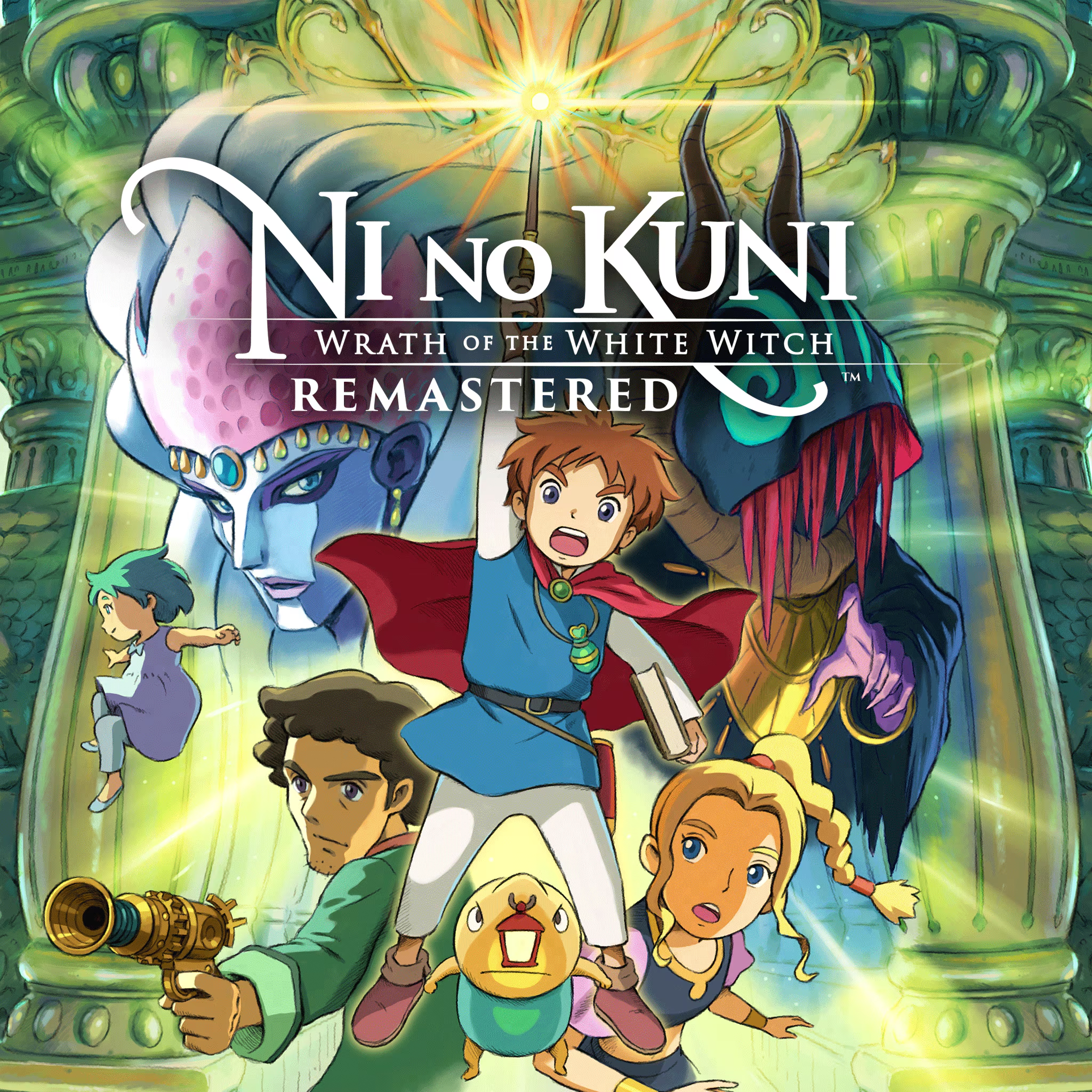
To inaugurate this new series, let’s take a look at my most recent DNF, Ni No Kuni: Wrath of the White Witch.
This game has been out for several years now, but I somehow remained mostly unaware of the specifics. I knew the big selling point: that the art and many cutscenes were lovingly designed in collaboration with the highly acclaimed Studio Ghibli, famous for such movies as Spirited Away and Howl’s Moving Castle. I was also vaguely aware going in that it was designed in the style of classic Japanese RPGs.
What I didn’t know, importantly, is that it is boring.
There’s something to be said about what it means to be a game “for kids” in the modern era, where games designed to be appealing to kids are often full of collection plate passing tactics like custom skins, battle passes, gacha pulls, etc. These games tend to be flashy, aimed at producing the most consistent dopamine hits that the medium can offer, and fast-paced to prevent kids from getting bored. And while Ni No Kuni is most definitely a game that seems eager to appeal to children, it is shockingly dull and slow-paced.
The game’s basic premise is very familiar. A young boy in a humble town embarks on an adventure to magical world living in parallel to his own, guided by a jovial companion (in this case, a smart-mouthed fairy named Drippy), whereupon he fights monsters, an evil sorcerer, and teams up with additional allies he encounters along the way. There is a lot of charm in the early hours of the game, from the pleasant visuals to the inoffensive (but certainly insignificant) music which evokes a sort of classic ideal of fantasy stories for children. Characters tell jokes, there are anthropomorphic animal folk, and the action of combat is bloodless and cartoonish.
It’s also, despicably clunky.
You never feel like you have enough time to react to the attacks of enemies, as combat is set in a strange combination of active time and turn-based styles that more often than not leaves you on the back foot, reacting instead of pushing the enemy into a corner and committing to attacks that often leave you vulnerable to a swift pummeling. To summarize, the members of your party can fight as themselves, or send familiars to fight in their place. These familiars are admittedly charming in their visual design, evoking a sort of Pokemon/Digimon sort of style, and they function similarly to the monsters in those games, having elemental weaknesses and resistances, a set number of special movies to use in combat, and even evolution paths that change their form and grant them new abilities. The familiars are the same monsters you fight on your journey, but a random roll upon defeating a monster can grant you the opportunity to claim them for your party’s collection.
When I first encountered the familiars, I was sort of surprised. I hadn’t expected this kind of gameplay, but I was open to it and kind of interested to see what the different monsters would play like.
It didn’t take long to find out that the system is needlessly complicated and clumsy. You have to feed them to up their stats, with specific kinds of food granting specific upgrades. But don’t feed them too much or they get full and can’t eat anymore! And don’t raise their abilities with food too far, because there is a hard limit to how much they can increase their stats! And don’t let them get stronger without evolving them because they drop back to level one when entering a new form, leaving them almost always weaker than they were before with the promise of long-term benefits, benefits that never feel meaningful because you are (most likely) continuing to advance through the game and therefore encountering harder and more dangerous monsters that will wallop on your poor little under-leveled creatures with precision and brutality.
And there are hundreds to collect but your party members can only hold 3! And for some reason, THEY ALL SHARE THE SAME HEALTH AND MANA. This means that if you send one familiar out and find that they’re getting absolutely stomped by the enemies you’re fighting, you have no recourse but to use items or spells to heal before you can switch to another creature, but that mana could have been better used on the other familiar if you had sent them out in the first place.
Battles are also more often than not unavoidable, and enemies work with much more focus and aggression than you (and certainly more than a child for whom this might be their first RPG) can manage with the clumsy controls and interface.
The story does even less to keep the player interested. The problems your party must solve are often connected to one of the game’s main antagonists only in a vague way, and the only real thread tying the events of the game together are the machinations of the aforementioned White Witch, whom you get remarkably far into the game before learning ANYTHING about. The dungeons are boring and might as well be gray hallways for as fun as they are to traverse.
And I unfortunately got very far into the game before finally reaching the conclusion that it wasn’t going to suddenly get better. For all of protagonist Oliver’s magical acumen, he couldn’t make the game entertaining.
He also can’t move at higher speeds than a brisk walk. Oliver, I have to work tomorrow! MOVE!!
 Vulpes Valentine's Video Game Valley