Video games can be their own kind of chore. Free-to-play games laden with micro-transactions will supply dozens of reasons to log in every single day: Daily Login bonuses (which, of course, get better the more days in a row you log in), Daily and Weekly Objectives, Season Passes, Limited Time Banners, the list goes on. They take the structure of a game, typically a turn-based strategy game, an idle game, or an open world game, and hollow out the bones, filling them with ways to empty your wallet and capture your attention and time.
There is a ghoulish efficiency to it, and a nightmarish level of effectiveness. If you play video games even on the most casual level, there is a solid chance that you’ve given more than $50 to a Fortnite, a Genshin Impact, or even a simple puzzle game on your phone.
Something that is fun becomes an obligation, which becomes a recurring charge to your credit card. For some people, it leads to bankruptcy and divorce as their time and money are sucked away by the endlessly nagging desire to keep playing: people with impulse control issues, addictive personalities, or loads of free time and few social obligations are usually not only the victims but the intended targets of these games. For the developers that create them, it’s a daily grind of their own. They pump out new content, new mechanics, new features, with such shocking regularity that it’s a wonder their own employees have time to do anything else, and if you know anything at all about video games as an industry you know that they probably don’t.
Outside of video games, our culture has become obsessed with the notion of the “grindset” AKA hustle culture. If you use any form of social media, you’ve come across this stuff. Hell, if you’ve ever ordered food from Uber Eats or Doordash you’ve brushed elbows with it. There are millions of videos, articles, and podcasts where the focus is how to maximize profits and financial growth in nearly every aspect of your everyday life. How to take your limited time on this Earth and turn it too, like everything else under capitalism, into a venue where the focus is the money coming in and the show is a strictly regimented cookie cutter carbon copy of every other hustler out there. Input money, output slop. Worse than making additional swill for the trough, you can find new and exciting ways to reach into peoples’ pockets while whispering false promises (whether or not you believe them is sort of irrelevant, eh?) about how wealthy they’re going to be, you know, once their money is in your hands. Sure, you can definitely make money driving Uber on the side, just forget that the pay is peanuts, you use your own car (which will require additional gas and maintenance, things not covered by Uber), and its hours upon hours of low physical activity, no social interaction with customers or coworkers to meet those needs, and there’s no way in hell you’re getting insurance out of the deal. Never mind that you need to set aside sufficient time to do any of these “side-hustles”, time that has to magically appear between your more regular job, sleep, your basic bodily needs, and any kind of social life.
You have been sold a lie. Wealth is not just beyond your grasp. If you weren’t born near it or neck deep in it, you’ll likely never get there, and if you do, take into account that the thousands of coincidences and occurrences specific to your situation and are not universal rules anyone can follow. There are thousands of “self-made millionaires”, if you set aside that they often came from money or were simply close enough to people who were willing to offload some of theirs. Prosperity gospel (the idea that if you are moral and good, money will follow) implies that poverty is a moral failing. If being good turns into financial gain, than what does that say about those who have nothing? Are they too wicked to deserve an income, a home, food?
Wealth can solve some problems, but happiness isn’t bought or made in a factory, and fulfillment takes more time to find than you might ever give yourself to find it. You can’t sweat and grind away the days to become a full person. It’s not one simple trick away. If it was, everyone would do it, and… well, does it look like everyone is doing it? Diamonds are made at great depths, not on the surface.
“I’m different,” you think. “I’m stronger, smarter, more committed. This is my life’s ambition, the key that will unlock the whole thing. This is who I am.”
And then, life is in the past. Where did the time go? You used it up. Existence is material: we use things and they are gone. One minus one is zero.
Did it work? Did you find what you were looking for?
Are you whole?
… I promise this is about a video game.
Wanderstop is the newest game from writer and designer Davey Wreden, who you might know from his sensational hit The Stanley Parable or it’s less popular but still excellent (I’m told) follow up, The Beginner’s Guide.
In it, you take on the role of Alta, a woman living in a fantasy world (think knights and dragons but also smartphones for some reason?) who has spent her entire young life training to be the world’s greatest fighter. She spent months with a blacksmith helping them forge the perfect sword. For years, she traveled the world and competed in tournaments, roundly defeating every foe that stood in her way and becoming the greatest champion of all time, a beast with a blade on a winning streak that felt seemed endless. This was everything she wanted. This was what gave her life purpose.
Then, before the game has even begun, she lost.
So she pulled herself back up. She trained harder than ever before, forced herself to work more diligently, to study technique, to get back on top and-
Then she lost again. And again. And again. Each defeat more crushing, more humiliating than the one before it.
When the game properly begins, she is racing through a strange and magical forest in search of someone who can help her reclaim her glory, but instead she starts experiencing anxiety attacks which leave her debilitated. Her sword grows impossibly heavy and falls to the grassy floor, and she follows it shortly after, as she loses consciousness.
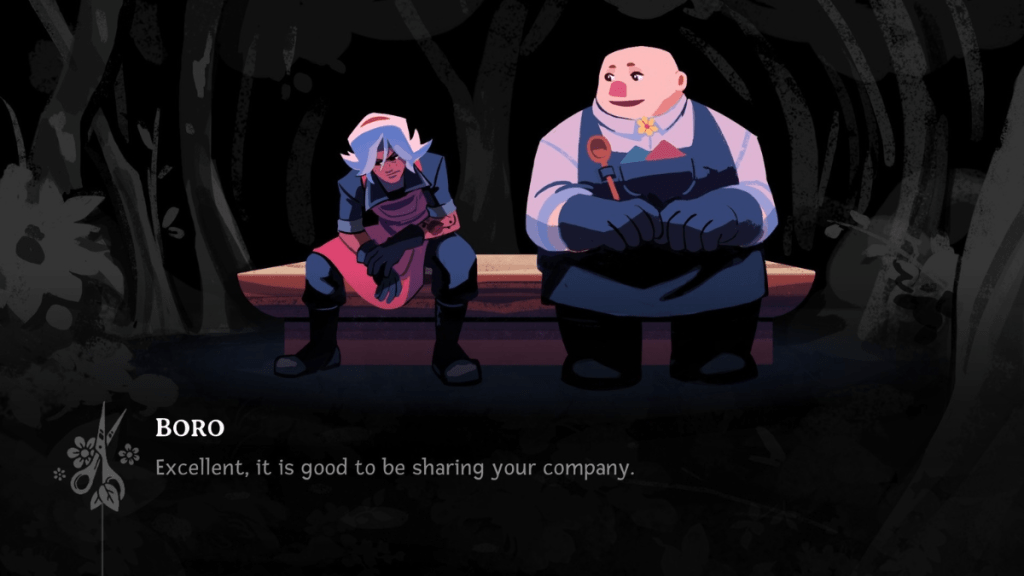
A large man finds her, and when she wakes up he has brought her to the safety of a pleasant clearing. He introduces himself as Boro, the owner of a teashop called Wanderstop situated in the clearing. He speaks to Alta gently and with bottomless compassion, in spite of your ability to respond in the following ways: biting sarcasm or begrudging indifference. Seriously, she is such a bitch and I LOVE her.
In spite of this, Boro offers her some tea and invites her to stay a while and relax. He’s brought her sword to the clearing, but she remains unable to move it even an inch. “In the meantime,” he says, “Why doesn’t Miss Alta help me with the shop?”
And, in spite of her protestations, that is exactly what you do.
You trim the bushes, gather herbs, collect mushrooms, talk to customers, decorate the shop, and (obviously) make tea. At first glance, this seems entirely unremarkable. There are literally hundreds of games about running a small business in a fantastical setting. I could name over a dozen right now off the top of my head.
(Actually, let me do that. Moonlighter, Stardew Valley, Harvest Moon, Story of Seasons, Graveyard Keeper, Animal Crossing Happy Home Designer, Fantasy Life, Tavern Keeper… ok you get it.)
A simple difference changes everything, and it’s a design choice completely in sync with the themes of the game.
Alta can, at any time, ask Boro what she should be doing. Boro will always answer with the same response. “Miss Alta can do anything she likes.”
You don’t HAVE to garden. You don’t HAVE to tidy up. You don’t even HAVE to make tea! You can, if you feel so inclined, throw an entire potted plant in into the mixture and drink that, or serve it to your customers. They won’t like it all that much, but there’s no money you have to manage, no reputation points or experience points. No skills, no leveling up.
You just do what feels right.
As Alta gets to know the customers who wander in and out of the clearing, she learns about their struggles and fears. One of the becomes afflicted with a magical curse, another hides her insecurities behind delusions of being an incredible businesswoman in spite of having (checking my notes here) zero customers. After a certain point, Alta even starts to open up about her own anxieties. But at eventually, each customer leaves and never returns, sometimes in what feels like the middle of a story rather than the end. When this causes Alta to worry, Boro gives her an important piece of wisdom. “I need you to know that everyone has their own story, and sometimes you won’t be there for all of it, even if you care.” You can’t save everyone. This isn’t the kind of a game where every character is reduced to a series of objectives. You’re not always there when you’re needed, and you’re not always needed to begin with.
You are yourself with all of your own fears, your own regrets, your own desires. At times, it can seem like a lot, like a weight you can’t lift no matter how much force or how much will you put in.
But you can relax. You can take time to reflect, to think about what it is that you want and who it is that you are. Who you want to be. What defines you? How have you failed, and are those failures really so existentially devastating as they feel? Alta spends a lot of the game blaming other people, blaming herself most of all, but it’s only towards the end that she starts to think forward rather than backwards.
You can’t keep going all the time. You can’t define yourself by one thing you’ve done, one passion you’ve followed, one dream achieved or abandoned. To do so is a profound disservice to what it means to be a fucked up, beautiful, and infinitely strange human being.
Sometimes, you need to sit down. You need to stop running towards something.
Sometimes, what you really need is to just drink some tea.
 Vulpes Valentine's Video Game Valley