Folks, we’re back.
What a rollercoaster this has been. Five games into the series and we’ve seen some of the highest highs and the lowest lows, and at the heart of it all are ideas and questions surrounding the core identity of the RPG as a genre: narrative, or rather, how can narrative can be conveyed through the structure of a game.
Final Fantasy I gave you a world and took its hands mostly off the reigns as far as your player characters go. That freedom can feel empty if you’re not willing to fill the spaces left with your imagination, the same way we can imagine a handful of colored squares on a TV screen are a dragon.
Final Fantasy II grabbed you by the wrists and dragged you through a lifeless story while trudging through the death by a thousand cuts that is the gameplay.
Final Fantasy III restored balance to the Force, giving you mechanical expression through the Jobs system and telling a (mostly boring, yes) story that focused on how your characters propel events forward.
Final Fantasy IV took an odd back-step, trying to tell a more structured, focused story with almost no chance to express your own narrative through gameplay. The presentation was better, characters underwent arcs, but neither half of the experience felt fully coherent or enjoyable enough to really take my breath away.
Now we have arrived. Final Fantasy V takes the series’ innovations and iterations, its confident strides and its clumsy staggers, and reaches newfound heights in nearly every aspect of the experience.
So why am I so bored?
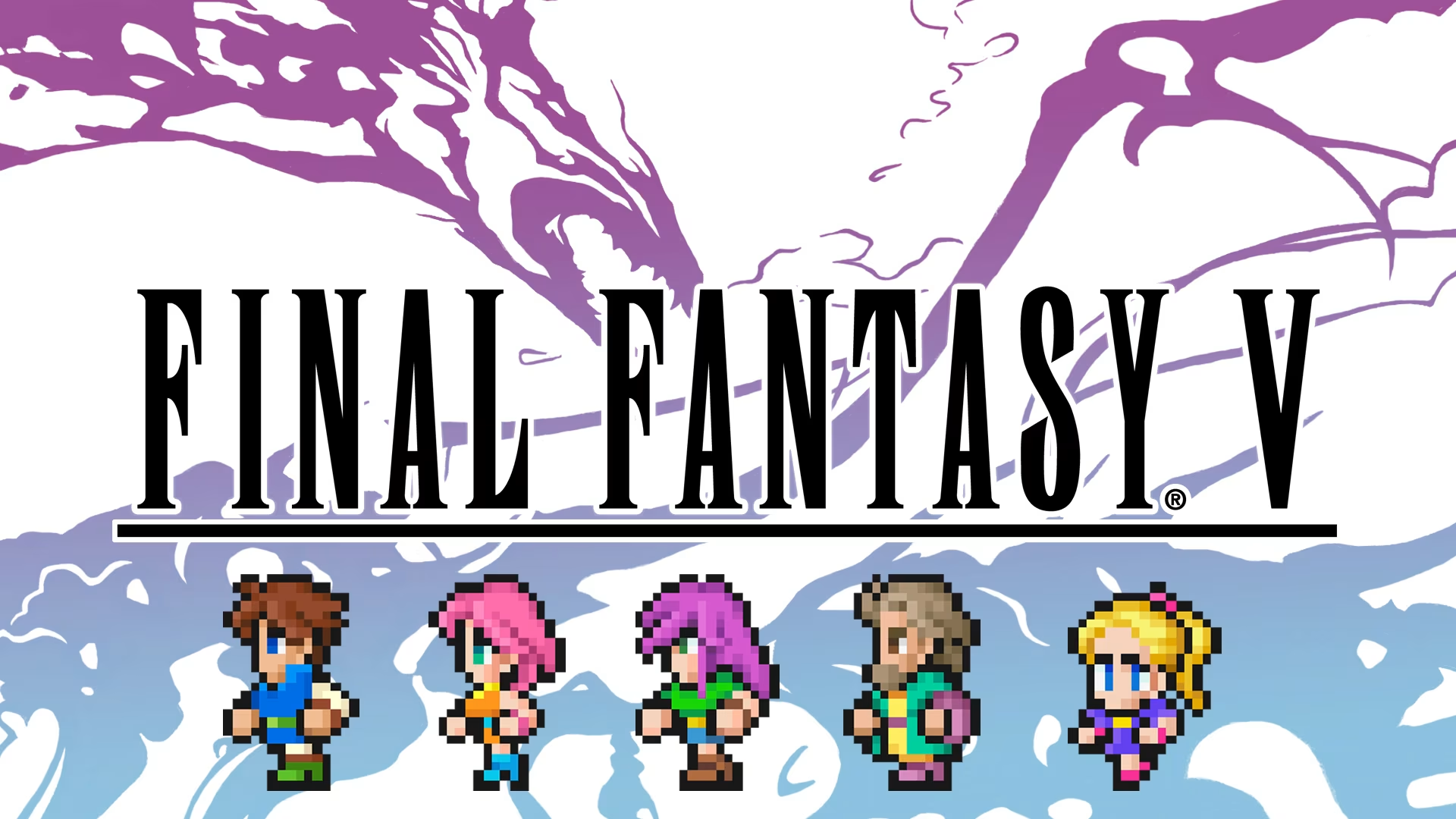
Starting from the beginning, we are introduced to our main cast in fairly quick succession: Bartz (a wandering… uh, guy), Galuf (an amnesiac old man with his fair share of secrets), Lenna (the princess of the kingdom of Tycoon), and Faris (a pirate captain with a mysterious past). These are not your clay figures to mold into characters of your imagining. They are well-defined, they have a lot to say, and (most importantly) they are good characters.
FFV is the first game in the series that makes an effort to have the characters move around in cutscenes. To emote, to react, to interact with one another in ways that are genuinely funny or heartfelt or that help to solidify the feeling that they are on an adventure together, developing bonds and gaining a sense of familiarity that comes with sharing so many experiences. While there aren’t many standout moments of characterization (all-in-all, these people are mostly one-note) there is far more effort made than in any of the previous games to endear them to the player. Cecil was a buffoonish loser, and the majority of other characters in FFIV ranged from annoying at worst to underutilized at best.
There are arcs for these characters. Reveals, moments of genuine affection, stories that intertwine. This is by far the best character work in the franchise, easily.
And now we reach an interesting point of contention. This game brings back the Job system from FFIII, only expanded and with the ability to mix and match abilities that you have mastered to create some truly fun and powerful combinations. Leveling up really only raises your HP; it’s the Job levels that make the difference. In practice, I adore this system and I am thrilled to see that it returned. It made the gameplay a lot more fun than some of the previous entries, probably the most fun yet in terms of digging into the mechanical structure of the game. But there is a downside and it’s that because any character can be any Job, some of the work done to give them a sense of identity is slightly undercut by giving the player free reign over how each character plays.
There is a prevailing feeling in games criticism (what little of it remains) that player freedom is paramount, the primary goal and objective moral good of game design. To me, this is a baffling perspective. While freedom can be an exhilarating feeling and can lead to some of gaming’s best experiences (see the immersive sim genre) there is profound beauty in a tightly designed and carefully prepared linear experience. When a game lets you do anything, the things you can do become equally valuable by default. Sure, FFV locks away its more interesting and powerful Jobs behind story progression, but they become immediately available to all members of your party whether or not there is a narrative (written or implied) reason for them to take on this new role.
So, yes, Galuf is an interesting character, but functionally there is nothing to separate him from the other characters and this feels like it was an over-correction from FFIV’s setup.
It’s a strange, living contradiction. On one hand, the customization feels really good and lets you do a lot of fun things. On the other, it undermines a story that could’ve used a little bit of a boost.
The story does play with some interesting ideas though. In this entry, the power of the crystals is not treated as sacred or divine, so much as they are batteries for industry and the conveniences of comfortable living. They are constrained, consumed, and ultimately destroyed by the people in power who have taken them for granted. The antagonist (yes, he’s really named Exdeath) is a being born of the natural world able to take on the shapes of trees and… a splinter. He is an avatar for the elements fighting back against the abuses of humans, and the many environments of the game often strive to show how the natural world is undergoing a state of turmoil.
And wow, some of the most fun locales we’ve gotten to explore thus far are here. Ghost ships, other dimensions, massive castle sieges featuring an aggressively paced and epic struggle on an enormous bridge, and a truly cursed palace made of flesh and bones. The visuals are quite nice in these areas and the game world is suitably massive for a franchise that continues to make enormous leaps in scope with nearly every entry.
But it’s almost too massive.
A level of fatigue had started to settle in by the time I was in the game’s final act, and there was a lot of side content I very intentionally left out of my playthrough. With each time the game’s world expanded I felt myself growing less impressed and, frankly, more intimidated. Is the fact that I’m playing all of these massive JRPGs in a row partially to blame? Probably. But I couldn’t escape the feeling that some of this stuff could’ve been pared down a bit.
Final Fantasy V is a great game. It has a fun story with fun characters, a level of mechanical complexity that is deep and enjoyable even by today’s standards, and for those who want it there is a ton of content. It’s biggest failing, oddly enough, is that it doesn’t quite manage to coalesce into a finished product that leaves a big emotional impact or introduces enough unique and new experiences. We’ve reached the “franchise fatigue” step in the arc that much of media undergoes. Will FFVI be able to breathe new life into the series?
Next month: Final Fantasy VI
 Vulpes Valentine's Video Game Valley
Leave a comment