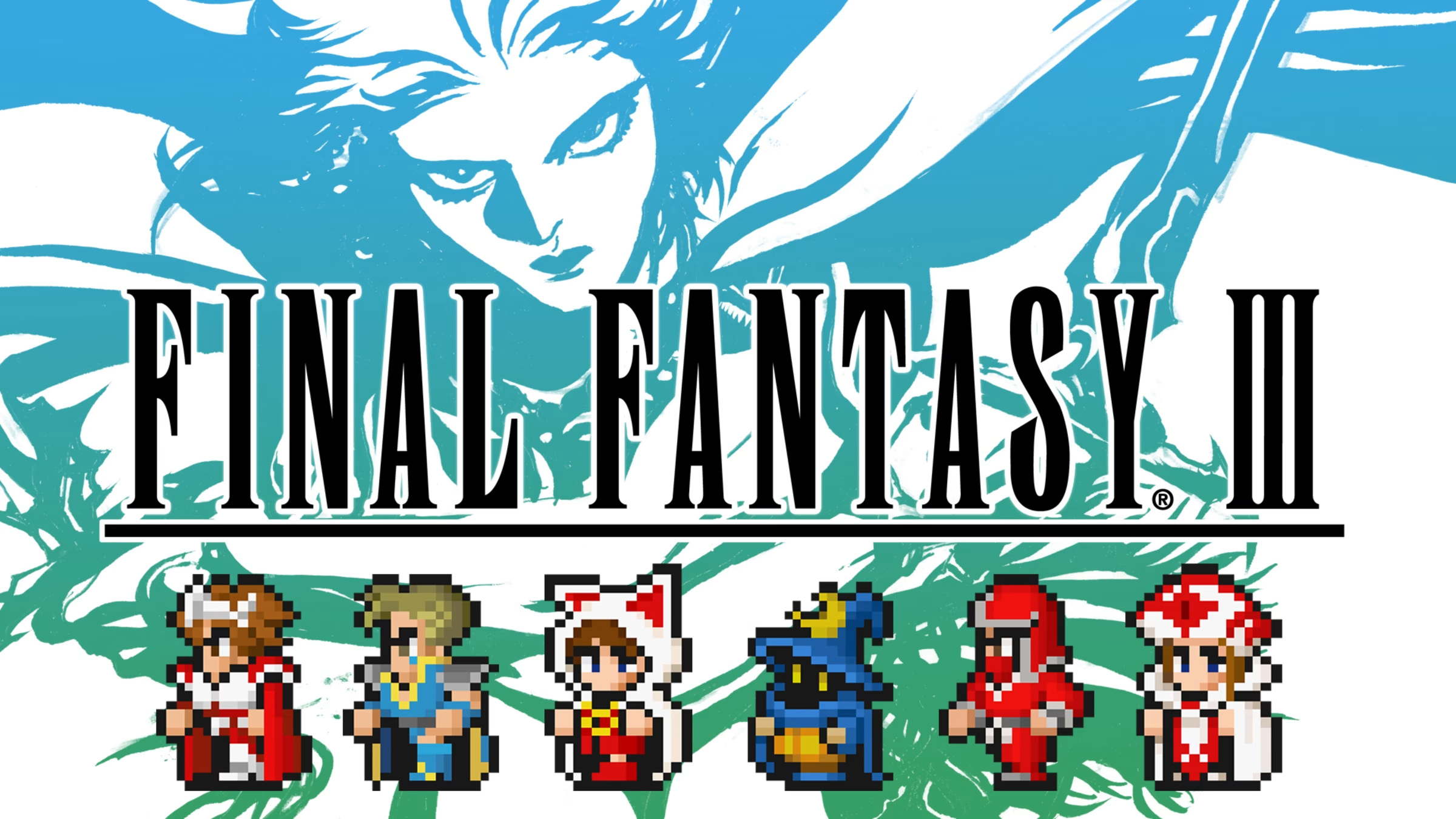
There is a moment in Final Fantasy I where you’ve just finished rebuilding the bridge that spans a narrow channel separating two continents. You’ve spent a few hours fighting monsters, learning the structure of the game, and exploring the small portion of the world you’ve been given access to, so at this point you’re understanding of the game’s world feels like it’s filling out. You step across the bridge and a splash screen comes up showing your party of adventurers overlooking a gorgeous pixelated landscape and the iconic music plays, accompanied by this feeling that here, right here, is where the adventure of a lifetime truly begins.
It’s an incredible moment. The world that seemed so small before suddenly explodes outward in all directions, expanding your understanding of the scale and scope of the game to an almost intimidating and certainly awe-inspiring degree. They even manage to repeat this trick three more times, once with the acquisition of the ship coupled with the opening of the channel taking you to the open sea, again with the canoe giving you the ability to sail along the currents of rivers, and again with the airship, taking not only the method of traversal but the speed at which you travel to unseen heights.
Final Fantasy III looks back at the legacy of Final Fantasy I, the experiments and failures (and there are many) of Final Fantasy II, and says with a smile: “Yeah, I can top that.”
And it does.
There is a moment very early in the game where you acquire an airship. I remember thinking, “Wow, that was really soon! I wonder how they’ll incorporate this into-” and then it explodes into a million pieces and becomes unusable. It’s a gag that works because it’s completely unexpected, and when the game starts to build its traversal systems and overworld exploration back out again, there’s always this little chuckling voice in the back of your head that remembers the airship and wonders if it’ll happen again.
It doesn’t, and that’s probably for the best, because the ways in which Final Fantasy III continues to expand its world are frankly astounding.
You start the game on a continent that seems like a densely packed and populated realm. There are multiple dungeons (even some late-game optional areas), several towns, castles, and big set-pieces to capture your imagination. It feels like a complete game. So when the camera pulls back, you get a proper, functioning airship again, and you set out over the continent’s edge for the first time you discover that all that has taken place thus far took place on a floating island above a far more massive world than you could’ve predicted would await you. It’s jaw-dropping.
AND THEY DO IT AGAIN. Late in the game you get access to a submarine and now there are multiple underwater dungeons to explore, mostly optional, with tons of cool treasures to find, new enemies to face, and environments to explore.
There’s an interesting parallel between the world’s constant expanding and the game’s mechanics similarly growing, because Jobs are back from the first one and they’ve been totally reworked from something passably interesting to a full on highlight of the game.
You start the adventure as four small children, all the same Job (the oddly named, Onion Knight), and you fall into a chasm beneath your home village wherein you find a magical crystal that grants them great power and access to the Jobs. With each crystal you find throughout the game, a batch of new Jobs gets unlocked, totaling in twenty-three unique classes for your characters to play, but we’ll come back to that.
OK, you might think, so this was a cute little introduction and now I pick my four Jobs that my party members will master as the game progresses. Probably gonna need to some balance so not too many mages but we can’t have none. That classic party composition math begins ticking away in your head. Maybe they’ll advance to new forms like in the first game, but this is the configuration I’m working with, right?
Wrong. Because in a masterstroke of design genius, FFIII allows you to freely change Jobs at will, meaning you can have a party of all White Mages, realize that this is untenable, and switch them around to various martial classes. Felt like switching one of your characters over to Red Mage for a while but now you’re not sure it’s working out the way you wanted? Switch them to something else! Try a Ranger! As the Job list expands periodically, you’re given multiple opportunities to entirely reconfigure your party and their skills, experimenting with different combinations, trying out the new mechanics that Jobs like the Bard and the Evoker bring to the table. And you’re encouraged to try all of these, since the only real cost is the time it takes to figure out if you like the Job for your character. You level up your party members separate from your level in a Job, meaning that while your mastery of a Job grows and you get new abilities, your stats are influenced by the equipped Job, but not pigeonholed by it. If you switch to a Knight from a Geomancer, get ready to watch your HP climb at a better rate. In theory, you could have a White Mage with more HP and Defense than your Knight. I don’t why you would do that but hey, it’s your game.
Each Job also has a unique feel to it that changes how you approach combat, and the ability to swap these around freely is such a gift to the player, which is really no surprise when you look at the game’s structure as a whole.
Because Final Fantasy III is the most impressive game I’ve played for this series and it’s not even close.
And it’s weird how much of what good was in Final Fantasy II they are able to wring out and restructure for this game, because like FFII this one has a much greater focus on the narrative than the original game. There are distinct characters with motivations and stories of their own, and lots of them join your party for a brief while to go on some quest together. And while your party members also speak and have ideas of their own, none of it feels like the game is taking all the roleplaying out of your hands. You are still given enough empty space to fill in with your imagination that the creative expression of the game (although extremely rudimentary by today’s standards) works in a way that is not only similar to the first game, but that actually surpasses it.
Advancement no longer feels like you need to be juggling spreadsheets and formations. Just grind for a bit. Level up. Watch your stats climb the way they’re supposed to. Sure, you can’t get as granular as you could in FFII (although for whom that is a problem I can’t imagine), but you still have a bounty of options at your disposal.
Except when the game hems you into making all your characters the same Job for a dungeon, lest you face endlessly replicating monsters. Or when you are forced to make yourself small using the Mini spell, but now your physical attacks and defense are pitiful and you need to rely on magic or successfully escaping every encounter. Or when a boss can be defeated if you grind for a while and just brute force it, but it goes much smoother if everyone just switches to the one Job that’s kind of tailor-made for this situation. And I could be wrong, but in this specific instance I found that particular Job, the Dragoon, to be mostly useless outside of that fight.
These kinds of setups are limited, but they are such a strange misstep in the design. It would be cool if one Job had a moment to shine, but the difficulty of these fights and areas for those not using that Job becomes frustrating and feels rather arbitrary.
The game is also… like… really long? There were times when fatigue started to set in, and the amount of optional content (while impressive) started to resemble a chore list. This probably has more to do with my own brain chemistry than the design of the game, but a little quicker pacing would’ve appealed to me quite a bit.
The story is mostly forgettable, being presented not so much as a continuous plot with growing stakes but instead as a series of small narrative arcs, usually revolving around an NPC you meet or the problems of a single town. It manages to evoke a kind of D&D feel, having your party bounce from location to location fighting various unrelated baddies and solving magical crises, but it lacks the kind of cohesion that would really elevate the emotional attachment you might get toward your characters and the setting. Ironically, it is this point that seems to undergo a complete turnaround in future games, though I’ll save my opinions for when I’ve actually played them.
Perhaps my biggest criticism is the game’s final dungeon. It’s massive, gruelingly difficult even for a high level party, and there is almost nothing in the way of checkpoints, meaning that failure is going to send you really, really far back. And the final boss, while managing to capture my interest, is more of a brute force blast-fest than anything else, and there isn’t a ton of mechanical depth to the fight, which – to be fair – is true of most of the game’s combat.
We’re still in an era where technological limits are tight, where modes of combat design that will become iconic to fantasy RPGs down the road simply haven’t been imagined yet.
It’s sad to say, but the lack of depth to the combat, the lack of variety in what it is that you’re doing moment to moment, makes a lot of this game fairly monotonous to play. We seem to have settled into a rhythm here, a pattern that while enjoyable is beginning to get a bit stale. Now, playing them back-to-back is a far flung experience from what most folks would’ve had when these games were new, but my motivation to continue if things stay relatively fixed will definitely slip away.
But don’t let that fool you into thinking that I had a bad time with this game. I didn’t. I had a great time, in fact! Much like the first game, it’s incredible to see the design methodology of fantasy games so clearly laid down so early on in the medium’s lifetime. I’m overjoyed at the game’s quality even when viewed from a modern lens, but I wonder if they will continue to innovate in ways that make the games interesting, or if they’ll fall into a repetitive rhythm that slowly fades into drudgery.
Only one way to find out, eh?
Next month: Final Fantasy IV
 Vulpes Valentine's Video Game Valley
Leave a comment