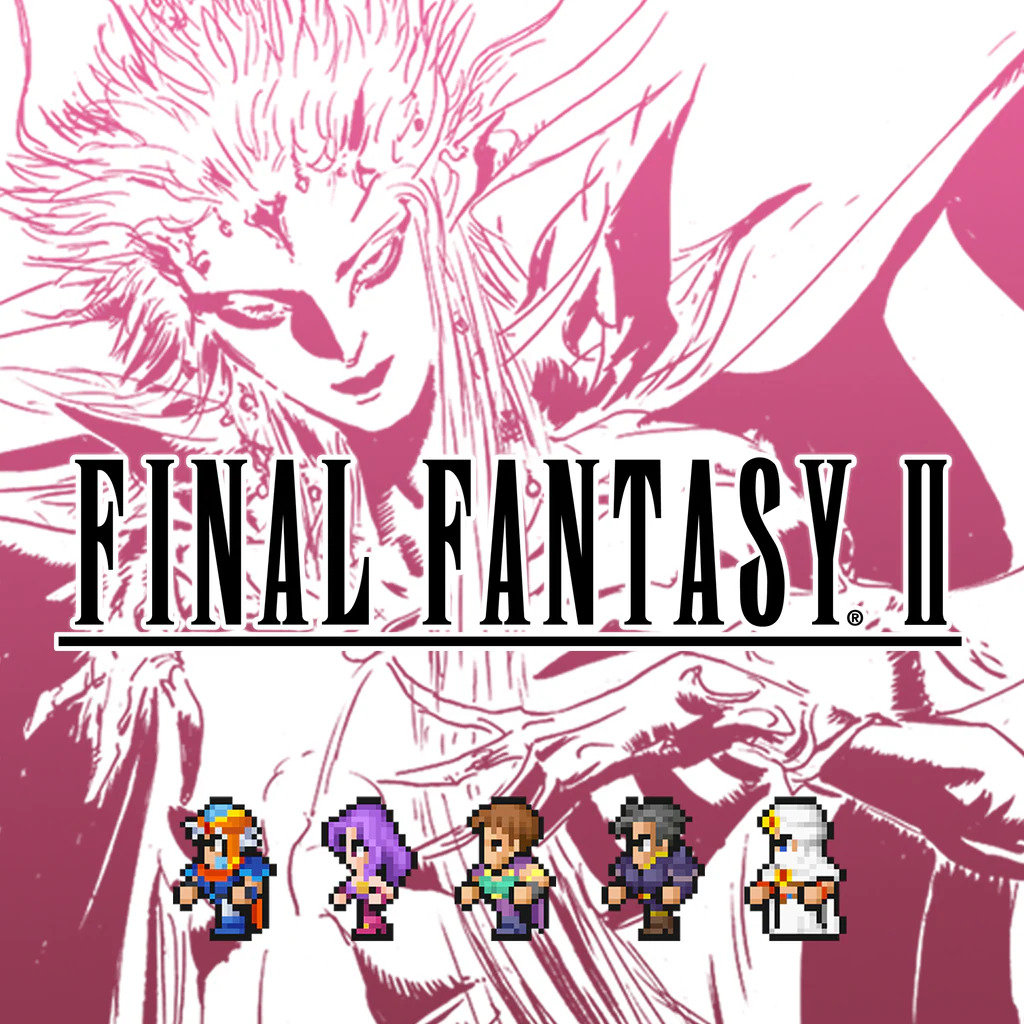
Well. That got weird fast.
Final Fantasy I, for its faults, left an impact on me I could never have predicted from the outset of this project. I was astounded by its inventiveness, its creativity, and how memorable each set piece was, and I developed the belief that each mainline entry in the series would likely feel as innovative (for the time) as each one before it. After finishing Final Fantasy II, I think that the game being innovative is probably the nicest thing I can say about it.
And also, the only nice thing I can say about it.
It’s interesting to see how the oft thrown about criticism of video games being too cutscene heavy and taking too much control away from the player, subjecting one to a story which happens around their choices rather than because of them, has roots that go as far back as 1988. The game has a ton of non-interactive sequences where events unfold and characters appear, join up with your party, leave the party, blow up half of the towns in the game (really), or straight up die. I’m not asking for branching narratives, not in this era of games and I’m not even sure of the inherent value of such designs, but the characters you embody within the story seem to have almost nothing to add other than performing errands for all the other characters. You know, the ones with actual narratives?
And yet, this lack of control or input is completely reversed in the combat and advancement. You have total free reign over what kinds of weapons, magic and armor your party is specialized in, and can build their stats accordingly, although (as we’ll get into) that might be too much freedom.
Interestingly, there’s also an entire mechanic around conversations: a system for learning important nouns and keeping them in a list which you can later pull from to ask other characters questions that will guide you on your quest. This is a really simple and creative way of getting you to interact with the story, but it’s a far cry from what we nowadays consider to be conversation mechanics. The primary problems with Final Fantasy II are not that the game is taking enormous leaps away from the established mode of FFI, but in how those changes and experiments interact.
FFI begins with an extremely simple character creation screen and then *plop* you’re in the overworld. FFII eschews any notion of jobs or the ambiguity of the low-detail sprites in favor of four explicit characters whose names you can change but whose appearances suggest little to nothing about how they are going to function mechanically. They’re also more specifically gendered, and the matching hair color on two of the characters suggests a familial relationship to anyone who has played a video game before. Right from the jump, FFII has taken some of the expression from the player, prescribing characters rather than having you create a party of custom ones. This is not an inherent flaw, but it’s a decision that’s indicative of a more tailored experience. You’re not telling stories in your head about who your four little heroes are, you’re putting names to people with predetermined identities.
Immediately after this, we’re introduced to what I consider to be one of game design’s most tricky maneuvers to pull off: the forced failure. Your four characters are tossed into an encounter with some baddies, although this time they are not classic fantasy monsters. Your attackers are human soldiers in dark armor. Whatever conflict is happening in the world of FFII, it does not at first appear to be caused by demonic entities or creatures of myth, but by human beings, by nations and rulers, suggesting a more grounded narrative about people and the kinds of conflicts people engage with.
And you instantly get wiped with no hope of success.
Now, obviously, this is an extremely small portion of the game. It’s over in about a minute, but the problem is that this is the very first thing you experience. And boy, is it ever indicative of what’s to come.
This can be done well. In Sekiro: Shadows Die Twice, you play through a basic tutorial section where you learn combat, stealth, and traversal mechanics, before you face down your first boss who almost certainly kills you with ease. Should you manage to succeed, likely on another playthrough, the protagonist is bested in a cutscene because this is a scripted narrative event. You play the game, then – armed with context for how the game operates – you get a taste of the sheer might the types of enemies you will be asked to best later can unleash. Failure in this fight teaches you a lesson: some enemies are going to take serious skill, and dying is part of the process. Additionally, From Software’s contemporary games are known for this sort of opening, so players experienced with their games are expecting it.
At the start of FFII, you have no tangible experience playing the game and are therefore sort of taken aback when your very first encounter is essentially a cutscene of you getting your ass handed to you with no recourse. You have no context, so all that this tells you is that you’re weak. Don’t bother. You can’t beat them. Again, this isn’t inherently bad design, but it does leave the player with a much different taste in their mouth. First impressions are everything and FFII fails to make a good one.
And it only gets worse.
Because the game’s philosophy of customizing your character’s abilities is so granular, and progression so awkward that you never feel like you’re getting what you want, and certainly not at the rate you would desire. Gone is the simple gain EXP to get levels. Seriously, a JRPG without EXP. Instead, the game tracks certain values, such as MP consumed, hits taken, etc., and upon a successful combat encounter it checks to see if you’ve reached any milestones to get a stat increase. It’s interesting in concept and in narrative design, for example: your HP increases from taking damage in battle and your MP increases from using spells in combat. This makes a kind of sense, you get stronger the more you endure, better at efficient spellcasting with practice. OK, simple and easy to understand. The issues start to arise when you realize that your characters who are a little more fragile, are likely only going to get more fragile, because you naturally want to protect them from taking damage, so their HP isn’t increasing nearly as fast as the other party members. And to make matters more confusing, there are no clear ways to track how close you are to getting these stat increases, making it difficult to find a useful method for grinding. Gone are the days of just tossing a few mildly challenging enemies in the meat grinder for the experience points, because if all you do is fight weaklings, no one is getting hit and you’re not hitting things often enough or casting enough spells to get any benefit.
Furthermore, all weapon types are their own skill to grind out, and (even worse), so is every single spell in the game. Fire strengthens separate from Blizzard which advances separate from Cure, and as the power of each spell increases, so does its cost, meaning there are actually disadvantages to using Cure to heal your party rather than potions, but if you abstain from spellcasting to preserve MP, you’re not getting Intelligence stat upgrades or more maximum MP.
This creates a royal clusterfuck of improvement and growth whereas the straightforward job system offered clear archetypes and varied abilities for your party members. Now, your characters are likely to become extremely skilled at one or two things, and useless at everything else if you’re not willing to put in some serious, SERIOUS, grinding time. It’s interesting in theory, but the way you advance ends up being so time-consuming, so needlessly complicated and frustrating, that when you finally DO get some improvements and they end up being small, you just wanna give up.
And boy did I want to give up at times. From an extremely lackluster story with no emotional weight and poor presentation, to the dungeons which are often too long, too confusing to navigate, and so overloaded with enemies way above your weight class, there are so many reasons that Final Fantasy II fails to make a good impression.
As I close this piece, I want to tell you about a specific moment in the game which perfectly encapsulates the experience of playing FFII.
Near the closing chapters of the game, you embark on a lengthy quest to recover the most powerful spell in all of existence, one that will surely be the key to defeating the great evil facing the world. The journey takes you all across the many lands of FFII (nearly all of which are open plains by the way), through different dungeons, requiring you to face many dangers and endless annoyances. Finally, at the end of an excruciatingly long tower climb, you reclaim the spell, one that would become an icon of the franchise: Ultima. Only one character may learn the spell, chosen to wield ultimate power that was so dangerous to had to be sealed away from the hands of mortal beings, for fear of the destruction it would wreak upon the world.
But you haven’t leveled it, so it’s weaker than your other spells if you’re a decent spellcaster, and takes just as long to improve.
And in that way, Final Fantasy II summarizes itself. Lots of buildup with some concepts that at first glance appear interesting, followed by a depressingly underwhelming experience.
The flaws of FFII are honestly too numerous to really delve into in a short post like this so now we move on. Suffice to say, I was pretty let down by this entry and I hope it doesn’t prove an ill omen for the future of this series. Our journey continues into (I hope) greener pastures! And more Jobs!
Maybe we’ll be 2 for 3 on good Final Fantasy games?
Next month: Final Fantasy III
 Vulpes Valentine's Video Game Valley
Leave a comment