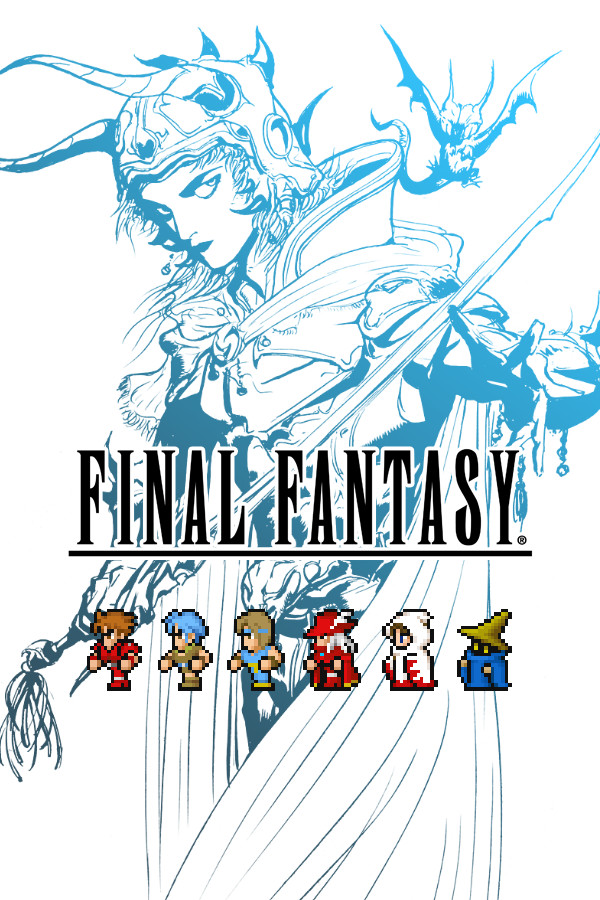
We begin our epic journey with a series of admissions.
Firstly, for the original 6 mainline entries in the series, I will be playing the Pixel Remasters of the games. I made this choice for a few reasons, chief among them being that I have serious ADHD and the idea of sitting through the painfully slow and dated combat and traversal of the original games sounds like a nightmare realm that would make Hades cry with fear.
Secondly, as I stated in the introduction post, I have only played two of the mainline games before (no, I’m not telling you which ones yet, just WAIT). Seriously, I have no idea how this happened but this was the strange childhood I had and now the world will have to bear the consequences. I will probably revisit these over the course of my expedition.
Lastly, I will attempt to get one of these out each month, but with my real job and the fact that these games tend to get progressively longer as the series goes on, and boy oh boy are there some impressive run times in store.
That being said, I think it’s time we get into the adventure proper, and talk about Final Fantasy I.
When I first envisioned this project, one of my biggest worries was that I wouldn’t really gel with these games, that their age and my lack of any nostalgic connection to the series would make it difficult to enjoy the experience, to really get something out of it.
I’ve been a fool.
Not only did I absolutely adore Final Fantasy I, but I adored it on my first, and subsequent three playthroughs. That’s right, I played it not only once but four times start to finish, even netting myself the platinum trophy. But even having become so familiar with the game, I find it difficult to put into words exactly what about the game truly stands the test of time.
As most of you have probably known for years but I’ve known for only weeks now, the game begins with you choosing the names and classes of your four party members, then plops you down without a moment of fanfare. Boom, game is starting, idiot. Get in. And from the jump it’s immediately earning its reputation as one of the foundational JRPGs, its influence resonating into the modern era of gaming without a shred of doubt in the fact that it just works. You fight random encounters in turn-based combat, explore a huge (and yeah, mostly empty) world map, crawl through dungeons, and stop in at towns to get some clues as to where to head next and stock up on gear, spells, and items. The real action of this loop occurs when you poke your heads into a dungeon and spend a while exploring its darkened corners, scouring each environment for valuable treasures and new monsters, before the climax of an encounter with a boss monster that advances the story and rewards you with one metric boatload of experience and gold. Or gil, or whatever.
What really amazes me, particularly in the age of bloated open world games with repetitive activities and staggering amounts of checklist style tasks to complete, is just how fresh and unique each dungeon is under the limitations of its time. One dungeon will have cracks in its icy floor which drop you down into lower regions of the cavern, while another is full of locked doors hiding valuable loot you have to return hours later to claim. The volcano dungeon is full of lava tiles which deal damage to your party while stepping over them, and the fortress up in the sky has a series of teleportation pads and a secret material necessary to craft the ultimate sword, Excalibur. Not only do they offer small, but unique, ways of interacting with the levels themselves, but each of them bear an aesthetic design that is specific to each location. This philosophy extends to the towns and villages as well, giving each one tiny visual signifiers, a personality that goes a long way even at such a small scale.
The music… do I actually need to talk about this? I feel like nearly everyone at every level of interest in gaming has at least heard the original battle theme and the iconic “Prelude”. Suffice to say: it slaps, it goes, it cooks, it owns.
Now, the game hasn’t escaped its age in all respects. Combat is simple, and there is an almost elegant quality to its simplicity, but there comes a time when you are so powerful that nothing can stand in the way of mindlessly mashing the Fight command, having your mages spam their most powerful offensive and healing spells over and over until they need to drink one of your *checks notes* 30,000 ethers give or take. At the outset (and even moreso in the original release of the game from my understanding), there is a small degree of strategy to be deployed, namely, conserving your MP and carefully selecting your targets so as to mitigate incoming damage. Some weapons even have special traits that make them more effective against certain kinds of enemies, but these hardly make any practical difference by the time you get most of them (and, hilariously, most of them actually didn’t work as intended at all in the original version).
It happens to everyone. You reach a certain point where no enemy, no status effect, no environmental hazard can do little more to hinder you than make you open the menu to use an item. Trolls, dragons, giants, mind flayers, all of them are momentary distractions to mow down so you can harvest that sweet EXP and become even more of an unstoppable god of destruction.
And it’s not like the developers of the remaster are unaware of this. My heart soared to heights undiscovered at the site of the Auto-Battle button, which instructs your party members to repeat whatever their last manual command was until you toggle Auto-Battle off again. It even (blessings continue) accelerates the speed of the game. They know. You know. Combat is a formality after the first third or so.
This isn’t even really a negative in my view, and that’s mostly because the game is so short. I was able to finish it in three or four sittings of a couple hours, and that was without a guide. Because the experience races by, the sped up, mindless combat takes on a new shape: a glimpse into the rising power of your characters like a sentence in a book describing some fantasy hero smackdown of another grunt-type foe. It’s quick, it’s concise. There are no unnecessary frills. Number go up.
Yet the game retains, even after all this time, a sense of wonder and epic heroism. You meet a dragon king who sends you on a perilous quest across a dangerous continent, the reward for which is a massive spike in power and abilities. You unearth a long-buried airship from the sands of a lonely desert, using a crystal stolen from the monsters of a hidden cave beside a maze of rivers. These things play out just as excitingly as they sound in part because the game lacks the ability to overindulge itself on visual flair. As has often been said of old pixel art: the beauty is in its minimalism, its lack of detail, because the mind is a powerful thing which is eager and overjoyed to fill those gaps with the limitless embellishment of your imagination.
It is in this low-fidelity that the game remains frozen in amber in some ways. Final Fantasy I can spark the imagination of a player with no pretext, no strong emotional ties to the game aside from its legacy (and, honestly, a mild skepticism of the merits of that legacy). It’s the kind of game that makes you want to pick up a book when it’s over, or to draw your favorite monsters in the margins of your notebook. It’s the kind of game that sticks with you in a small, kindly way, leaving a mark on your heart and mind of a journey overcome and a quest now ended.
As far as beginnings go, it’s hard to imagine a better first impression on a franchise than this, and the fears I felt at the sheer size of this undertaking have been mostly stripped away by the simple fact that Final Fantasy I remains a true classic, one which I will no doubt revisit when there is as much distance for me as there is for the players who experienced the original, and to which I will likely feel a bit of that same reverent love.
Next month: Final Fantasy II
 Vulpes Valentine's Video Game Valley
Leave a comment